
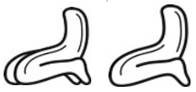

MHD.HL6 0358md 0358st T358
A’? A’? -


Safronov W. Coe
Denver-Brussels Panel D6 (a.k.a. Brussels Panel B6) TIK Stela 31 C23
<AJ:<K’IN+A’>:a>.<AJ:CHAK:TOOK’:la> (newer reading) ya.<A’+hi> (newer reading)
<AJ:YAH:K’IN:a>.<AJ:CHAK:TOOK’:la> (earlier reading) ya.<YAH+hi> (earlier reading)
· No glyphs given in K&H, K&L, TOK, BMM9, 25EMC.
o With the exception of TOK, this is not surprising for the other four reference works, as they are very much based on the pronunciation of the glyph – without a confident pronunciation, a glyph will not be listed in any of these works.
o TOK is an exception to this general rule, and it lists many glyphs whose pronunciation is totally unknown. Despite this principle, this glyph has not been included.
o It is not included in the K&L.p45 list of undeciphered glyphs.
· Features:
o A headless body sitting on the ground (not cross-legged, but “kneeling”).
o No arms or head, just torso and legs.
o Canonically with only one leg visible – the outline of the other leg is visible in some forms (0358md).
· Do not confuse this with the visually similar “half-kneeling legs” / HKL.
· This is not a very common glyph – There are only 10 hits on MHD for “blcodes contains HL6” (2022-10-27, 2026-03-15). Accompanying it are (the “floppy-pear” variant of) HUL, K’IN, ya, hi. Formerly, these last two were considered to be the initial and final phonetic complements of the logogram YAH. The MMM-consensus (in 2022) was that it is read YAH – TIK Stela 31 C3 was considered to have initial and final phonetic complements ya and hi.
· In TIK Stela 31 C3 it’s verbal (i.e., contributing significantly to the meaning of the narrative) whereas in the Denver-Brussels Panel it’s a toponym (i.e., noun-based, not contributing the “injure” meaning to the narrative – at most “Injure K’ina”?). Or perhaps it’s a different glyph when combined with K’IN?
· MHD and Bonn (as of 2026-03-15):
o Pronunciation – agree with one another in reading A’? (both with a question mark indicating doubt).
§ Other sources (including MHD and Bonn?) formerly had YAH.
o Meaning – do not agree with one another as to the meaning:
§ MHD has no translation.
§ Bonn has “thigh”.
Neither of them have the older pronunciation YAH nor one of the older meanings “suffer”, “injure”; “wound”, “pain” which CMGG still retains.
· Do not confuse this glyph with the visually similar MHD.HL7/1605st; this latter has:
o A “swollen belly”, giving the whole glyph more of a boulder outline because the “belly” fills the space delineated by the L-shape of the torso and legs.
o A wood property marker just clear of the back and running parallel to it, forming a sort of reinforcement for the back.
Unlike MHD.HL6/A’ and 0358/A’, MHD.HL7 and 1605 have no pronunciation or meaning.
· GrubeEtAl-TLA is probably the paper which led to the above changes:
o It explains how one of the older readings was YAH.
o It proposes a reading of A’.
If the arguments of this paper are accepted, then the old question of what the difference was between YAH (the head with the “stepped-V” under the eye and the optional obsidian blade) and this “YAH” (sitting/kneeling headless torso and legs) becomes irrelevant.