


K&L.p41.pdpf41.#5.2 = JM.p268.#1 TOK.p24.pdfp24.r3.c2 BMM9.p14.pdfp14.r3.c2
WE’ WE’ WE’ WE’
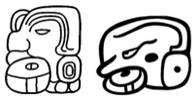
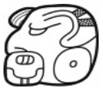
MHD.PM5.1&2 1732st
WE’ WE’?


TOK.p21.r2.c4 = BMM9.p17.r1.c3 1732st
WE’ WE’ WE’?

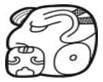
TOK.p24.pdfp24.r3.c3 1733st
WE’ WE’?


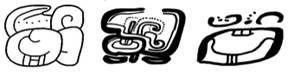

TOK.p33.r1.c1 = BMM9.p21.pdfp21.r4.c4 K&L.p41.pdfp41.#5.1 = JM.p267.#4 MHD.PXC.1&2&3 1691bv
WE’ WE’ WE’ WE’ WE’
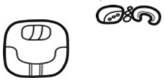
1691bb 1691bt
WE’ WE’
· No glyphs given in K&H (except for a whole series of nouns derived from verbs – ceramic forms).
· Kaufman-APMED.p1195.pdfp1195 has many cognates with meanings related to “to eat” / “comer”.
· Variants (4):
o A. Representational #1 – a human head with WAJ (“maize-based food”) in the mouth.
o B. Representational #2 – a human head with WAJ (“maize-based food”) in the mouth, but without an eye, and with a “feathery wing” element on the cheek.
§ Bonn recognizes this variant as 1732st.
§ In the same way as the human head variant of WE’ = “eat” with WAJ in the mouth has a (sub)variant – without an eye and with a “feathery wing”, so too, Bonn also recognizes a parallel (sub)variant of the human head variant of UK’ = “drink” with HA’ in the mouth – without an eye and with a “feathery wing”.
§ BMM9.p17.pdfp17.r1.c13 and TOK.p21.pdfp21.r2.c4 also recognize this variant.
§ MHD seems to subsume it as a minor subvariant of “A”, without its own code.
o C. Representational #3 – a human head with a human (WINIK) in the mouth:
§ Does it represent mythical monsters eating humans, or the ritual eating of human flesh?
o D. Abstract – the reduced (3-element, horizontally rectangular) TI’ (i.e., a mouth) above (i.e., in connection with) WAJ (“maize-based food”). Bonn recognizes two further subvariants of this form:
§ Just the bottom (1691bb):
· This is, in fact, indistinguishable from the boulder outline variant of WAJ.
· Whether WAJ or WE’ is intended has to be worked out from context.
§ Just the top (1691bt):
· This is, in fact, indistinguishable from the reduced (3-element, horizontally rectangular) variant of TI’.
· Whether TI’ or WE’ is intended has to be worked out from context.
§ In TOK.p24.r3.c3, it is not WAJ but
§ This is in contrast to a similar-looking element in KOJ/KOOJ/CHOJ, where the WINIK does represent a human being.
· Both MHD and Bonn read both representational and abstract variants as WE’, but with differing levels of confidence. Despite many parallels to UK’, the situation is slightly different here (as of 2026-03-14):
o MHD reads both representational and abstract variants as WE’, with equal confidence (similar to how they view UK’).
o Bonn reads the abstract variants as WE’ with confidence, but has a question mark against all the representational variants (this is different from how they view UK’).
Note, also, that while MHD recognizes one abstract and one representational variant, Bonn recognizes one abstract (corresponding to the MHD one) and three representational variants (one corresponding to the MHD one, but with two additional variants: with a “feathery wing” element, and with a WINIK in the mouth.
· The iconographic origin of this logogram is pretty obvious: a human head with a tamale in its mouth = “eating”. In the more abstract variant, it’s just the juxtaposition of the reduced variant of “mouth” and “tamale”.
· MHD statistics (2026-03-14) – a search in MHD on “blcodes contains …” yields 47 (=25+22) hits:
o Abstract – PXC (“reduced mouth above tamale” variant): 25 hits.
o Representational – PM5 (“head with tamale in the mouth” variant): 22 hits.
Unlike in the case of UK’, the abstract and representational variants occur in roughly equal numbers.
· Contrasting usage of logograms for UK’ vs. WE’. If we ignore the difference between the abstract vs. representational logograms and just look at the usage of logograms for writing UK’ vs. WE’ as names/titles, objects (vessels for drinking or eating), and as a verb (the act of drinking or eating), then an interesting contrast appears:
|
|
WE' |
UK' |
|
name/title |
24 |
3 |
|
object |
10 |
18 |
|
verb |
11 |
18 |
|
n/a |
2 |
0 |
|
Total |
47 |
39 |
About half of the time, WE’ is used for writing the name/title of a person (24 out of 47), whereas most of the time, UK’ is not used for writing the name/title of a person (only 3 out of 39). The following names have We’ or We’n in them (some with a question mark):
o Aj Yax Cho’ K’inich We’n
o Ix We’om Yohl Ch’e’n
o Ix Yax We’n Chahk
o K’ahk’ We’ Chitam
o K’ahk’ We’n Chan K’awiil
o K’an Took Wawe’l
o Ya’x Took We’lan
o Yax We’n Chan K’inich