
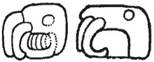
K&H.p77.pdfp79.r3.c1.2 K&L.p20.pdfp20.#5.1&2 TOK.p29.r3.c1
wa WAK wa
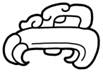
BMM9.p7.pdfp7.r2.c1.2 25EMC.pdfp50.#3.1&2&3 [25EMC.pdfp50.#3.4&5 = K&L.p20.#5.1&2]
wa WAK
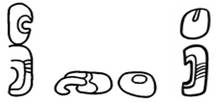
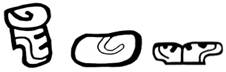
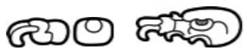
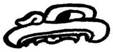
MHD.2S2.1&2&3&4&6&7 0335ex 0335st
wa wa
· Reading – wa or WAK:
o wa: given by K&H (2020), TOK (2017), BMM9 (2019), MHD (current), Bonn (current).
o WAK: given by K&L (2018), 25EMC (2020).
It looks like the syllabogram-only reading of wa was started by TOK, not taken up by K&L and 25EMC, but taken up by BMM9, K&H, and has persisted to the present day in MHD and Bonn.
· Meaning – only relevant for when it’s read as WAK:
o EB1.p196.pdfp201.#4 gives: wak (2) n. centipede(?).
o All adaptations of EB1 (without glyphs) give “centipede?”.
o K&L and 25EMC both give “centipede”, but K&L gives it with a question mark and 25EMC without.
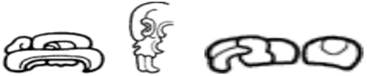
· It seems to me to be highly likely that the 2-element form – perhaps the head and eye(?) of the centipede – as shown in 25EMC.pdfp50.#3.3, MHD.2S2.2, 0335ex is the origin of the more abstract 2-element form with the “crescent and bold scroll/L” – as shown in MHD.2S2.1&3:
o The head with fangs evolved into the L-shaped element.
o The eye evolved into the crescent-shaped element.
· Do not confuse this with the semantically related chapaat / chapaht, and kamis, which are two other words for “centipede”.
· Do not confuse this with the abstract variant of wak = “6” which is has a rectangular/ovalish outline with an S-shaped element inside and a squarish element at each end.
· It forms one of the EG’s of El Peru-Waká, as extensively discussed in the MatL2022 glyph workshop.
o To me, this seems like a good reason to restore the WAK reading.
o In the context of being an EG, the WAK reading (with meaning centipede) would seem to make more sense – the name of the site El Peru-Waká suggests that the non-Spanish Waká would have come from WAK-HA’ = “Centipede Water”.