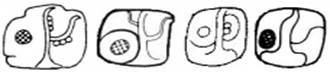




K&L.p46.#2.1&2&3 [MHD.ZT2.1 = K&L.p46.#2.1] TOK.p16.r3.c3 BMM9.p12.r7.c3 MHD.ZT2.2&3 0559st
UN UUN UN UUN / UN UUN
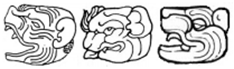


K&L.p14.#1.1&2&3 [1621st = K&L.p14.#1.1] TOK.p31.r3.c4 MHD.AP4 1621st
UN UN UUN? / UN? UUN
· No glyphs given in K&H.
· Variants (2):
o A. Boulder – features:
§ An upright vine (i.e., growing upwards).
§ Cross-hatched circle (=the seed of the avocado fruit?) – optionally occasionally with no cross-hatching.
Do not confuse this variant with TAK = “dry”, which has K’IN in the top left whereas UUN / UN = “avocado” has a cross-hatched circle.
Do not confuse this variant with tzu, which has LEM in the top left whereas UUN / UN = “avocado” has a cross-hatched circle.
This is similar to HOP. It’s not clear whether a distinction can be made between a cross-hatched circled and a non-cross-hatched circle because the non-cross-hatched circle examples might just be due to erosion.
o B. Mammal head – features:
§ Mammal ear.
§ Open mouth with 1-2 fangs.
§ A large, “snouty” nose.
§ Parallel arcs in the cheek, emanating from just to the right of the mouth to the back of the head (“sound waves”).
§ The nose and fangs suggest that this is probably a dog.
· MHD: the “picture” field in the MHD Catalog for AP4 gives: “dog (Canis familiaris)?”.
· Bonn: is even more specific, giving the meaning of UUN as “hairless dog (Xoloitzcuintle)”.
· Pronunciation:
o Both TOK and K&L (which consistently indicate long vowels) give UUN for the “boulder with vine” variant.
o TOK.p16.r3.c3 (the vine-based variant) is given as UUN (long -uu-) while TOK.p31.r3.c4 (the mammal head variant) is given as UN (short -u-).
· Almost all instances of both are as a rebus to write the month name uniw. Or, rather, more accurately, I don’t really know whether the month name itself is related to the concept of “avocado” or “dog”.
o If the month name is related to neither “avocado” or “dog”, then both these logograms are used as a rebus to write uniw.
o If the month name is related to “avocado”, then the “dog”-logogram is used as a rebus to write uniw.
o If the month name is related to “dog”, then the “avocado”-logogram is used as a rebus to write uniw.
· MHD statistics (2026-03-12) – a search in MHD on “blcodes contains …”
o Boulder outline (ZT2): 122 hits.
o Dog head (AP4): 29 hits.
The “boulder outline” variant occurs about 4 times more often than the “dog head” variant.
· Calendrical (month name) usage vs. non-calendrical usage.
o This distinction can be detected using the “blsem contains/does not contain ‘365 cycle’” criterion:
§ Boulder outline (ZT2, 122 hits):
· and “blsem contains ‘365 cycle’”: 105 hits, vs.
· and “blsem does not contain ‘365 cycle’”: 17 hits.
o These are almost all (15 hits) as the EG of Pusilha, either as K’uhul Uun Ajaw (13 hits) or just as Uun Ajaw (2 hits).
o The exceptions are 2 hits, both from vases, writing the deity name K'ahk' ?? Uun K'awiil = “The Fire <Something> Avocado Lightning God”.
§ Dog head (AP4, 29 hits):
· and “blsem contains ‘365 cycle’”: 28 hits, vs.
· and “blsem does not contain ‘365 cycle’”: 1 hit.
o This is from UXM Monument 3 where the context is slightly unclear, but it probably isn’t a calendar-related usage.
From this, we can say that both glyphs are used almost exclusively to write the month name Uniw, except that the “avocado” glyph has one significant other usage, as the EG of Pusilha. 17/122 = 13.9% ~ 14%, so about 15 out of every 100 occurrances of the “avocado” glyph are related to the Pusilha polity rather than as a month name. In the case of the EG of Pusilha and the name K'ahk' ?? Uun K'awiil, I’d venture the guess that the glyph is being used with its literal / original meaning of "avocado” – the “Avocado Polity” or “The Fire <Something> Avocado Lightning God”.