


K&L.p24.#6 = 25EMC.pdfp49.#8 TOK.p32.r2.c1 BMM9.p13.r1.c2 SJ.p322.#3.2
UT / ut ~ hut UT / HUT UT / HUT UT / HUT UT
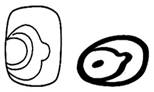


MHD.HE3.1&2 1901tc T618
HUT? - -
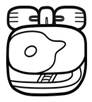
1901tv


BMM9.p13.r1.c1 =
KuppratApp
SJ.p322.#3.1
0650st (formerly, this exact form now abolished)
UT / HUT
à JOM
UT
à JOM
-
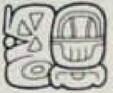

M&G.p102.#3 Coll-1
NAR Stela 47 A4
<AJ:<XAAK/SAAK>:li>.<HUT.?.<CHAN:na>>
· No glyphs given in K&H.
· The two variants of UT / HUT are each listed twice in BMM9:
o BMM9.p13.r1.c1 = BMM9.p16.r7.c2.
o BMM9.p13.r1.c2 = BMM9.p16.r7.c3.
· EB1.p203.pdfp208.#6 gives that it could also be WUT? and gives 3 references to where it could be wu?-WUT?, glossing that as “eye, face”.
· K&H, K&L, BMM9 dictionaries all give hut as an alternative pronunciation, and also add the meaning “visage”.
· AT-YT2021-lecture13.t0:02:13-2:18: the slide says wuut for “eye, face”, but Tokovinine himself says: ut or hut is “eye”, but it can also mean “face” in general.
·
Variants
(2à1):
o A. Boulder:
§ Dorota Bojkowska: caution – SJ.p322.#3.2 may be IL not UT as it seems to have inside an eye with optic nerve and the outer edge has a gap in the middle of the left, like IL.
o
B. “Pizza
slices”:
§ The glyph given in
BMM9.p13.r1.c1 is listed as an undeciphered glyph in
K&L.p45:
§ There can be either three or four
“pizza slices”:
·
Three slices: 3/4 of a circle –
at N, W, E, with the fourth quarter missing at S.
·
Four
slices: full circle, at N, S, E, W.
§ Optionally, a triangular slit in
the middle of the left side, with a non-touching dot in it. The dot
might not be part of the logogram – so far seen only in real-life
examples, not in any textbooks or workbooks. There variants are
also suggestive of IL.
· Caution: there’s been a change in the reading of a set of glyphs which (visually only) resemble one another, but are quite different. They are:
o This UT/HUT = “face”, “eye”, which basically shows the eyeball, with optional optic nerve on the right.
o The IL = “see”, which also shows an eyeball, sometimes with an optic nerve on the right, but (optionally, often) has two “feelers”, joined at the non-tip end, vertically oriented, with the tips of the feelers pointing to the left. The “feelers” suggest (perhaps) the “looking outwards” of the eye.
o The “CWPS” (“CHUM with pie/pizza slices”) glyph, in some cases with just a plain boulder outline, i.e., without the “thigh and knee” outline on the bottom left, but with the distinctive element of 4 (occasionally 3) “pizza slices” in the middle of the top.
This historical change in reading can be seen by the fact that CMGG now recognizes only one variant of UT/HUT instead of two, with abolishment of the “pizza slices” variant. However, remnants of that history can be seen in:
o BMM9.p13.r1.c1, which is a boulder outline, no thigh-and-knee (but perhaps hinted at by the two slightly curved lines in the bottom half), 3 “pizza slices” variant of “CWPS”, which is given as UT/HUT.
o SJ.p322.#3.1, which is a boulder outline with 3 “pizza slices”, given as UT.
o An older version of Bonn’s 0650st, which has the vertical, “joined double feelers” of IL, with no pronunciation. The most current version of 0650st (as of 23026-03-28) has had the “double feelers” removed, and the outline is now CHUM, with the “thigh and knee” explicitly present in the lower left. It still, however, has been assigned no pronunciation or meaning.
This is reflected in strike out of BMM9.p13.r1.c1, SJ.p322.#3.1, and 0650st above. They’ve been preserved here instead of just being deleted because I feel that they help to show the earlier confusion and state of things, for if they are encountered in the historical literature. See “CWPS” for more information.
· The M&G and NAR Stela 47 examples both write the name of “Sky Witness”, an early ruler of Kaanul. It’s probably the “face” / “eye” aspect of logogram UT/HUT which influenced the coining of the “Witness” part. Part of the historical confusion between IL, UT/HUT, and “CWPS”/JOM is probably from this ruler’s name, which is known from more than 5 inscriptions, all with a mix of the distinctive characteristics of IL and “CWPS”/JOM (“PAX feelers” and “pizza slices”), while UT/HUT (generally) only has the eyeball and optic nerve.