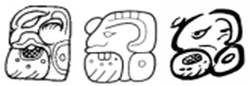


K&L.p41.pdfp41.#3.1&2&3 TOK.p24.pdfp24.r3.c1 BMM9.p14.pdfp14.r3.c1 JM.p256.#2 = K&L.p41.#3.2
UK’ / UCH’ UK’ UK’
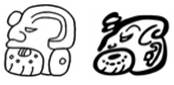

MHD.PM4.1&2 1070st
UK’ UK’

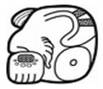
BMM9.p17.pdfp17.r1.c2 = TOK.p21.pdfp21.r2.c3 1723st
UK’ UK’ UK’
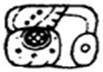

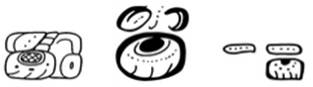

K&L.p41.pdfp41.#3.4 TOK.p33.pdfp33.r1.c2 = BMM9.p21.r4.c2 MHD.PXB.1&2&3 1690bv
UK’ UK’ UK’ UK’


1690bb 1690bt
UK’ UK’
· No glyphs given in K&H.
· Variants (3):
o A. Representational #1 – a human head with HA’ (“water”) in the mouth.
o B. Representational #2 – a human head with HA’ (“water”) in the mouth, but without an eye, and with a “feathery wing” element on the cheek.
§ Bonn recognizes this variant as 1723st.
§ In the same way as the human head variant of UK’ = “drink” with HA’ in the mouth has a (sub)variant – without an eye and with a “feathery wing”, so too, Bonn also recognizes a parallel (sub)variant of the human head variant of WE’ = “eat” with WAJ in the mouth – without an eye and with a “feathery wing”.
§ BMM9.p17.pdfp17.r1.c2 and TOK.p21.pdfp21.r2.c3 also recognize this variant.
§ MHD seems to subsume it as a minor subvariant of “A”, without its own code.
o C. Abstract – the reduced (3-element, horizontally rectangular) TI’ (i.e., a mouth) above (i.e., in connection with) HA’ (“water”). Bonn recognizes two further subvariants of this form:
§ Just the bottom (1690bb):
· This is, in fact, indistinguishable from the boulder outline variant of HA’.
· Whether HA’ or UK’ is intended has to be worked out from context.
§ Just the top (1690bt):
· This is, in fact, indistinguishable from the reduced (3-element, horizontally rectangular) variant of TI’.
· Whether TI’ or UK’ is intended has to be worked out from context.
· The iconographic origin of this logogram is pretty obvious: a human head with water in its mouth = “drinking”. In the more abstract variant, it’s just the juxtaposition of the reduced variant of “mouth” with “water”.
· The nature of K&L.p41.#3.1 is slightly unclear to me:
o For convenience, I’ve just grouped it as a form of “A” – the “regular” head with HA’ = “water” in the mouth.
o However, there appears to be a ka-comb in the top right, just to the right of the eye, teeth pointing down.
o I suppose there’s a vague possibility that this ka-comb is meant to be the equivalent of the “feathery wing” element of “C”.
· Both MHD and Bonn read both representational and abstract variants as UK’, and with equal confidence. Despite many parallels to WE’, the situation is slightly different there). Note, also, that while MHD recognizes one abstract and one representational variant, Bonn recognizes one abstract (corresponding to the MHD one) and two representational variants (one corresponding to the MHD one, but with one additional variant: with a “feathery wing” element.
· MHD statistics (2026-03-12) – a search in MHD on “blcodes contains …” yields:
o Abstract – PXB (“reduced mouth above water” variant): 28 hits.
o Representational – PM4 (“head with water in the mouth” variant): 11 hits.
Interestingly, the more abstract variant (combining the idea of “mouth” with “water”) occurs more than twice as often as the more representational variant (having a human head with water in the mouth). As MHD doesn’t distinguish between the form with a feathery wing element in the cheek vs. the one without, we cannot use a database query to gather statistics on the relative frequency of these two forms. However, with only 11 hits, it isn’t hard to walk through these 11 to see what the statistics are, by visual inspection. Unfortunately, however, 3 of the 11 have no image and the remaining 8 of the 11 don’t have a very distinct feathery wing element in the cheek. But the fact that Bonn, BMM9 and TOK have recognized this form makes me feel that it’s worth trying to track down its occurrences in real life inscriptions. Sadly, the “Artefacts” field of the Bonn Catalog is not yet filled for 1723st (as of 2026-03-12).