


TOK.p22.r2.c3 BMM9.p15.r7.c2 SJ.p320.#2
UH UH UH
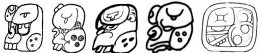
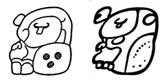
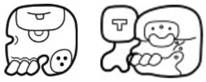
K&L.p30.#6 SJ3.1&2 1049br 1049bh
UH UUH / UH UH

KuppratApp.1-7 [25EMC.pdfp49.#3.1&2&3 = KuppratApp.7&2&6]
UH


M&G.p126 M&G.p186 = M&G.p189.box
IX.UH <CHAN:na>.LEM? UH.CHAPAAT


TOK.p22.r2.c2 MHD.SJ2.1&2
UH UUH / UH
· No glyphs given in K&H.
· Distinct from homonym UH “moon” – the only connection is the identical pronunciation, not the look of the glyph, nor the meaning.
· SJ: 1. necklace, collar; 2. bead (SJ has collar, but this could be a mistake on his part, e.g., from K&L.p30.#6, where the Spanish word “collar”, meaning “necklace” was misinterpreted as an English word; alternatively, the difference between a necklace and a collar is an English/European distinction, and the two concepts really shade into one another – for example, S&Z.p45.para3 says that the God of the Underworld has a “eyeball-studded death collar”, which could also be described as a “eyeball-studded death necklace”.
· Can be used to write uht = “to happen”, see uht-iiy / uht-jiiy. This could be viewed either as being used as a rebus (so the -h- is explicitly present), or acrophonically (so the -h- is underspelled).
· Variants (2):
o A. Skull with IK’:
§ IK’ (T-shaped) element on the forehead.
§ 2-3 teeth on the bottom of an upper jaw, which is just a simple line or reinforced line.
§ In the bottom right, 3 tiny non-touching dots in a triangular formation, pointing down.
§ K&L.p30.#6.5 = KuppratApp.3 ~= KuppratApp.4 is a single instance which is more abstract than the others, but share common features with the IK’ variant:
· The IK’ becomes more rounded, producing the appearance of a po infixed in the forehead.
· The jaw from which the 3 teeth hang becomes a straight bar SW-to-NE.
· The teeth become smaller and rounder (if they were squarer and larger to start with).
· The 3 dots in a triangular formation pointing down remain as before.
§ K&L.p30.#6 lists it as “meaning unknown”, but this is their very specific use of the phrase “meaning unknown” – they mean that the iconographic origin of the glyph, even in cases where the meaning by usage is well known.
§ Found in the names of (at least) two people mentioned in M&G:
· M&G.p126: Ix Uh Chan Lem? – meaning “Lady Necklace Sky Jade-celt”.
· M&G.p186 = M&G.p189.box1: Uh Chapaat – M&G lists11111111111111 this as meaning “Moon? Centipede”. Sim: in normal circumstances, we would not read this as “moon”, but it is a late inscription, so perhaps the “necklace”- logogram is used purely for sound to mean the word “moon”, as “Moon Centipede” makes more sense than “Necklace Centipede”.
Bonn has a sub-variant with a vertically oriented, rectangular, bi-partite element to the left of the skull: The IK’ (= bold-T/“breath”) normally infixed in the forehead moves to the top of the bi-partite element, and the bottom of the bi-partite element is a scroll.
o B. skull with “se”:
§ “se” element on the forehead.
· MHD statistics (2026-02-02) – a search in MHD on “blcodes contains …”
o SJ3 (IK’ in forehead): 50 hits.
o SJ2 (se in forehead): 27 hits – note that 9 of these are from the same monument – TIK Stela 31, used as a rebus (i.e., not meaning either “moon” or “necklace”) to write uhtiiy.