
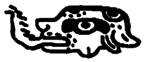

T801 MHD.AP2b 0801st
- TZUL / PEK? -
Madrid Codex
· The logogram for this word appears to be Madrid Codex C2 and is the only instance known – the search in MHD “All - Blocks” on “blcodes contains AP2b” gives only this one hit. In other words: there are no known instances of this logogram in the Classic Maya corpus (of MHD).
· Bonn does not commit to reading this as TZUL.
· The case in support of reading TZUL is probably based on the syllabogram-only spelling tzu-lu (see below). Unfortunately, the link between the logogram and the syllabogram-only spelling is more tenuous than one could wish for:
o The logogram is found in the Madrid Codex.
o The syllabogram-only spelling is found in the Dresden Codex.
Ideally, one would like to have them both not only in the same Codex, but in close proximity to one another – perhaps even on the same page (along with iconography showing a dog). This is probably the reason that different epigraphers may give different weight to the idea that the one is a substitution for the other. This then leads to different degrees of willingness to read the logogram as TZUL.


K&H.p11.fig3.#2 JM.p244.#4
tzu.lu tzu.lu
· Known from the Dresden Codex. Knorosov used the iconography (which portrayed a dog) and the syllabogram-only spelling (which labelled the iconography) and the fact that cognates in the modern Maya languages had words resembling tzul for “dog” to support his idea that (at least some of) the glyphs were sound-based.
· See kutz = “turkey” for further information.