

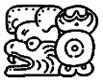


TOK.p31.r3.c2 25EMC.pdfp48.#3 = S&Z.p181.#76 MHD.APG 1878st MHD.AP7 0753st
TZ'UTZ'IH TZ'UTZ'IH TZ’UTZ’IH TZ'UUTZ'? / TZ'UTZ'? TZ'UUTZ'? TAK TAAK

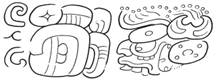
Helmke&Vepretskii-RtRN.p6.pdfp6.fig4a (Helmke) Helmke&Vepretskii-RtRN.p6.pdfp6.fig4b (Helmke)
K8342 F-H CRC Stela 6 B21-C21
ya.<AJAW:TE’> K’INICH TZ’UTZ’IH ya.<AJAW:TE’>.wa K’INICH+TZ’UTZ’IH


Helmke&Vepretskii-RtRN.p6.pdfp6.fig4c (Helmke) Helmke&Vepretskii-RtRN.p6.pdfp6.fig4d (Helmke)
CRC Stela 1 F2 CRC Stela 26 pCp2
ya.<AJAW+TE’+K’INICH+TZ’UTZ’IH> ya.<AJAW+TE’+K’INICH+TZ’UTZ’IH>

MHD (Graham)
NAR Lintel 1 C1-D1
<TUM:OHL:la>.K’INICH TZ’UTZ’?
· No glyphs given in K&H, K&L, BMM9.
· Only TOK, 25EMC = S&Z give a logogram with this reading.
· It’s not given as a logogram in EB1, only as syllabogram-only spellings.
· Features:
o Mammal head.
o Smallish circle for the eye (with a dot for the pupil), with optional protector around the upper half (TOK.p31.r3.c2, 1878st, 25EMC.pdfp48.#3, the protector is cross hatched in the first two).
o A single fang (two in TOK.p31.r3.c2).
o Optional additional roundish cross-hatched element on the cheek (TOK.p31.r3.c2, 25EMC.pdfp48.#3 – in the it’s oblong and not free of the floor).
o “Sound waves” emanating from the right of the mouth towards the right, along the floor and up the right wall (up to the ear).
· S&Z:
o Gives the trilobate ear as canonical / distinguishing feature.
o States that there are many substitutions where the syllabograms spell tz’u-tz’u-hi.
o S&Z.p181.para1.l+3: The TZ’UTZ’IH glyph is clearly a portrait of the coati, whose characteristic trilobate ear helps to distinguish it from portraits of dogs and jaguars. Glyphs associated with the coati in such scenes often spell its name out phonetically, usually as tz’u-tz’i-(hi).
· MHD and Bonn each have a code assigned for a TZ’UTZ’-type logogram meaning “coati”, but both are tentative, with a question mark:
o MHD:
§ MHD.APG: TZ'UUTZ'? / TZ'UTZ'?.
§ Curiously, the MHD Catalog example given doesn’t seem to have a trilobate ear:
· Or is the element on the top right corner the trilobate ear?
· There is a tendency for the ear to be slightly “outside” the main outline of the head (TOK.p31.r3.c2, 25EMC.pdfp48.#3, 1878st), but it only sticks out slightly and is “diagonally” oriented (= lobes pointing NE). The trilobate element in MHD.APG is completely outside the main outline of the head and is “vertically” oriented (= lobes pointing up). The whole right side looks like three stacked elements, like a “fancy ear”.
· Further investigation shows that the MHD.APG Catalog example is based on NAR Lintel 1 D1. In the drawing (by Graham), the element has exactly the same characteristics as the Catalog example (by Looper).
o Bonn:
§ 1878st = TZ'UUTZ'?.
§ The Bonn Catalog example given has a trilobate ear.
· MHD TTT’s:
o There is no logogram translated as “coati” in the MHD TTT’s.
o A search on “blengl contains coati” (2026-03-14) returns 2 hits, but both of them are syllabogram-only spellings (see below, under syllabogram spellings).
o There are more than just these two syllabogram-only spellings for tz’utz’ih / tz’uutz’, but the others don’t show up in the “blengl contains coati” search because they’re part of royal names, which are then just transliterated into English, not translated as “coati” (a number of them are shown under syllabogram spellings).
· Helmke&Vepretskii-RtRN.p3.pdfp3.c2.para2-p7.pdfp7.para1 gives four examples of the logogram, all four being in the name of the CRC “Ruler III” – Yajawte’ K’inich Tz’utz’ih.
o Interestingly, only the first of the four has the logogram in isolation as TZ’UTZ’IH. In the second example, it’s conflated with the preceding logogram K’INICH, and in the third and fourth examples, all of ya-AJAW-TE’-K’INICH-TZ’UTZ’IH are combined in one glyph-block, with all the characteristics of AJAW, TE’, K’INICH, and TZ’UTZ’IH conflated.
o The conflation is so extreme in the case of the three occurrences on the CRC stelae that the trilobate ear is the only distinctive characteristic of TZ’UTZ’IH remaining.
· The monument known as NAR Lintel 1 was actually originally part of the CRC HS, captured as war booty when NAR defeated CRC in a battle in retaliation for an earlier attack of CRC on NAR. The ruler Tum Ohl K’inich Tz’utz’ih is hence a CRC ruler (with the nickname of K’an II), a younger son of Yajawte’ K’inich Tz’utz’ih.
· For the association of the word tz’utz’ih / tz’uutz’ with the mammal having a trilobate ear in the iconography, see tz’utz’ih / tz’uutz’ in syllabogram spelling.
· Do not confuse TZ’UTZ’IH with the visually similar CHIK. Both mean “coati”, and both logograms are a mammal head with a longish snout, but:
o TZ’UTZ’IH has a trilobate ear and no darkness property marker.
o CHIK has a regular mammal ear and (optional) darkness property marker.
· Do not confuse TZ’UTZ’IH with the visually similar (head variant of) TAAK/TAK = “dry” as these are the two mammal head glyphs with a trilobate ear:
o TZ’UTZ’IH has “sound waves” on the bottom right, while TAAK/TAK doesn’t have.
o TZ’UTZ’IH (optionally) has an “eye protector”, while TAAK/TAK doesn’t have.
o As the “eye protector” is optional, there’s really only one criterion to distinguish them. Perhaps (as so often the case in Maya) one has to just look at the context to decide which of the it is.
· Do not confuse TZ’UTZ’IH with the visually similar CH’AMAK = “fox” as these are the two mammal head glyphs with “sound waves” on the bottom:
o The “sound waves” of TZ’UTZ’IH start only to the right of the mouth, while those of CH’AMAK go all the way from left to right, “under” the mouth.
o TZ’UTZ’IH has a trilobate ear while the ear of CH’AMAK is more heart- or pear-shaped.
o TZ’UTZ’IH tends to have a longer, slightly snouty nose, while CH’AMAK is more snub-nosed.
Only the first of these is really distinctive, as the ear of some forms of CH’AMAK can also seem a bit trilobate, and the nose may be somewhat elongated as well.
· The meaning of tz’utz’ in modern Maya language (Erika Raven’s notes of EMC2019, Advanced Glyph Workshop):
|
REC pM |
tz’utz’ |
‘pizote’ |
|
TEC |
tz’utz’ |
‘pizote’ |
|
MAM |
tz’utz’ |
‘pizote’ |
|
ACA |
tz’utz’ |
‘pizote’ |
|
JAC |
tz’utz’ |
‘pizote’ |
|
MOC |
tz’utz’ |
‘pizote, andasolo (coati), tejón (Nasua narica) |
|
CHU |
tz’útz’ |
‘coati’ (Nasua narica) |
|
CHU |
tz’utz’ |
‘pizote’ |
|
TZO |
tz’utz’un-chab |
‘oso hormiguero’ (miereneter) |
|
CHL |
tz’utz’ub |
‘tejón’ (badger (Meles meles) which is not found on the American Continent ) |
· Memo (Guillermo) Kantun: In Mexican Spanish, tejón is the white-nosed coati (Nasua narica). Synonyms for the white-nosed coati: antón, coatí, coatí de nariz blanca, coati pizote, chico, chico-ataj, chiic , choluga, pizote, puerco espín de la tierra, tejón mexicano, tejon pizote; tejón rojo.

SJ.p249.c3.r8 = SJ.p320.entry+5
tz’u.tz’i{h}
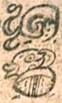
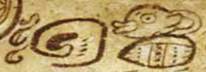
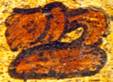
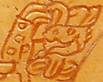
EMC2021-AW-D3 / mayavase.com EMC2021-AW-D3 / mayavase.com MHD (Kerr)
K1181 K1-K2 K4116 A1-B1 K4548 N1
K’AHK’.<ne{h}/NEH> tz’u:tz’i{h} K’AHK’.<ne{h}/NEH> tz’u:tz’i{h} tz'u:tz'i{h}

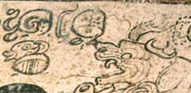
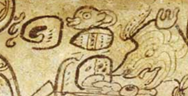
Law&Stuart-CM.p160.ex78.c5 = MHD (Kerr) = Looper&Polyukhovych-TaIPotPoRV.p11.fig11.D2 = Looper&Polyukhovych-TaIPotPoRV.p10.l-4
K8076
tz’u.<tz’i:hi>
· EB1 gives only syllabogram spellings for this word:
o Maya -> English: EB1.p252.pdfp257.#17: tz’utz’ih “coati”; many other references to tz’utz’ih as meaning ‘coati’.
o English -> Maya:
§ EB1.p180.pdfp185.#3.1: tz’utz’ih Figure 7b n. coati » tz’u-tz’i-hi > tz’utz’ih “coati” K8076.
§ EB1.p180.pdfp185.#3.2: » tz’u-tz’i > tz’utz’i[h] K0927.
§ EB1.p180.pdfp185.#3.3: » K’AK’-ne tz’u-tz’i > k’ak’ ne[h] tz’utz’i[h] “fire-tailed coati” K0927.
· Unusually, all four real-life examples appear to be references to actual (real or mythical) coatis, rather than being part of a ruler’s name/title.
o The two examples from EMC2021-AW-D3 (K1181 and K4116) refer to a k’ahk’ neh tz’utzih = “fire-tail(ed) coati”.
o K4548 and K8076 refer to a more general coati.
In all 4 cases, a mammal with a trilobate ear is depicted in the iconography.
· Most of the examples use the “abstract” variant of tz’i, but K8076 uses the “bat-head” variant (which can also be read xu or SUUTZ’).
· The examples using the “abstract” variant of tz’i all have an underspelled -h, but the example with the “bat-head” variant has an explicit hi.
· There is evidence that, iconographically speaking, the mammal with a trilobate ear is a coati (the trilobate part is on the upper side, “outside” the head) – adapted from information provided by Erika Raven (personal communication, May 2022):
|
K-number |
Detail |
Transliteration |
|
K1181 |
|
K’AHK’.<ne{h}/NEH> tz’u:tz’i{h} |
|
|
|
|
|
K4116 |
|
K’AHK’.<ne{h}/NEH> tz’u:tz’i{h} |
|
|
|
|
|
K4548 |
|
tz'u:tz'i{h} |
|
|
|
|
|
K8076 |
|
tz’u.<tz’i:hi> |
· If many examples have spelling tz’u-tz’i, then it would have been believed that the final -i is silent, and merely lengthens the first vowel, according to the Lacadena-Wichmann spelling rules; however, with the discovery of tz’u-tz’i-hi, it seems that the 2-syllabogram spelling is an underspelling with the -h left out, and so it should be tz’utz’ih. Unfortunately, the publication dates of the reference sources indicate the exact opposite. List of tz’utz’ih vs. tz’uutz by source and publication date:
|
Author |
Reading |
Year |
Comment |
|
S&Z |
tz'utz'ih |
2011 |
Logogram |
|
SJ |
tz'utz'ih |
2013 |
Logogram & syllabogram spelling |
|
TOK |
tz'utz'ih |
2017 |
Logogram |
|
25EMC |
tz'utz'ih |
2020 |
Logogram |
|
Law&Stuart-CM |
tz’uutz’ih |
2017 |
Syllabogram spelling |
|
BMM9 |
tz’uutz’ |
2019 |
No logogram or syllabogram spelling, dictionary textual entry only |
|
K&H |
tz’uutz’ |
2020 |
No logogram or syllabogram spelling, dictionary textual entry only |
· The above line of reasoning is confirmed by Helmke&Vepretskii-RtRN.p5.pdfp5.c2.fn4, which nevertheless argues for tz’uutz’ as also a valid reading: In one example (K8076) we see a supernatural scene wherein a coati is seated before a ruler in a palatial setting, and the glyphic caption between them can be transliterated as mi / o-na / pa-ta / AL-ji-ya / tz’u-tz’i-hi, and transcribed as mih o’n patan yalajiiy tz’utz’ih, for ‘not much tribute, said the coati’. The variant form tz’utz’ih, has been taken as canonical (Helmke and Nielsen 2009: 65-66, n. 14, Table 1), regarding the other forms written tz’u-tz’i essentially as underspellings. Yet, given that all other examples are written in this manner it may be that the lexeme was originally tz’uutz’, with the -ih suffix in this one instance serving as a type of agentive marker.