

MHD.ZRQ 1951st
TUUP TUUP
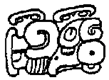
MHD (Schele)
'Brussels' Jade Ear Ornament glyph-block #1
<u:TUUP.<u:MAM>
· This is quite a rare logogram – a search in MHD on “blcodes contains ZRQ” returns only 2 hits, 1 of which (from the 'Brussels' Jade Ear Ornament) is given as an example above (plus the MHD Catalog (MHD.ZRQ) and Bonn (1951st) examples makes 3). Even though it’s not a common logogram, the iconographic origin seems clear enough – the earspool is the element on the left. (Is the scroll with protector in the top right a stylized ear?).
· EB1.p172.pdfp177.#2: tup n. earflare (EB1 never writes long vowels).


JM.p238.#4 MC.p22.#5
tu:pa tu:pa

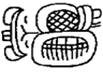
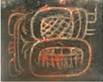
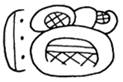
AT-E1168-lecture11.t0:06:01 = MHD (Mathews) = MHD (Looper) MHD (Martin)
ALH Obsidian Ear Ornament 1 glyph-block A CLK Ear Ornament 1 glyph-block A
u.<tu:pa> u.<tu:pa> u.<tu:pa>


MHD (Schele) MHD (Schele) MHD (Schele)
PAL TI CT I8 PAL TI CT K7 PAL TI CT M3
u.<tu:pa> u.<tu:pa> u.<tu:pa>
· JM gives the pronunciation as short tup (but JM never indicates long vowels anyway). The JM.p238.#4 and AT-E1168-lecture11.t0:06:01 examples are both probably ALH Obsidian Ear Ornament 1 glyph-block A.
· According to the Lacadena-Wichmann rules tuup should be written tu-pi, so it is unclear why this is usually given as tuup. This is perhaps from linguistic reconstruction, based on the modern Mayan languages. There is a single, lone spelling of tu-pi è tuup in MHD, but it’s very late Classic, in CHN. And the context isn’t outstandingly obvious (to me) that the context actually refers to an earspool.
· The full syllabogram-only spelling tu-pa is slightly more common – a search in MHD on “bllogosyll contains tu pa” and “blmaya1 contains tuup” (optionally, and “blengl contains ear ornament”) gives 9 hits (the second clause is to exclude phrases like tu paat = “at the back of”, tu pakal = “with the shield of”):
o 5 from PAL (PAL Temple of the Inscriptions).
o 1 from CLK.
o 1 from TIK.
o 2 from elsewhere.