


K&H.p86 K&L.p8.#2.1-8 TOK.p7.r4.c3 BMM9.p11.r1.c3 BMM9.p11.r1.c4
TOK’ TOK’ TOOK’ TOK’ TOK’


JM.p234.#4 = K&L.p8.#7 S&Z.p83.#27 JM.p234.#5 JM.p235.#1
TOK’ TOOK’ TOK’ TOK’
MHD.1C1.1&2 0257st
TOOK’ / TOK’ TOOK’

MHD.1C1.3 0112st T112a&b
TOOK’ / TOK’ TOOK’ -


K&L.p8.#2.9 TOK.p22.r3.c3 = BMM9.p15.r6.c4 MHD.SC5 0257hc
TOK’ TOOK’ TOK’ TOOK’ / TOK’ TOOK’


MHD (Graham) MHD (Luin) = MHD (Macri) Lacadena = Coll-1 MHD (Helmke)
ANL Panel 1 B1 CNC Panel 3 A1 EKB West Hieroglyphic Serpent #9 XUN Panel 2 pC1
<u:<K'UH.HUL>:TZAK>.<HA'AL:la:TOOK'> AJ.<3:TOOK':na> to:TOOK’ ti.TOOK’
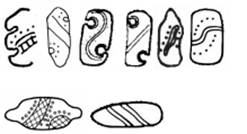
· Variants (3):
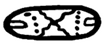
o A. Flint outline with wavy band:
§ 2 “ponds” (a “pond” is a circular element with a dotted protector).
§ The “ponds” can be actual bays, i.e., no longer be completely within the outline of the glyph, but actually form part of the outside of the glyph).
§ One or even both “ponds” may be absent.
§ If present, they are separated by a (slightly curved) band:
· The curvature varies from very slightly curved S to completely straight.
· The band has optionally dotted reinforcement on both sides.
§ As in the glyph TUUN/ku, the “pond” represents the fissures and cracks of a rocky surface. Indeed, JM.p235.#1 even shows a “stalactite”/“grapes”, another element which represents the fissures and cracks of a rocky surface (though it is the only one of the given examples to have this element).
§ The “flint outline” may sometimes be a “lemon” (= two distinct “tips”, one at each end of the rounded rectangular form).
Almost every combination of the above features can be present or absent. The most regularly present feature is probably the wavy band (hence the nickname for this variant), but even that can be absent (e.g., S&Z.p83.#27, JM.p234.#5) if enough of the other features are present.
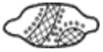
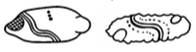
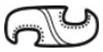
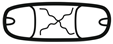
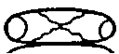
o B. Flint outline with wavy-X:
§ There’s a “wavy-X” in the centre, reminiscent of the “wavy-X” in the Tzolk’in day name Etz’nab.
§ This “wavy-X” also represents the fissures and cracks of a rocky surface.
§ It consists of a flint outline / rectangle with rounded corners, with a dot at each end – each dot is optionally protected by an arc on the inner side, either a solid or a dotted protector. These dots are hence the equivalent of the “bays” or “ponds” of the “flint outline with wavy band” variant, as they are associated with a dotted protector in both variants.
· A visual scan of the flint outline TOOK’ glyphs in the MHD corpus shows a number of examples where the two dots are clearly “ponds”.
· One general pattern is if the “ponds” are “diagonally” opposite one another, then it’s the “wavy band” variant, while if the “ponds” are “diametrically” opposite one another (along a horizontal or vertical axis), then it’s the “wavy-X” variant (even if the X is actually missing).
§ They perhaps represent tiny cracks and fissures in the surface of the flint – an equivalent to the “pond(s)” of the “flint outline with wavy band” variant.
This variant is not given in any of the 5 standard reference works, but is recognized by MHD as 1C1.3 and by Bonn as 0112st, both corresponding to T112.
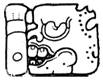
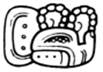
o C. Skull:
§ This variant is given only by K&L, TOK, and BMM9, but well recognized by MHD and Bonn.
§ It seems to be just a skull with the distinctive features of the “flint outline with wavy band” variant.
§ EKB West Hieroglyphic Serpent #9 is unusual:
· It has three touching, parallel, diagonal (SW-to-NE) elements at the back of the head, each ending in what seems to be a “pond”, in the end on the right.
· It has so few of the distinctive features of TOOK’ that the main reason for reading it as such is that it has a to initial phonetic complement and took’ is a plausible reading.
· It seems to bear a slight resemblance to a rare variant of the syllabogram chi – the one with two or three agave “leaves” on the right. This chi variant also has a number of touching, parallel, diagonal (SW-to-NE) elements at the back of the head though without, of course, a “pond” at the end of the element.

ju.chi
· MHD statistics (2026-02-27):
o MHD’s SC5 enables us to easily gather statistics on that variant.
o Unfortunately, MHD’s code 1C1 doesn’t distinguish between the two flint variants – “wavy band” and “wavy-X” (and the multitudinous variation within the “wavy band” variant would have been impossible to capture using codes anyway).
o Nevertheless, the total count of 147 hits for MHD.1C1 is low enough for us to get approximate statistics of its two main forms. The number of hits is approximate, because it’s sometimes a bit of a judgement call, whether a particular instance is a “wavy band” or “wavy-X”, or “unclear” – lots of grey area in between the various sub-categories.
o The statistics are:
§ “Wavy band” (1C1, visually): approximately 83 hits.
§ “Wavy-X” (1C1, visually): approximately 24-26 hits.
§ [“Flint, unclear” (1C1, indeterminate whether “wavy band” or “wavy-X”): approximately 28 hits.]
§ [No image available: 9 hits.]
§ “Skull” (SC5): 15 hits.
This shows that the “wavy band” flint variant is by far the most common, with the “wavy-X” flint variant in the middle (about 1/3 as many), with the skull variant least common (about 1/10 of the “wavy band” flint variant).
· Beliaev&Houston-ASSiMW.p3 explains an interesting contrast between took’ and taaj: if took’, “flint,” inflicts the injuries of war, often in connection with the Sun God, obsidian, taaj, cuts flesh in acts of sacrifice.

K&H.p73 DP HS stair 4, step5 JM.p235.#2
u.<to:k’a> to:k’a