
0044bv
TOK / to


BMM9.p11.r1.c2 0044bt 0044do 0044dt
TOK TOK / to
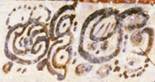
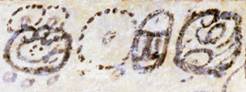
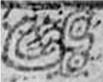
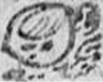

HLHI (Kerr) HLHI (Kerr) MHD (mayavase.com, Kerr) = Zender-GFHaS.p7.pdfp7.fig10
K2284 A1 K2284 E1-G1 K1652 A1-A2
<TOK:JATZ’:la>.EK’ <HIX:?>.? TOK:JATZ’:la mo.ko chi{h/j} <TOK:JATZ’:la>.EK’ HIX

0044bb
TOK / to

0044hp
TOK / to
· No glyphs given (as logogram TOK) in K&H, K&L, TOK, 25EMC.
o It looks like most of the standard pedagogical resources view this glyph only as syllabogram to.
o It’s clear that the syllabogram is derived from the logogram via the acrophonic principle.
· Variants (4):
o A. Full:
§ Top:
· Three left feelers, each with a dotted protector (optionally, two only).
§ Bottom – boulder outline (three parts):
· Left: a series of parallel horizontal ticks, each ending in a dot.
· Middle: crossed bands between two columns.
· Right: mirror image of left.
o B. Reduced: top part of full variant. This can be further reduced to only two of the protected feelers (Bonn gives an example of just one).
o C. Boulder-only: bottom part of full variant.
o D. Monster-head: full variant with Waterlily Serpent head underneath.
· As with the standard pedagogical sources, MHD also doesn’t recognize a logogram reading of this glyph: MHD.ZBC & MHD.AB4 are both only given as to. In contrast Bonn recognizes all variants of 0044xx (full, reduced, boulder-only, and monster-head) as both TOK and to.
· K&L gives only the “S surrounded by touching dots”, and even then, gives the reading as MUYAL / TOKAL (not TOK).
· Epigraphers have traditionally translated tok as “cloud”, and that is still the majority opinion, but S&Z.p159 gives “spark”. The traditional translation of “cloud” is based on the fact that many descendent Mayan languages have variations of tok or tokal meaning “cloud” and/or “fog”. Kaufman reconstructed Proto-Mayan *tyoq and assigned it the meaning “cloud”. However, Zender disagreed and reconstructed Proto-Mayan *tyoqaal/*tyokaal and assigned it the meaning “cloud”. He hence felt that only *tyoqaal/*tyokaal and Ch’olan tokaal mean “cloud”, leaving Ch’olan tok without the meaning “cloud”. Instead he associated tok with Modern Yucatec tóok “to burn” and felt that it lay in the semantic area "a type of flashing or sparking fire associated with lightning". He hence chose the translation “spark”, which is how it’s rendered in S&Z.p159. After that, he found Wastek tok "storm" and tokow "cloud". He hence now recommends “storm” as a better translation than “spark” for Classic Maya tok. [Sim: paraphrased from a personal communication from Zender to Raven, 2016.]
· Zender-GFHaS.p5.pdfp5.para3: More recently, Timothy Knowlton (1999) has proposed a reading of TOK “to burn, to take”, based on the to- signs occasionally prefixed to “stone-in-hand” in the names of jaguar spirits depicted on a number of Codex Style vessels (Figures 8c, 10-11). However, given that the putative to prefix never appears outside the context of this “jaguar” name, it seems unlikely that it functions solely as a phonetic complement. Rather, the prefix is probably meant to be read as a fully functioning part of the jaguar’s name phrase—perhaps as TOK, a value the to syllable is known to carry elsewhere, and possibly a reference to the writhing coils of the snake that envelop him, features frequently marked by TOK signs in these and other contexts (Figure 8c; see also Miller and Martin 2004:102-3; Taube 1989:fig. 24-17). In any event, the to/TOK prefix in these contexts probably has little bearing on the phonetic reading of the “stone-in-hand” sign itself. [Sim:
o This is from a paper by Zender concerning the logograms NAB and JATZ’. Specifically, this passage pertains to the “stone-in-hand” being read as JATZ’. But a peripheral remark pertaining to the reduced variant of to/TOK (two feelers with protectors) is extremely relevant to the idea that the glyph can be either a logogram or a syllabogram (see K2284 A1 and E1, and K1652 A1 in the examples above).
o Note that I read the glyph below JATZ’ as la, to make Tokal Jatz’.]
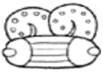
JM.p233.#6
to:ko
· JM gives the meaning “cloud”.
· This could also be viewed as TOK with an end phonetic complement of ko.