

K&L.p24.#7.9-14 TOK.p10.r2.c4 BMM9.p11.r1.c1
TI’ TI’ TI’


 .
.
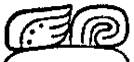
T128b = T168f Gronemeyer-GGF.p12.pdfp12.fig11.l = TMHW.pdfp432.F.59 TMHW.pdfp432.F.
- YAX Lintel 48 D7 QRG Stela K B5
TI’:HUUN:na HUUN.<<“po”?.TI’>:na>


K&L.p24.#7.1-8 TOK.p21.r2.c1 BMM9.p15.r1.c1 BMM9.p17.r1.c1
TI’ TI’ TI’ TI’


TOK.p32.r5.c3 BMM9.p21.r2.c3
TI’ TI’
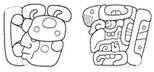


MHD (Krempel) MHD (Graham) MHD (Graham)
TNA Monument 76 C TNA Monument 146 I TNA Monument 170 M
u.TI’ <HUUN:na>.li TI’.<SAK:<HUUN.na>> TI’.<SAK:HUUN:na>

MHD (Mathews)
TNA Monument 30 A2
HUL.TI’
· No glyphs given in K&H.
· Variants (3, perhaps 4, or 3 with a very rare sub-variant):
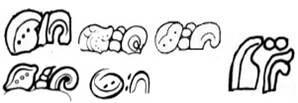
o A. Abstract / rectangular / 3-component – features:
§ Left: cave-like element with 3 to 5 very small dots going from bottom left to top right, in a slight arc which follows the line of the bold wall/ceiling.
§ Middle: 2 – 3 dots stacked vertically, tending slightly towards to right as they go up, last dot can be a leaf (similar to the middle element of the 3-component ya).
§ Right: bloated crescent with tips pointing down (or right bold feeler) – optionally with reinforcement of spine.
There are some (quite rare?) sub-variants of this variant:
§ A 2-component sub-variant where the middle component of the 3-component form is missing.
· See T128b in the examples above.
· Thompson assigned this glyph the codes T128b and (unusually for Thompson) T168“f” (He didn’t explicitly assign the -f suffix, but it can be conveniently referred to as that because it’s placed after T168abcde).
· In so doing, Thompson was correct in classifying T128b together with T128a and T128cd as variants of T128 (all TI’), but he was incorrect in classifying it also as T168“f”, as all the other variants T168abcde are AJAW.
· He might have done this on the basis of QRG Stela K B5 (see example above) where there’s a puzzling po-like (i.e., “cushion”/”ICH”) element between the vertical HUUN on the left and the TI’:na on the right (the na being, despite its position) just an end phonetic complement for the HUUN).
§ A 3-component sub-variant where the only difference between it and the regular 3-component form is that the leftmost component resembles the simple/single wing variants of k’i/K’A’.
· See YAX Lintel 48 D7 in the examples above.
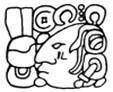
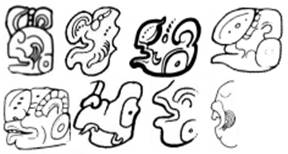
o B. Representational / human head:
§ Largish nose.
§ Open mouth with thick lips (optionally reinforced or bolded).
§ Partitive disk in bottom right corner.
§ The 3-component variant can optionally also appear above or infixed into the human head, in particular the far-left element of the three.
Note that BMM9.p15.r1.c1 is quite an aberrant variant – it doesn’t have the open mouth with thick lips of the others, but instead has two scrolls going downwards, at the right of the mouth (which the others don’t have). Furthermore, it has a very large, squarish, cross-hatched eye and what might be a cruller under and to the right of the eye. TOK.p21.r2.c1 is also aberrant (but less so than BMM9.p17.r1.c1) – it doesn’t have any elements of the abstract variant at the top of the head. This is however also known from K&L.p24.#7.6-8.
o C. Stylized-face:
§ Above:
· Two feelers (left and right) with protectors (alternatively: two tightly scrolled leaves, symmetrically placed, scrolling to the left and right).
· Optional but common (in the sense of 2 out of 3 cases have them, if so few cases permit the making of generalized statements).
§ Below: stylize face:
· Top half: three non-touching dots in a triangular formation, with the triangle pointing up (“upside-down face”), the top dot touching the ceiling.
· Bottom half: resembles the bottom half of HAAB.
o D. mo-NAL-like:
§ Above: the reduced (bifoliate) variant of NAL.
§ Below: circle of touching dots, with some internal element resembling the bottom half of HAAB.
· Usage – the almost complementary distribution of “A” and “B” vs. “C” and “D”:
o Firstly, variants “A” and “B” (but not “C” and “D”) are commonly found as the first word in the phrase ti’ huun = Glyph-F of the Supplementary series.
o In contrast, variants “C” and “D” (but not “A” or “B”) form, in combination with an old variant of HUL, one of the variants of Glyph-G2 of the Supplementary series.
§ It’s MHD which reads “C” and “D” as TI’, with both forms given the code MHD.ZHF.
§ A search in MHD on “blcodes contains ZHF” (2025-07-03) yields 28 hits, almost exclusively in the context of being known (by position/context) to be Glyph-G2.
· A search in MHD on “blcodes contains ZHF” and “blsem contains G02” yields 25 hits (one of which is “D”, the mo-NAL-like variant).
· A search in MHD on “blcodes contains ZHF” and “blsem does not contain G02” yields 3 hits – the three examples given above.
o All three are from TNA, with context showing that they’re read TI’.
o These three instances are, in fact, how we can infer that Glyph-G2 is read as HUL-TI’ (despite the lack of resemblance between “C” and “A” and “B”).
o From that reading, we can also infer that the unique instance of the mo-NAL-like glyph “D” is also read TI’, as it too (from context) is known to be Glyph-G2. Perhaps (in some obscure way) the bifoliate reduced NAL at the top of “D” corresponds to the two protected feelers, and the mo-like element at the bottom of “D” corresponds to the stylized face of “C”.