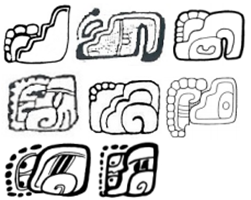
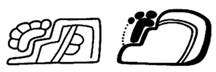


K&L.p39.#7 MHD.ZY1.1&2 0843bh T843
T’AB[ji] T’AB? T’AB -


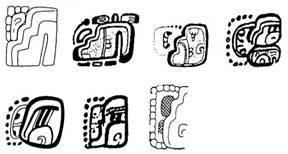
TOK.p17.r4.c2 BMM9.p21.r2.c4 StuartEtAl-GoP.pdfp35.#1
T’AB T’AB T AB[yi]



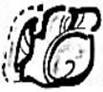
JM.p223.#1 JM.p223.#2 JM.p223.#4 JM.p224.#1 StuartEtAl-GoP.pdfp22.#2.2 StuartEtAl-GoP.pdfp37.#1.2
T’AB[yi] T’AB[yi] T’AB[yi] T’AB[yi]
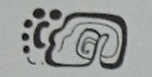


M&L.252.ZY1 Gronemeyer-FtG.p2.fig2.a Gronemeyer-FtG.p4.fig4.b
T’AB[yi] T’AB[yi?] ] T’AB[yi?]

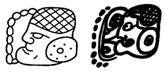

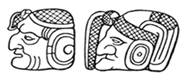
BMM9.p15.r1.c3 MHD.PA3.1&2 1014st T1014ac
T’AB T’AB? T’AB -


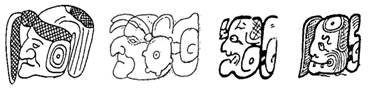
JM.p223.#3 JM.p224.#2 StuartEtAl-GoP.pdfp35.#2.1&2&3&4
T’AB[yi] T’AB[yi] T’AB.yi


Zender-TRGiCMW.p12.c2.fig10.D1 Stuart Greene
PAL TS F8/O8 PAL TS F8/O8
T’AB[yi] T’AB[yi] T’AB[yi]
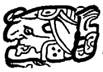

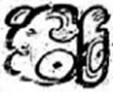
StuartEtAl-GoP.pdfp13.#1.2 StuartEtAl-GoP.pdfp13.#2.2 StuartEtAl-GoP.pdfp20.#2.2
T’AB.ji T’AB.yi T’AB.yi
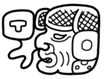
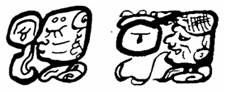
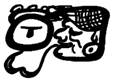
TOK.p25.r4.c4 StuartEtAl-GoP.pdfp35.#4.2&3 MHD.PA2 = StuartEtAl-GoP.pdfp35.#4.3
T’AB T’AB:yi T’AB:yi T’AB?
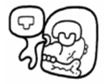
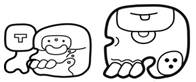
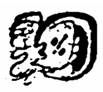
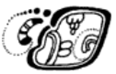
BMM9.p15.r7.c1 = TOK.p22.r4.c4 1049bh 1049br StuartEtAl-GoP.pdfp35.#4.1
T’AB UH? T’AB
· No glyphs given in K&H.
· See alay for more glyph examples.
· Variants (3):
o A. Stairway:
§ Outline of steps ascending from left to right.
§ (Optionally,) a “footprint”, or
§ What appears to be an arc of dots acting as a “protector” for the steps. Gronemeyer-FtG.p3.l+3: [the dots are a] representation of the footprint ascending a stairway).
· Dorota Bojkowska: the dots might have evolved from the toes of the foot (other interpretations not known).
· TOK has an example with a foot instead of blood drops.
§ Optionally, the “darkness property marker” within the arc formed by the dots.
§ Sim: The “arc of dots” is characteristic of the stairway-variant of T’AB, but the old-man head variant occasionally has it as well (e.g., MHD.PA3.1&2, JM.p224.#2, Zender-TRGiCMW.p12.c2.fig10.D1).
§ Optionally, a slightly curved vertical line or bar with two vertically stacked touching dots attached halfway up the middle of the right side.
· This is the “wood property marker”.
· Sim: Could it be wooden support for the steps, could the steps be made of wood instead of stone?
· Dorota Bojkowska: wooden platform to make the steps, e.g., stages built for performing on during the ceremony.
o B. God Head (God N) – older god with:
§ Cross-hatched head covering.
§ Cross-hatched forehead ornament is part of the head covering.
§ God head is interchangeable with the steps.
§ Do not confuse this with the visually similar “UHMAN”. That it sometimes has a scroll between the mouth and the back of the head does not make it “UHMAN”:
· This is merely an infixed yi, whereas in “UHMAN” it is a much more extensive and curling spiral (which would rarely be mistaken for a yi).
· The distinguishing characteristics of T’AB which “UHMAN” never have are:
o Sunken cheeks due to a toothless mouth.
o A cross-hatched head covering.
§ This logogram is considered to be Pawahtuun / God N.
§ Optionally, one or the other (but not both) of:
· An “arc of dots” (with or without a “darkness property marker” inside the dots (see above, under the stair-variant).
· A “breath” emanating from the god-head (see below, under the skull-variant).
o C. Skull:
§ What appears to be a forehead ornament with a scroll descending from it is in fact “breath” emanating from the skull.
§ A clue that it’s the breath is the bold T in the circular component at the top – the property marker for wind or breath.
§ StuartEtAl-GoP.pdpf35.para3 (2005): A third form of the same verb [Sim: in reference to StuartEtAl-GoP.pdfp35.#4.1&2&3] seems to show a death's head with its ik' "breath, spirit" ascending skyward.
§ AT-E1168-lecture18.t0:02:14: But there are two additional varieties [Sim: in reference to TOK.p25.r4.c4 and TOK.p22.r4.c4], which actually show the last breath, like, air – IK’ – escaping from an old guy or a dead body ([here represented by] a skull). […] But the idea, of course, is not about the skull, it's about the last breath. So: wind, [or] breath coming out.
§ Sim: This “breath” element is characteristic of the skull-variant of T’AB, but the old-man head variant occasionally has it as well (e.g., TOK.p25.r4.c4, StuartEtAl-GoP.pdfp35.#4.3).
· Reading:
o Almost all sources give T’AB but:
§ JM gives TAB:
· Dorota Bojkowska confirms that JM is outdated.
· JM on the FAMSI website (updated by Helmke) have moved the glyphs from T to T’.
· Sim: this has been silently corrected in the transliterations under the JM examples given above.
§ Surprisingly, MHD gives T’AB? with a question mark (for all variants), indicating some doubt as to the reading. I don’t know the reason for this, as I haven’t seen any other such expressions of doubt in other reference sources or papers – particularly not with the stair-variant.
§ Bonn gives UH?:
· The fact that 1049bh has the same “skull” with (to the left) a “T” = IK’ = “wind” and a scroll below, exactly as do BMM9.p15.r7.c1 and TOK.p22.r4.c4, indicates that they are the “same” glyph.
· It is hence curious that all the other sources (including JM, after adjusting for the T/T’ difference) give T’AB.
· Zender-TRGiCMW.p11.c1.l+17:
o Transliteration: T’AB-yi 6-?-CHAN-na NAAH-la 8-?-NAAH U-K’ABA’ yo-OTOOT-ti xa-MAN?-na.
o Transcription: t’ab[a]y-i-Ø wak ?-chan naahal waxak-?-naah, u-k’aba’ y-otoot xaman.
o Translation: He goes up to 6 ?-Sky, (to) the Northern 8-G1 Edifice, (which is) the name of the house of the north.
o Dorota Bojkowska: t’abay means “raised up”, but not passive, and often present tense.
o Sim: t’abay appears to the medio-passive form of a transitive verb t’ab.
· The initial sections of Boot-OOO give some information about the various forms of T’AB in connection with the PSS.
o In this context, it seems to mean “to present” rather than “to ascend”. Perhaps an object was lifted up high in presenting it (e.g., to a crowd) and the verb hence acquired the extended meaning of “to present”.
o It is unclear to me whether the “presenting” refers to the inscription on the ceramic or the ceramic itself.
· Contrast between MHD and Bonn:
o MHD distinguishes between the old-man head with “arc of dots” (MHD.PA3) vs. old-man head with “breath” (MHD.PA2). The old-man head with neither is presumably subsumed under MHD.PA3 while MHD.PA2 is “intrinsically” with “breath”.
o Bonn goes in the opposite direction, with 1014st being just an old-man head, with neither “arc of dots” nor “breath”. It (again, presumably) includes the forms with either “arc of dots” or “breath”.
o MHD hasn’t assigned a specific code for the skull-variant whereas Bonn has (but reads it as UH?).
· MHD statistics (2025-07-16):
o Unfortunately, the way the MHD codes have been assigned, it isn’t possible to distinguish the skull from the old-man variants just by the search queries alone. However,
o “blcodes contains ZY1” (stair): 183 hits.
o “blcodes contains PA2 (old-man head with breath, might include skull with breath): 3 hits only – all 3 with an old-man head.
o “blcodes contains PA3” (old-man head with arc of dots): 320 hits.
· k’al, na’, and t’ab are translated as “to present” in English, but they are quite different types of “presenting”:
o k’al: a ritual object (e.g., a headband or stela) is the object of k’al.
o na’: a human being (e.g., a bride or prisoner) is the object of na’.
o t’ab: a ceramic (or perhaps the inscription / painting on the ceramic) is the object of t’ab.


Gronemeyer-FtG.p2.pdfp2.fig1 = MHD (Grube)
IKL Lintel 1 glyph-block B IKL Lintel 1 glyph-block 2
<t’a:ba>.yi
· Gronemeyer-FtG.p1.l-3: a unique instance of syllabic substitution for the typical “step verb” T843 T’AB?
· MHD uses a slightly different system of glyph-block labelling, where MHD’s glyph-block 2 = Gronemeyer’s glyph-block B.
· IKL is Ikil, a site in the state of Yucatán, in modern-day Mexico.
· That this is a unique instance can be confirmed by a search in MHD on “bllogosyll contains t’a” and “bllogosyll contains ba” and“bllogosyll contains yi”, which indeed yields exactly this one hit. In fact, even the first two clauses are already sufficient to establish this. That yields two hits, but the second hit is not a syllabogram spelling of t’a-ba è t’ab but instead a “false hit” caused by a possible T’AB (MHD searches are, appropriately and fortunately, not case sensitive).
· This reading is still only a tentative proposal. See ta’ elsewhere in the CMGG for more information.