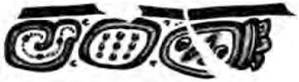
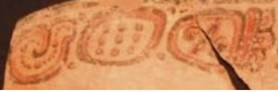
Looper&Polyukhovych-AVftLCA.p4.pdfp4.fig5 drawing (Sansregret) = photo (Guzmán)
CRN Looter’s trench fragments
so no SAK[WAY{is}]
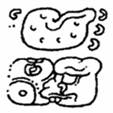
Bacon-PhD.p572.pdfp595.fig40c (Houston)
MTL Stela 4
<so+no>:<chi.?>
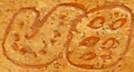



mayavase.com (MHD) MHD (Polyukhovych) MHD (Graham) MHD (Graham)
K8076 S MS1214 / Bowl, Fralin Museum of Art 1980.EL.6.4 K-L YAX HS Step 7 U1 YAX HS Step 7 X1
so.no so.no <so+no>:EK’ so+no
· No known logogram – syllabogram-spelling only.
· In three of the above examples, there’s a corresponding dwarf in the iconography – three different dwarfs:
o One dwarf on K8076 – with the glyphic text yaljiiy son = “said (the) dwarf” (though what exactly was said is not clear, as those glyphs are obscure).
o Two dwarfs on YAX HS Step 7 – in this case son is just a tag in the iconography, one for each dwarf.
· Meaning – “dwarf” or “hunchback”:
o From an etic (or modern Western) point of view, a “dwarf” and a “hunchback” may be quite different, but perhaps they weren’t from an emic (in this case, Classic Maya) point of view. Miller-TDMiCMA.p1.pdfp1.para1.l+1: Among the curiosities of Moctezoma's court described by the early Spanish chroniclers were the dwarfs and hunchbacks who served as confidants and jesters to the Mexica ruler.
o One incised vessel (K8076) and YAX Hieroglyphic Stairway 2 Step 7 show three different dwarfs in the iconography, each described as son.
o I don’t recall seeing iconography showing hunchbacks (but my experience is quite limited).
o MHD has settled on “hunchback”, but for the above reasons, I prefer “dwarf”.
· Ch’at and mas are also words for “dwarf”. On YAX HS Step 7, the second dwarf is tagged as ch’at son and perhaps the first dwarf as well (the presence or absence of ch’at in addition to the son is unclear because of erosion).
o There is no reference to son in EB1.
§ EB1.p219.pdfp224 English -> Classic Maya for “dwarf” gives only ch’at and mas.
§ EB1.p136.pdfp141 is an entry referring to YAX HS Step 7 X1 and it’s glossed as no[NOL?] è nol = “dwarf” – this is apparently an outdated reading, superseded by son (see below).
o I’ve been unable to find a reference to a cognate in the Colonial or modern Mayan languages – I looked in Kaufman-APMED for “dwarf”, “enano”, “petiso”, (Mexican Spanish) “nomo”. So currently the only connection between “dwarf” and son is via the iconography.
· Additional notes:
o CRN Looter’s trench fragments & MS1214 have a “royal figure” who was a son:
§ CRN Looter’s trench fragments: so no SAK[WAY{is}] è son, Sak Wahyis.
§ MS1214: so no SAK:WAY{is} è son, Sak Wahyis.
§ The WAY is reduced to just a %-sign in a circular border. It’s infixed in the SAK in the case of the CRN Looter’s trench fragment and below the SAK in the case of MS1214.
§ Sak Wahyis was a common title for rulers under the suzerainty of CLK. So it would seem that a dwarf was, in both of the cases above, a ruler as well.
o Miller-TDMiCMA is a 13-page paper on dwarfs in Classic Maya society:
§ In addition to discussing their societal role, it covers their representation as independent statues (e.g. Jaina figures), and as being part of the iconography of carved monuments and painted/incised vessels.
§ The emphasis, however, is entirely on the visual aspect, not on the linguistic, so glyphs not really mentioned (not even enough to qualify as “in passing”) and there is no discussion of how son (or any other word for “dwarf”) was written.
o Bacon-PhD is a 604-page “anthropological” PhD dissertation on the dwarf motif in Classic Maya monumental iconography.
§ Chapter 7 (Bacon-PhD.p336-349.pdfp359-372 (though only a very small part of the whole dissertation) is devoted to epigraphy and provides lots of very useful information (see below).
§ It explains how, despite the enormous number of instances of dwarfs being represented in the iconography, very rarely are these instances accompanied by glyphs. And in the few instances with glyphic text, the glyphs are either too eroded to read or, if not, don’t apparently refer to the dwarfs in the iconography of the inscription.
§ What’s left is just a tiny handful of instances:
· Bacon-PhD.p345.pdfp368.para2: T24.74:564v/(li-)ma-su è mas = duende, ‘goblin, fright’ in Yucatec Maya. [Sim: for the status of the initial T24/li, see maas = “dwarf” for further information.]
· Bacon-PhD.p347.pdfp370.para2: T134:210v/no-T210v, where T210 is read as either NOL (with no as an initial phonetic complement) or as providing an -l (presumably as lo), giving nol. [Sim: T210 is nowadays read as so, and the reading order of the conflation is reversed, giving so-no èson = “dwarf”. See under so, for further information .]
· Bacon-PhD.p347.pdfp370.para3: T93:?:59/ch’a-?-ti è ch’aat = “hunchback”. [Sim: there’s no strong reason to posit a middle syllabogram. See ch’at = “dwarf” for further information.]
Both of the above works speak of how widespread a role dwarfs had in (royal) Classic Maya society, both over time (in the chronology) and in space (in geographical distribution).