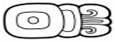
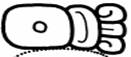
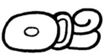

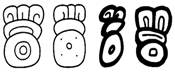
K&H.p86.#3 TOK.p9.r2.c1 BMM9.p10.r7.c2 JM.p213.#3 MHD.3M1.1&2&3&4
SAK SAK SAK SAK SAK
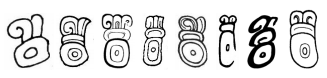
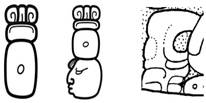
K&L.p33.#5 0058st 0058hs 0058hc
SAK SAK
· Features – a long, rectangular glyph with:
o Bottom: a large circle with a circle or washer in the centre.
o Middle: an oval element with optional reinforcement on the side away from the large circle. If the reinforcement touches the oval itself, then it becomes a “grip”.
o Top: two or three longish “leaves”.
§ The leaves are long in the same axis as the whole glyph.
§ They are symmetrical: either a left and right leaf, curling to the left and right respectively (two leaves) or with a third leaf between them, going straight outwards (three leaves).
§ Some forms can look like a left and a right feeler with protectors. If a middle leaf is present, then it may have a tick in the centre, to correspond to the left and right feelers.
· MHD gives one example with a quincunx infixed in the main (large) circle (MHD.3M1.2). Bonn gives two rather uncommon head (animated) variants – a skull (0058hs) and an animated creature (0058hc).
· Do not confuse SAK with (the reduced variant of) ti: ti has only one “leaf” whereas SAK has two or three.
· MHD statistics (2025-02-24):
o A query of MHD (Classic – Blocks) on “blcodes contains 3M1” (=SAK) and “blsem does not contain Glyph G07” yielded 785 hits.
o The exclusion of Glyph-G7 instances was because occurrences of the SAK-like glyph in Glyph-G7 often have an unusual element in the middle of the main (large) circle (e.g., a crescent with tips pointing upwards). I wanted to see what “pure” SAK looked like, in order to get a feel for whether that element in Glyph-G7 was just a decorative variant of the smaller circle or “washer” found in the centre of the main (large) circle, or whether it was an infixed glyph to be read in addition to SAK, or perhaps even whether it made the “SAK” in Glyph-G7 into a totally different glyph. Not that statistics could give a definitive answer to this, but knowing something of how commonly this strange (crescent-like) element in Glyph-G7 occurs in other contexts of SAK could give some indication as to its nature.
o Of the 785 hits, visual inspection revealed the following:
§ A small but significant number are eroded in the middle of the main (large) circle, so it’s not possible to determine the element infixed there (this is no different from erosion in parts of many other glyph examples).
§ The overwhelming majority have a small circle or a washer in the middle of the main (large) circle. This is indeed, the “canonical” conception of the SAK logogram.
§ There are about 25 hits with a (right-side up) la-face. These are almost all in connection with the usak xaak/saak ik’ik associated with death, with the la-face transliterated as XAAK/SAAK = “seed”, “sprout” by some epigraphers and as MOK by some other epigraphers (and by MHD).
§ There are about 15 hits with a crescent (or a small circle with a short tick in the middle of the top, which could be a very bloated crescent (so bloated that the “bay” of the crescent completely disappears, leaving just the tick).
§ There are about 4 hits with a quincunx.
§ There are about 2 hits with the 3-dot la glyph.
§ There are about 2 hits with an element which resembles the syllabogram lo.
The number of hits given for each category above is only “about” rather than an exact figure, because these statistics were gathered by visual inspection, with some cases being judgement calls as to whether there is a crescent (etc) present (for example, if the element is partially eroded). Exact figures are not needed, as these statistics are more just to get a rough feel for the variation in this element.
· If there had been no crescents (or just one or two) in the non-Glyph-G7 occurrences of SAK, then that could have been an indication that the glyph in Glyph-G7 might not actually be a SAK. The 25 out of 700+ occurrences of such crescents isn’t a very large proportion but their presence in a context where the glyph is confidently known to be SAK means that it’s entirely possible that it’s a SAK in Glyph-G7 as well.