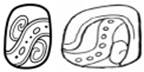


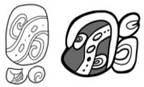

K&L.p9.#1.1&2 TOK.p14.r4.c4 S&Z.p141.#56 MHD.ZG4.1&2 1708st
POLAW PALAW? POLAW - POLAW? / PALAW?

Coll-1
PAL Temple 19 Platform South Side F4
3.POLAW.ja


K&L.p9.#1.3 MHD (Tokovinine) MHD (Tokovinine) = Coe&Benson-TMRPaDO.p22.fig8 = Schele
Usumacinta region monument fragment Dumbarton Oaks Unprovenanced Panel 2 P1 (PAL)
POLAW K’AHK’:POLAW <POLAW>.WINKIL?

MHD (Tokovinine)
Usumacinta region (Chancala)
K’AHK’.POLAW


MHD (Valenzuela) = Coll-2
CPN Altar K O1
<*YAX?:POLAW>.<*WINKIL?>
· No glyphs given in K&H, BMM9.
· This reading was first suggested in Lopes-TWG (2004).
· TOK lists it as PALAW with a question mark.
· Dorota Bojkowska: sometimes even PULAW.
· EB1.p224.pdfp229.#29 (2009) (English -> Classic Maya): ocean k’ak’ nab, palaw.
· EB1.p145.pdfp150.#5 (2009) (Classic Maya -> English): palaw n. ocean.
· EB1.p145.pdfp150.#5.fn206 – alternative readings for this logogram are PULAW and POLAW, also meaning “ocean.”
· No currently known spelling provides information on the opening syllable.
· Features:
o A ‘”water band”: a wavy band going diagonally across a boulder outline:
§ With a spine of small non-touching dots, the dots are usually of varying size though the variation is not “random” (as in “jaguar spots”), but with some sort of pattern in the variation.
§ The edges of the band may be bold or non-bold.
o 2 scrolls, one on each side of the water band. From the examples I examined:
§ Each scroll is “tightly wound”, i.e., goes right round one revolution and ends up curled inside itself.
§ Both scrolls are either clockwise or anticlockwise.
§ Both scrolls are either bold or non-bold.
o A wa-like element:
§ Lopes-TWG.p2.pdfp2.para-1: The first noteworthy characteristic of the glyph is the apparently mandatory -wa suffix. It appears in all available examples of the glyph in texts. There is the possibility that it may not work as a phonetic complement but rather that it is an integral part of the logograph, as in the case of T567 WI' and other complex logographs (Marc Zender, personal communication 2003). It is possible, however, that this is simply a statistical effect caused by the scarcity of examples coupled with the fact that certain logographs are complemented in an unusually frequent way and in the same manner (e.g., the so-called “checkers” glyph, part of the name of GIII of the Palenque Triad, is very often complemented with a -wa suffix).
§ MHD consider this element to be an essential part of the logogram, rather than just an end phonetic complement wa.
§ K&L, TOK, S&Z, and Bonn do not include this element in their examples (so it seems that they do consider it to be an end phonetic complement).
§ Sim: I adopt the Lopes/MHD stance and have not transliterated a wa in the examples above.
o Variants:
§ There may be 2-4 additional elements resembling either the syllabogram le or the “boniness” property marker (the two are visually slightly similar – both have an oval-ish outline, the former having a spine of “soundwaves”, the latter of three small non-touching dots):
· CPN Altar K O1 has 3 instances of the “boniness” property marker distributed on the inside edge of boulder outline, replacing the water band.
· K&L.p9.#1.3 and the Usumacinta region monument fragment have 2 le’s, one on each side of the wavy band, attached to the inside edge.
o In the former, the dotted spine disappears completely.
o In the latter, the dotted spine is replaced by a single, more angular zigzag band (with just 2 roundish “turns”).
The two are sufficiently similar for the question to arise if they might just be two different drawings of the same glyph in a real-life inscription – the former stripped of context (and with the wa-like element removed), the latter as it appears in its glyph-block, with an additional K’AHK’ and the “obligatory” wa-like element.
· Dumbarton Oaks Unprovenanced Panel 2 P1 (PAL) shows a variant which is dramatically different from the common form:
o The water band and spiral scrolls have been replaced by a “wavy bold X” with a cross-hatched background.
o It appears to have 4 le’s – on the inside of the two walls, floor, and ceiling.
o It’s not totally clear that all 4 elements are le’s – the Tokovinine drawing is the only one that shows a clear le element (the one on the floor). The other three are too eroded to determine if they are le’s. The Coe & Benson and Schele drawings of the same glyph-block only have oval outlines with no le-like internal characteristics.
o Seeing 4 le’s is based on other totally different glyphs with multiple le’s and the 2 le’s in K&L.p9.#1.3, suggesting that these 4 eroded elements are probably also le’s (also influenced by 1 of the 4 being very likely a le).
· Statistics – a search in MHD on “blcodes contains ZG4” gives 15 hits (2025-02-28):
o 3 of those hits have a le-like element (all 3 examples ).
o 1 of those hits has boniness property marker.
o 8 of those hits have a water band.
o 3 of those hits are unclear (probably assigned ZG4 from context).
This shows that the wavy (water) band is the most common variant, though the glyph itself is quite rare. Furthermore:
o Practically every single (readable) drawing has a wa-like element in the POLAW.