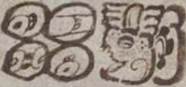
mayavase.com = EB1.p185.pdfp190.fig6d
K7786 E-F
<u.po>:<ko:lo> <che:e>.bu
· Boot-THToK7786&K4669.p3.para2.l+1: a rare collocation […] ’u-po-ko-lo che-’e-b’u […] leads to a transliteration upokolche’eb’ or “his quill-washing bowl”.
· EB1.p151.pdfp156.#1.1: pok- tv. to wash (something) » po-ko > pok- “to wash”.
· EB1.p151.pdfp156.#1.2: pokol.che’bul cn. washing basin for brush [Sim: giving K7786 as reference].
· The EB1 readings are perhaps based on Kaufman-APMED.p541.pdfp541.#1:
|
GTz *pok |
|
|
|
|
CHR |
pok |
v |
lavar |
|
CHT |
#poc-o |
v |
lavar |
|
CHL |
pok |
vt |
lavar |
|
TZE |
pok |
vt |
lavar (+manos) |
… with Spanish lavar = “to wash”. While this isn’t particularly many reflexes, the textual context – in connection with brushes – and the actual putative use of the ceramic object (in its time) make the EB1 reading extremely plausible.
· See also under cheb / chehb / che’b / che’eb = “brush” / “paintbrush” / “quill pen”.