


K&H.p85.#2 K&L.p16.#5 TOK.p26.r5.c2 BMM9.p19.r5.c1 JM.p171.#1
MO’ MO’ mo MO’ MO’

MHD.BP5.*
MOO' / MO' / mo

582bh 582bl 582ex 582fc
MO’ / mo


TOK.p11.r3.c2 MHD.XF6 1707st
mo MOO’ / MO’ MO’
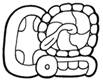


MHD
(Tolles)
MHD
(Stuart)
MHD (Looper)
PNG Panel 3
Q’1
PNG Stela 5
E1
PNG Stela 12 K1
K’AN.<mo:TE’> <K’AN:na>.<mo:TE’> AJ.<mo?:chi:hi>
· Variants (2):
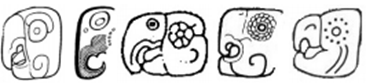
o A. Head of a parrot:
§ Boulder-shaped glyph with large distinct beak.
§ Round eye with a circle of touching dots around it – probably to indicate the very distinctive markings around the eye of a macaw.
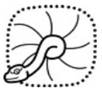
o B. Snake emerging from curved radial lines:
§ Boulder-shaped glyph with large distinct beak.
· Different sources / epigraphers have taken different approaches to whether the two variants are the logogram MO’ or the syllabogram mo. This is the perennial “philosophical question”, whenever a glyph is used to write a word ending in a consonant (especially the “softer” consonants, and most of all a glottal stop, which is particularly easy to drop): “Is this glyph a logogram (with the consonant at the end), or is it a syllabogram (with no consonant at the end)?”.
o In the former case, if a further syllabogram for the end consonant follows, then it can be considered the optional (but present) end phonetic complement for the logogram; and if not, then the logogram stands by itself, as the end phonetic complement is optional anyway.
o In the latter case, if a further syllabogram for the end consonant follows, then the two glyphs can be considered a fully syllabogram-only spelling for the word; and if not, then the word can be considered underspelled, as these “softer” consonants are often underspelled at the end of syllables anyway.
This question arises for BAAH/ba, CHIH/chi, KAY/ka, MIH/mi, MO’/mo, NAAH/na, NEH/ne, [NUUN?/nu?,] PA’/pa, PIH~PIK/pi, PUH/pu, TZ’EH/tz’e, TZU’/tzu, YOP/yo (with different solutions for each pair, and differing per epigrapher). Here, we see that TOK, MHD, and Bonn take different approaches for MO’/mo – all equally valid, but some more “aesthetically” appealing than others, depending on personal taste, of course (2026-03-08):
|
|
TOK |
MHD |
Bonn |
|
Parrot head |
mo only |
MO' / mo |
MO’ / mo |
|
Snake |
mo only |
MO’ / mo |
MO’ only |
As explained, reading mo for both the “parrot head” and the “snake” is always “correct”, but it seems sensible to read MO’ – especially for the “parrot head” – when it’s actually writing mo’ = “macaw”. But, even when it’s a “parrot head”, there will be (some) occurrences where it must be read mo (as both MHD and Bonn have done), because it’s writing a word which has nothing to do with mo’ = “macaw”. Perhaps slightly surprising is that Bonn have gone for “MO’ only” for the snake variant.


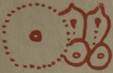
JM.p172.#1 JM.p172.#2 MC.p22.#1
mo:o mo:o? mo.o.o
· Both instances of JM are from the name Mo’ Witz Ajaw, the Lord of Macaw Mountain.
· Dorota Bojkowska: if the JM.p172.#2 is an o, then it is indeed a very strange variant of o.
· Dorota Bojkowska doesn’t know why MC.p22.#1 has a double o.