

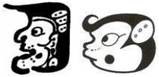
K&L.p14.#8 TOK.p30.r3.c1 25EMC.pdfp42.#2.2&3 [25EMC.pdfp42.#2.1 = K&L.p14.#8]
MAX (maax) MAAX MAX

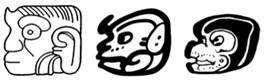

BMM9.p17.r7.c1 AM1.1&2&3 1754st
MAX MAAX / MAX MAAX
· No glyphs given in K&H.
· Features – the head of a monkey, with:
o Snub-nose.
o Optional ear resembling an oval at a SW-to-NE angle, with a spine three dots of tiny non-touching dots (what is a boniness property marker doing here?).
o Optional cross-hatching in an arc across the top and right (except the ear).
o There is no skull variant. BMM9 looks a bit like a skull (because it seems to have a nose-hole, and even a visible jawbone with two teeth), but we can tell that it’s still a monkey head, because it has an ear, and skulls usually don’t have an ear.


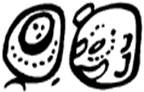
JM.p168.#5 JM.p169.#1 JM.p169.#2
ma:xi ma:xi ma xi
· Caution: the skull-based “main sign” glyph is not a logogram MAAX, with an initial phonetic complement ma, it’s a syllabogram xi in a syllabogram-only spelling ma-xi è maax.
· EB1.p128.pdfp133.#4 gives max, but EB1 always writes single vowels, never double (even for baak and tuun), so this doesn’t preclude the reading maax.
· Do not confuse maax/max = “spider monkey” with the phonetically similar maas/ma’as = “dwarf”.
o There is the additional possibility of confusion because the xi of ma-xi is a skull-like head, and the logogram for MAAS/MA’AS is also skull-like.
o One apparent difference is that the head in the xi doesn’t have an AK’AB (“darkness”) property marker whereas the MAAS/MA’AS does.