


TOK.p22.r1.c4 BMM9.p15.r6.c3 MHD.SCG 1727st
MAAS MAS MAS MAAS

Stuart (Coll-2)
CRN Panel 2 B6
SAK.MAAS

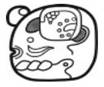
MHD.SC6 1727st

MHD (Stuart)
CRN Panel 1 P1
MAAS.su
· No glyphs given in K&H, K&L, 25EMC.
· Features:
o The “standard” skull with the usual features of:
§ Nose hole.
§ Medium-sized eye.
§ The “Boniness” property marker as “eye protector”, above the eye.
§ Bone-jaw with two or more touching dots as teeth.
o The distinctive (“atypical”) features seem to be:
§ A “fancy ear” in the lower right corner (not quite down to the floor).
§ An AK’AB / “darkness property marker” either above ear or infixed in the top part of it.
· Variants (2) – both MHD and Bonn recognize two distinct variants of this logogram:
o A. As above.
o B. Skull (with only a limited number (2) of “standard” skull characteristic) with infixed “KAWAK” (=TUUN/ku):
§ Nose hole.
§ Bone-jaw.
Additional (“non-standard”) features:
§ Infixed “KAWAK”, covering the position of the eye.
§ “Death eyeball” as forehead ornament – unusually, the eye doesn’t look to the left/“west”, but rather upwards/“north-east”.
§ Two darkened patches, reminiscent of the two darkened patches of KAB, with a “squiggly protector” to the right and under the patch of the right.
· The substitution of the logogram by the pure syllabogram spelling ma:su in the CRN ruler Sak Maas’s name (see syllabogram(-only) spellings below) helps to determine the pronunciation of the logogram.
· However, just establishing that the logogram is pronounced MAAS says nothing about its meaning. That has to be established from a combination of the look of the logogram and the meanings of putative descendent / related words in the Colonial or modern Mayan languages.
o Look/appearance: a skull.
o Meaning of related words (according to the tab in the MHD Catalog called “Lexical”, for the logogram MHD.SCG):
§ YUK: (aj) mas = duende (Sp) = “elf”, “goblin”.
§ LAC: mas = “shrink”, “shorten”
I suppose the semantic connection between all of these is “skull” ~ “death” ~ “sinister” while elves and goblins are smaller than humans, so, shrunken or shortened (and sinister), while dwarfs are also smaller than the average person and, because of their difference from the rest of society, might have been considered “sinister” or “goblin-like”, in Classic Maya times. Out of this semantic mishmash, one could surmise a meaning such as “dwarf”, especially in combination with SAK = “white”.
· The Stuart drawing in Coll-2 is called Panel XX – perhaps because it was given this designation at a time when the numbering of CRN panels was very uncertain and unstable. At any rate, this is now called CRN Panel 2.
· MHD statistics (2026-03-07) – a search in MHD on “blcodes contains …” yields:
o SCG (“standard” variant): only 4 hits, of which only 2 don’t have a question mark.
§ Both of these are from CRN and write the name of the CRN ruler: Sak Maas = “White Dwarf”.
§ The other two write another title Maas Winik = “Dwarf Person” / “Dwarf Man”, on the PAL Palace Tablet and on an unprovenanced monument from the PAL region.
Quite a rare glyph indeed.
o SC6 (“non-standard” variant): only 1 hit.
§ Also from CRN but not in writing the name of the CRN ruler Sak Maas = “White Dwarf”.
§ The lack of being a substitution for Sak Maas makes the association of this glyph with MAAS more tenuous.
An even rarer glyph.
· Caution: there’s a good substitution between a logogram and syllabogram-only spelling for SCG / “standard” variant, resulting in confidence in the reading for the logogram as MAAS/MAS/MA’S, but (in contrast) a similar reading for the logogram spelling for SC6 / “non-standard” variant is more tenuous:
o SCG (“standard” variant):
§ CRN Panel 2 and Panel 3 were created at the same time (9.11.16.02.8).
§ CRN Panel 2 B6 refers to the CRN ruler Sak Maas with a logogram spelling of the second word.
§ CRN Panel 2 A3 and CRN Panel 3 D8 refer to the same ruler with a syllabogram-only spelling of the second word (ma-su).
From this, we can confidently reason that SCG is read MAAS/MAS/MA’S.
o SC6 (“non-standard” variant):
§ Only found as a single instance in CRN Panel 1 P1, but not in connection with the name of the CRN ruler Sak Maas.
§ Its association with the reading MAAS/MAS/MA’S arises only from:
· Being in an inscription from CRN.
· The commonality with SCG of also being a skull-related glyph.
· The syllabogram su following SC6, suggesting MAAS/MAS/MA’S-su (as an end phonetic complement for a word ending in -s).
These are all reasonable indications for the same reading, but not nearly as strong as for SCG. Note also:
· BeliaevEtAl-LTJM.p197.pdfp21 (2016) gives only …-su
· PragerEtAl-DDe3D.p77.pdfp77 (2019) gives <MAS?.su> èmaas?
It’s not clear to me whether the reading of MAS? in PragerEtAl-DDe3D (compared to the totally non-committal “?” in BeliaevEtAl-LTJM) Is a result of increasing confidence in said reading, in the 3 years from 2016 to 2019, or if this reflects genuine (and persistent) differences in opinion as to the reading of SC6 by the respective epigraphers.
· EB1.p219.pdfp224.#22: dwarf ch’at, mas.
· Do not confuse this with the semantically related ch’at, which also means “dwarf” (if such a word actually exists, see ch’at = “dwarf”, elsewhere in the CMGG).
· Do not confuse maas/ma’as = “dwarf” with the phonetically similar maax/max = “spider monkey”. Do not confuse them both with the visually similar xi.
o There is the possibility of confusion because the xi of ma-xi is a skull-like head, and the logogram for MAAS/MA’AS is a skull.
o But the head in the xi doesn’t have an AK’AB (“darkness” property marker) whereas the MAAS/MA’AS does.
o MAAS/MA’AS has a “complex ear” (with the AK’AB infixed into the top) whereas MAAX and xi do not.


Stuart (Coll-2) Safronov
CRN Panel 2 A3 CRN Panel 3 D8
SAK.<ma:su> SAK.<ma:su>
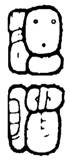
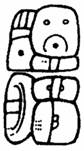
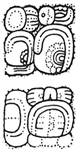
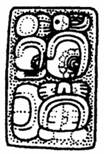
MHD (Houston) = Bacon-PhD.p572.pdfp595.fig40b (Houston) MHD (Montgomery) = Bacon-PhD.p572.pdfp595.fig40a (Wanyerka)
DPL Stela 15 G1-G2 PRU Stela 34 I1-I2
<ti?/SAK?>.<?.?> <li?/LEM?>.<ma:su> <PAT.TUUN:ni>.<a{h}:ku> <li?/LEM?>.<ma:su:*la>
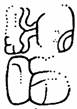

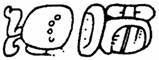
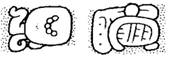
Bacon-PhD.p572.pdfp595.fig40f (Houston) = MHD (von Euw) Bacon-PhD.p572.pdfp595.fig40g (Houston) = MHD (von Euw)
XUL Stela 24 I2-I3 XUL Stela 25 A8-A9
*K’AHK.*TUUN <li?/LEM?>.<ma:su> K’AHK.<TUUN:*ni?> <li?/LEM?>.<ma:su>
· CRN Panel 2 A3 is also given in StuartEtAl-UE.p445.pdfp12.fig4.#1 as being Sak Maas, one of the rulers of CRN.
· The Stuart drawing in Coll-2 is called Panel XX – perhaps because it was given this designation at a time when the numbering of CRN panels was very uncertain and unstable. At any rate, this is now called CRN Panel 2.
· Bacon-PhD.p572.pdfp595.fig40g displays the two glyph-blocks (actually three) of XUL Stela 25 horizontally, but MHD’s assignment of glyph-block references as A8-A9 (and those of the label of Bacon-PhD.p572.pdfp595.fig40 for that matter, with three glyph-blocks A7-A9) implies that they’re vertically placed.
· Reading / pronunciation – maas/ma’as/ma’s/masul:
o BMM9.p111.pdfp45.#9 (in the text only part, no glyphs) gives ma-su è ma’s (which is what is predicted, if the Lacadena-Wichmann rules are applied).
o The difference between ma’as and ma’s is only a matter of convention: some epigraphers believe that a glottalized vowel always has the vowel repeated after the glottal stop, others don’t (or do, but don’t consider it necessary to write it).
o There are 3 small touching circles at the bottom of PRU Stela 34 I2b:
§ MHD reads them as a (three-dot variant of) la.
§ MHD hence has ma-su-la è Masul, yet another slightly different form of maas = “dwarf”.
§ The possibility should be entertained that all the others are underspelled ma-su{l}è Masul, rather than Maas/Ma’s/Ma’as.
o Four of the examples above, from three different sites (DPL, PRU, XUL, XUL), have a vertically rectangular / flint-outline glyph on the left (strictly speaking, the von Euw drawing of XUL Stela 24 I3 doesn’t, but the equivalent Houston drawing does).
§ MHD reads LEM? for DPL and PRU and nothing for the two in XUL while Bacon-PhD.p345.pdfp368.para2 reads all four as T24/li.
§ This is because the drawings used by MHD for XUL (von Euw) don’t suggest anything, while the drawings used by Bacon-PhD (Houston and Wanyerka) for all three sites suggest li):
§ Reading LEM has the advantage that it can be made into a separate word as part of the name/title: Lem Maas = (perhaps) “Shiny Dwarf”, which nicely parallels the name/title Sak Maas = “White Dwarf” of CRN.
§ Reading li has only disadvantages, as it would then spell a word like limaas, making it potentially a different word from the name/title in CRN, or would require finding a weak consonant to underspell after the li: Lin? Maas, Lij? Maas, etc, which would in turn require finding putative cognates or descendants in the Colonial or modern Maya languages. That would then preserve parallelism to Sak Maas and Lem Maas, but with no known logograms for substitution in this context, it would be very hard to even know which words to consider as candidates (as logograms can, from their iconography, suggest semantic areas to look at).