

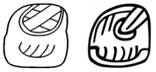

TOK.p21.r1.c2 BMM9.p12.r3.c1 MHD.ZR3.1&2 0597st
? LUT? LOT/LUT? -
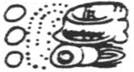


Beetz Baron-PhD.p193.fig4.4d Coll-1 Baron-PhD.p193.fig4.4e
CRC Stela 16 B13 CRC Stela 16 B13 CRC Stela 3 (back) C5b CRC Stela 3 (back) C5b
3.K’UH.<LUUT:ti> 3.K’UH.<LUUT:ti> 3:LUUT 3.LUUT


Schele Schele Schele Schele Schele Baron-PhD.p193.fig4.4b
PAL TI ET E1 PAL TI CT F5 PAL TI CT N5 PAL TI WT B6 PAL TI WT N11 “typical” PAL
3.<LUUT:ti>.K’UH 3.<<LUUT.K’UH>:ti> 3.<<LUUT.K’UH>:ti> 3.<<LUUT.K’UH>:ti> 3.<LUUT:ti>.K’UH 3.<<LUUT.K’UH>:ti>


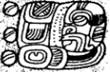

Greene Greene Greene Coll-1 Baron-PhD.p191.fig4.3b
PAL TFC L3 PAL TFC N9 PAL TS N6 TIK Stela 26 zB7 TIK Stela 26 zB7
3.<LUUT:ti>.K’UH 3.<<LUUT:K’UH>:ti> 3.<LUUT:ti>.K’UH 3.<LUUT:ti>.K’UH 3.<LUUT:ti>.K’UH
· No glyphs given in K&H, K&L, 25EMC.
· PDIG = “Palenque Deity Introductory Glyph” – a term coined by Baron. Baron-PGaPL.p62.pdfp62.para2.l+6: One of the first patron deity categories that scholars recognized was labeled with what I call the Patron Deity Introductory Glyph (PDIG).
· Features:
o Basically a boulder outline, though there seems to be a tendency for it to be (slightly) “vertically rectangular”, i.e. a bit taller than wide.
o In the middle of the bottom half, a “ka-comb” with teeth pointing upwards.
§ A very few instances show instead a “lipped-U” with grass-blades growing from the base of the U (MHD.ZR3.2).
§ A very few instances show cross hatching instead of “teeth” (PAL TI WT B6).
§ This is either the “iconographic origin” of the “ka-comb” or just a creative “flight of fancy” of the scribe in these instances.
o In the middle of the top half, touching or just clear of the ceiling, a circular element (can have bold circumference) with crossed bands.
§ A very few instances show a “ladder” instead of crossed bands (CRC Stela 16 B13, CRC Stela 16 B13, CRC Stela 3 (back) C5b).
§ This element can occasionally drift to the top right (TOK.p21.r1.c2, BMM9.p12.r3.c1, 0597st, PAL TS N6).
§ When it does, the “ka-comb” tends to tilt in a NW-SE direction, so that the “teeth” continue pointing at the cross bands, i.e., they point straight up when the crossed bands are in the middle of the top half, and point SW-NE when the crossed bands are in the top right.
· Most often found in the expression uhx luut k’uh.
· From Erika Raven’s summary on PDIG (personal communication 2021-08-17) – this glyph has had many proposed readings:
o cha: Yuri Knorozov
o HAL: Michel Davoust
o K’AHTIB: Alexander Voss
o LOT: Linda Schele
o lu: Martha Macri
o LUT: Peter Mathews
o LUUT: Baron
o p'u-lu-ti: Martha Cuevas García & Guillermo Bernal
· MHD and Bonn:
o MHD: LOT/LUT?
o Bonn: -.
It looks like MHD have (at least partially) accepted Baron’s proposed reading while Bonn has not.
· Baron-PhD.p190-198 is devoted to the decipherment of this glyph:
o Baron discusses some of the alternative proposals.
o Baron-PhD.p193.fig4.4b is an idealized distillation of the many occurrences of the PDIG in the PAL TI tablets.
o Many other examples were found via this dissertation.
o I have included Baron’s drawings as well as other drawings of the same glyph-blocks.
o I have adopted Baron’s proposed reading of luut as well as a slightly modified meaning she proposed for ux luut k’uh = “gods from a set” (Baron proposed “gods from a large set”, but I think it already works quite well without the “large”.
· Baron-PGaPL.fig3.4 has some discussion on this also.
· Baron-PGaPL.p62.pdfp62.l-1: The PDIG consists of three parts: the number three (hux), an undeciphered middle element, and the glyph for k'uh (Figure 3.4a). The reading of the PDIG hinges on the glyph's undeciphered middle portion, consisting of a sign that resembles the lu syllable with an infixed crossed-band element and the phonetic ti sign. […] // A far more convincing reading of the PDIG is hux luut k'uh. The two ceramic examples and Postclassic codex example of the phrase all spell the middle portion phonetically as lu-ti (Figure 3.4b). The term luut probably referred to twins, friends, or sets (Table 3.1). […] // To read the PDIG as hux luut k'uh, one must argue that the crossed-band element inside the lu sign either functions as a variant of the more typical lu sign or, alternatively, that it is a logogram reading LUUT somehow fused with the lu sign. The latter is probably the better explanation, given that in one example, the -ti suffix is totally absent, suggesting that it was not entirely necessary in order to read the middle part of the glyph as luut (Figure 3.4c). // The reading of the PDIG as hux luut k'uh was first proposed by Schele (1992:127-28). Those who accept this reading of the glyph typically interpret the hux ("three") part of the phrase as referring to three gods (Prager 2013:584). Because the PDIG was used frequently to introduce Palenque's patron gods and because Palenque's most important patrons were three in number, it is logical to assume that the hux in the glyph corresponded to the three gods listed after. This assumption has also led to the wider inference that patron deities primarily occurred as sets of three. As it turns out, both of these conclusions are incorrect. While many inscriptions did list patron gods as sets of three, they were often inconsistent. Take the patron gods of Calakmul, for example. Stela 58 named three gods, while Stela 54 named five. Cancuen Panel 1 named three Calakmul patron gods, but only two were the same as those listed on Stela 58. Other inscriptions mentioned only one Calakmul patron deity. At first glance, god lists appear to have been more formulaic at Palenque, since the typical triad of GI, GII, and GIII can be found eight times in its inscriptions. Twice, however, an additional three gods were added to the list. Once GII was paired with a different god, and on another occasion, GI was listed with four other deities. The PDIG introduced deity lists at Palenque consisting of one, two, three, or six gods. And at Caracol the glyph introduced lists of three, four, and six gods. On the Vases of the Seven and Eleven Gods it appears to have referred to just one god in a list of many. Thus, not only did Maya texts regularly list patron deities in groups other than triads but the "three" in the PDIG does not seem to have referred the actual number of gods that it introduced. In some hieroglyphic contexts hux had the extended meaning of "many" (Grube 1997:88). Given the lack of consistency in how many gods followed the PDIG, it may be best translated something like "the many-together god(s)" or "god(s) from a large set." Thus, the phrase is a quite literal description of patron deities, who were venerated in ever-accumulating pantheons.
· A search in MHD with “bllogosyll contains 3” and “bllogosyll contains lut” (2026-03-08) yields 20 examples (uhx luut k’uh), many of them very clear.
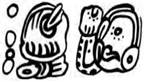
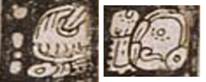
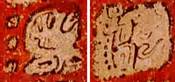
Baron-PhD.p193.fig4.4c = mayavase.com mayavase.com
Vase of the Seven Gods Vase of the Eleven Gods
K2796 Column ‘C6’-‘C7’ / R6-R7 K7750 Side 2 Column ‘F6’-‘F7’ / E’6-E’7
3.<lu:ti> K’UH 3.<lu:ti> K’UH
· The two vases are among the few examples of a pure syllabogram spelling – photos from mayavase.com (Kerr) and drawing by Baron – which help to support the reading luut.
· There are quotes around the glyph-block references as they are “unofficial”, assigned by me for convenience.
· The Vase of the Seven Gods is also referred to for this pure syllabogram spelling in Baron-PGaPL.fig3.4b.
· Note the similarity between the logogram LUUT and the syllabogram lu:
o Similarities:
§ They both have a “boulder outline” (approximately).
§ They both have a “ka-comb” (teeth pointing upwards) in the middle of the bottom.
o Differences:
§ LUUT has crossed bands in the centre of the top.
§ lu has a curved (and bloated) V- or U-shaped element at roughly an angle of 45 degrees, with a NE-SW orientation, in the top right.
Although -t is not one of the “weak” consonants which are often dropped in the acrophonic principle of dropping the final consonant of a logogram to form a syllabogram, it seems plausible that this is the case here. Note that as of 2026-03-08, MHD does not code lu-ti and LUUT-ti differently – the first glyph in luut is coded LUUT for both the cross-bands in the middle and the bloated-V/U form on the right. So the two syllabogram-only spellings cited by Baron (shown above) as a substitution (and hence a decipherment/reading) of LUUT are treated as just the logogram plus end phonetic complement.