


TOK.p6.r5.c1 TOK.p6.r5.c2 BMM9.p10.r5.c4
LEM? LEM? LEM?
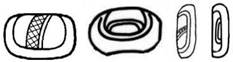
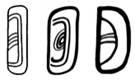

25EMC.pdfp41.#5 MHD.1M2.1&2&3 0121st
LEM? LEM? LEEM / WIN??


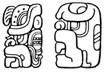
TOK.p18.r1.c1 MHD.SM6 0121hc T1017ab
LEM? LEM? LEEM / WIN?? -
· No glyphs given in K&H, K&L.
· Variants (2):
o A. Abstract: rectangular boulder outline (= “flint”), containing one internal arc and that internal arc containing, in turn, its own internal arc.
o B. Head: an anthropomorphic head (human or god) with the abstract variant infixed in the forehead (and optionally in the bottom right?).
· The pronunciation and more precise meaning of this logogram appears to be uncertain:
o Of the “pedagogical sources”, only TOK, BMM9, 25EMC list the glyph at all, and all three sources have LEM? for the pronunciation.
o In the iconography, it’s an element used to label shiny objects (polished surfaces, fruit, etc), but only 25EMC gives a tentative meaning “shiny?”.
o Furthermore, it appears to also mark divinity, when it’s shown on the body of a full figure in the iconography – HrubyEtAl-AICV.p157.pdfp5.c1.para-1 (in connection with an unusual vessel excavated at Ucí): Panel I (Fig. 60 depicts an old god. The large squarish cycs, perhaps infixed with mirrors, and god markings on his arms show that this is not a mortal, and the chapfallen smile indicates advanced age. [Sim: the figure portrayed has a LEM-like element on each upper arm and on his left thigh.]
o Even without glyphs, the word lem is not listed in the dictionary parts of K&H, K&L and EB1 (from which K&H and K&L are derived).
o However, both MHD and Bonn now give a LEM-related reading to this glyph:
§ MHD: gives LEM?, with a question mark, continuing the doubt of the earlier pedagogical sources.
§ Bonn: gives LEEM, without a question mark, but note the long vowel -ee-, which the other sources don’t have. Furthermore, there is an additional reading of WIN??, with a double question mark, presumably to show quite a high degree of doubt.
As might be expected, the readings and degree of uncertainty are exactly the same for the head variant as for the abstract variant, for both MHD and Bonn.