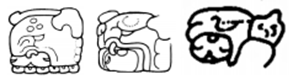


K&L.p11.#3.1&2&3 TOK.p31.r5.c3 BMM9.p17.r6.c4 25EMC.pdfp38.#8.1&2 = K&L.p11.#3.2&1
KOJ / CHOJ KOOJ KOJ KOJ
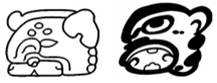

MHD.AT4.1&2 1508st
KOJ / CHOJ? KOOJ?
· No glyphs given in K&H.
· Features:
o There is a human (WINIK) in the mouth, showing a characteristic of the cougar as a “man-eater” (that cougars attacked humans was also mentioned in reports of early Spaniards in the New World).
o Mammal ear.
o Quite often has 3 spots in a triangular formation – meaning unknown.
o Optional: single fang (sometimes even double).
· Note that K&L.p11.#3.1 is identical to 25EMC.pdfp38.#8.2, except that K&L includes the end phonetic complement of the (“multiple horseshoe”) variant of syllabogram ji while 25EMC omits it. The disharmonic spelling -o-i is probably what gives rise to the long-o of kooj, given by many epigraphers.
· According to the English Wikipedia articles on the jaguar and the cougar, both are / can be nocturnal, but jaguars are more consistently so than cougars.
o Jaguars are active between dawn and dusk, so include most of the night, but can be diurnal in dense jungle. Cougars on the other hand can be very nocturnal (including dawn and dusk), but that’s very dependent on geographical location and the animals they prey on. In certain regions (and dependent on prey) they can be much less nocturnal than jaguars.
o This helps to explain that the AK’AB darkness / blackness property marker is almost always present in the BAHLAM logogram, but less consistently present in the KOOJ logogram. In the examples from the standard pedagogical works and MHD and Bonn, only the TOK and Bonn examples show the darkness / blackness property marker.