

25EMC.pdfp38.#3.2 MHD.XG2.1
KAJ KAAJ?

Bíró-EGiCMI.p145.pdfp23.fig5b
K’UH.<T511:AJAW>


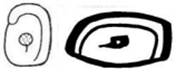


TOK.p11.r4.c4 BMM9.p12.r2.c1 25EMC.pdfp38.#3.1&4 MHD.XG2.2 1570st
KAAJ? KAJ KAJ KAAJ? KAAJ?


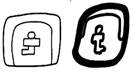

TOK.p11.r2.c3 25EMC.pdfp38.#3.3 MHD.XG8.1&2 1706st
KAAJ? KAJ KAAJ? KAAJ?
· No glyphs given in K&H, K&L.
· Variants – 3 (A, B, C) x 3 (A’, B’, C’):
o A boulder outline, where the perimeter can be one of 3 possibilities:
§ A. A single line or bold, or
§ B. A “cave”, i.e., the top 1/3 of the left wall, the entire ceiling and the entire right wall reinforced, or
§ C. A “symmetric cave”, i.e., the entire left wall, ceiling and right wall reinforced.
o An element in the centre, which can be one of 3 possibilities:
§ A’: Simple: a dot (optionally cross-hatched).
§ B’. Medium: a cross-hatched dot in the centre with a “tail” hanging off it (the tail can start at the bottom of the dot, or quite a bit higher, with an arc “protecting” one side of the dot, ending with a “tail” at the bottom).
§ C’. Complex: a much more complex element. It appears to be the side-view of a 3-dimensional object made up of 3 or 4 parts:
· The end of a cylinder.
· An annulus (ring) of slightly larger diameter.
· The rest of the cylinder (perhaps of slightly large diameter than the end).
· A wavy “tassel” coming out of the end (it can be just a simple L-shaped bend).
It seems that the orientation of this complex element can be horizontal or vertical (bent/squiggly end to the left, right or downwards, but not upwards).
· These are just the theoretical possibilities – some of the 9 combinations may not actually occur.
o The non-bold form of A (just a circle/boulder outline) with A’ (a plain dot in the centre) would be indistinguishable from T511 = PET = “round”. If it does occur, then context would be required to tell if it was PET or KAAJ (if indeed it is a variant of KAAJ).
o Most epigraphers don’t distinguish the variants with a plain dot (A’) from those with a dot and a tail (B’) but do distinguish these (collectively) from the variants with a fancy element in the centre (C’).
o For example:
§ MHD has:
· On the one hand: MHD.XG2.1 (A’/plain dot) and MHD.XGH2.2 (B’/dot with a tail), vs.
· On the other hand: MHD.XG8.1&2 (C’/fancy element).
§ Bonn has:
· On the one hand: 1570st (B’/dot-with-tail) (with A’/dot-with-tail), vs.
· On the other hand: 1706st (C’/fancy element).
Bonn doesn’t give an example of just a plain dot, but, presumably, would classify A’/dot as a minor variant of 1570st, i.e. it doesn’t distinguish between A’/dot and B’/dot-with-tail.
§ Similarly, all the other pedagogical sources have one or two of the 9 theoretical possibilities.
· This is an additional (and commonly occurring) EG for YAX, the primary one being PA' CHAN.
· Reading(s):
o Most epigraphers don’t distinguish A’/simple dot from B’/dot-with-tail, i.e. A’/B’ are treated as “the same glyph”.
o Some however distinguish A’/B’ (simple dot or dot-with-tail) from C’ (complex element), but some don’t.
o Those that don’t make this distinction read A’/B’ and C‘ as KAAJ, but both MHD and Bonn are more cautious (with Bonn being even more cautious than MHD):
§ TOK (2017) has KAAJ? for A’/B’ (TOK.p11.r4.c4 and for C’ (TOK.p11.r2.c3).
§ MHD gives KAAJ? with a question mark for A’/B’ (MHD.XG2.1&2) and for C’ (MHD.XG8.1&2).
§ Up to 2024, Bonn gave no pronunciation for both A’/B’ (1570st) and for C’ (1706st), but as of mid-2025 also has KAAJ? for both.
o Sim: Can we even be sure A’/B’ and C’ are variant ways of writing the same word? Probably yes, because if both occur as a secondary EG of a ruler of Yaxchilan, then the chances are minimal that there are two different EG’s which look so similar.
· Beliaev&Safronov-SAaX.slide#28 (2009) shows a map on which the eastern-most 1/3 of the Pa’chan polity is marked off as being Kaaj.
· Bíró-EGiCMI.p145.pdfp23.para1 (2016): Yaxchilan is another site that had two emblem glyphs, one of which has been deciphered by Boot (2004) and Martin (2004) as K’UH-PA’CHAN-AJAW, while the other is the still undeciphered K’UH-T511-ji-AJAW (Figure 5). Many have dealt with the chronological and spatial distributions of the Yaxchilan emblem glyphs (Helmke 2012; Mathews 1997: 68; Schüren 1992). Mathews has concluded that the distribution of the emblem glyph main signs showed only two patterns and that Pa’chan was the only one mentioned in foreign sites, while T511-ji was connected to women. Schüren (1992) went further in her investigation and proposed the existence of two separate sites, Pa’chan and T511-ji, suggesting that at least two women, Ix Pakal and Ix Chak Jolom from T511-ji had married into the royal family of Pa’chan. This resulted in the joining of the two polities during the reign of Itzamnaj B’ahlam III (AD 681-742), who in his inscriptions projected this political situation back into the past. Finally, she noted that T511-ji might have been the name of the unlocated Laxtunich (Schüren 1992: 37). Regarding the discussion above, it is highly unlikely that the emblem glyph of the queen was joined into the double emblem glyphs because it is most probable that it was the male ancestor who was key to developing this pattern. [Sim: T511 = PET, but the main sign of the secondary EG of YAX has a "cave" (bold ceiling and right wall) or “symmetric cave” (bold ceiling, left wall, and right wall) which PET never has. Furthermore, as far as I know, the dot in the middle of T511/PET is never cross hatched, whereas the dot in MHD.XG2.1 (and MHD.XG2.2) very often is. For these reasons, I think the glyph in the secondary EG of YAX should not be considered to be a variant of T511/PET. But this discrepancy in no way detracts from the validity of all the other observations in Bíró-EGiCMI.p145.pdfp23.para1. I only question the validity of its association with T511/PET.]
· AT-E1168-lecture15.t0:16:46-17:19 (2016): Kaaj is their “aspirational” title. Two generations before this king [Yaxuun Bahlam IV], they had some kind of marriage which allowed them to claim a very ancient pedigree which was not necessarily embraced by nearby dynasties, who continued calling them just Pa’-Chan lords. But Kaaj had the advantage of an extra twenty generations of kings. And given the political aspirations of the late Classic Yaxchilan rulers, it was very important for some reason to have this kind of pedigree – it gave them an extra clout, vis-à-vis their neighbours. [Sim: These remarks very likely are related to “while T511-ji was connected to women” in the previous bullet-point.]