

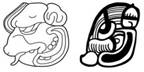

TOK.p30.r5.c4 BMM9.p17.r6.c2 MHD.AS4.1&2 1620st
K’EK’EN? KEKEN K’EK’EN? K'EK'EN?
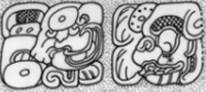
Schele
PAL PT C10-D10
<YAX:CHIT>.<K’EK’EN?:ne> ka.KAN
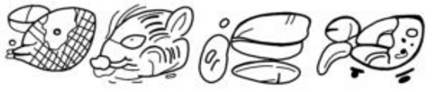
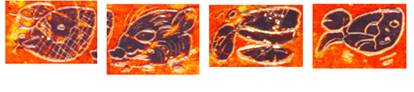
Grube-ALfYW.p9.fig12b = MHD (Kerr)
K3844 tag for figure left of temple W-Z
YAH K’EK’EN/<CHITAM:ma> xa.<MAN:na> wa.<WAY:?>
· No glyphs given in K&H, K&L, 25EMC.
· BMM9.p17.r6.c2 is probably based on PAL PT C10b (top / main sign).
· Features:
o Animal head with mammal ear.
o Trilobate nose (the Bonn Catalog example, 1620st, tends toward a bilobate rather than trilobate nose).
o “Reduced variant of ja” (i.e., the right half of a full lunar crescent), infixed into the bottom right of the animal head.
o Optional eye covering: an element consisting of a “washer” above and a trilobate element (leaves pointing downwards) below.
§ This element covers the eye of the mammal.
§ It (somewhat) resembles an upside-down SAK, except that the eye-covering element here is bipartite, while a SAK is usually tripartite – the missing element being the “bracket” present in the middle of SAK but absent in the bipartite element.
§ Furthermore, this resemblance is probably more superficial than real, as SAK never appears with the trifoliate leaves pointing downwards, while this is always so with the element covering the eye of K’EK’EN (when present).
§ This distinguishing characteristic is present in the examples from the two pedagogical sources (TOK.p30.r5.c4, BMM9.p17.r6.c2) and in the example from the Bonn Catalog (1620st), but not in the examples from the MHD Catalog (MHD.AS4.1&2). Indeed, the most reliable / consistent distinguishing characteristic seems to be the “reduced variant of ja” infixed into the bottom right of the animal head.
· MHD statistics (2026-03-05). A search in MHD on “blcodes contains AS4”:
o Yields 11 hits, including one hit which is one of the extended names/titles of K’inich Janaab Pakal – Yax Chit K’ek’en Kan, on PAL PT C10-D10.
o Only this one hit has the trilobate element covering the eye.
In fact, only TOK and BMM9 have this optional trilobate element, and they both appear to be based on PAL PT C10. Much more characteristic for all 11 hits is the “reduced variant of ja” infixed into the bottom right of the animal head.
· The table below is adapted from the “Lexical” tab in the MHD Catalog entry for MHD.AS4 (the Spanish-only glosses have been augmented by Google Translate translations of the Spanish gloss into English).
|
Mayan Language |
Mayan Word |
Gloss (Spanish) |
Gloss (English) |
|
YUK |
k’ek’en |
puerco o cochino |
pig or swine |
|
YUK |
k’ek’en che’ |
jabalí |
wild boar |
|
LAC |
k’éek’an |
puerco, puerco de monte |
pig, peccary |
|
ITZ |
k’ek'en |
cerdo |
pig |
· Pronunciation:
o Both TOK and MHD have two glottalized k’s but indicate some hesitation towards the whole reading with a question mark.
o BMM9 has KEKEN with two unglottalized k’s but without a question mark. Seeing as this is the only source which gives an unglottalized k’, and the 4 examples from the modern Mayan languages all have k’, BMM9’s KEKEN should perhaps be considered an outlier to be ignored (perhaps it’s just a typo).
· It’s unclear to me to what extent it’s justified to associate the Classic Maya k’ek’en (reconstructed, presumably, from the words for “pig”/“peccary” in the modern Mayan languages) with this glyph with the “reduced variant of ja” infixed in the bottom right (= the “AS4/1620st” glyph):
o One would have more confidence in the association if there were an instance of this glyph with a k’e- initial phonetic complement. There isn’t in fact such a thing, as the “Complementation” tab of the MHD Catalog entry for AS4 shows only end phonetic complements of -na, -ne, -ni.
o Alternatively, one would have more confidence in the association if there were an instance of this glyph in an inscription accompanied by iconography, where the iconography portrayed a clear and obvious peccary. [This may well be the case – I haven’t tried looking at the whole object, in the case of the 11 hits of “blcodes contains AS4” in the MHD TTT’s (but I doubt that such iconography exists).]
o The absence of either of the above two supporting pieces of evidence is probably the reason for the question mark in the reading K’EK’EN?, as given by both MHD and Bonn. The existence of iconography and (only) the -n end phonetic complements would already go some way towards making us more confident of the K’EK’EN reading.
· It is unclear to me why Grube-ALfYW reads K’EK’EN instead of CHITAM in K3844, as the trilobate element is not present over the eye, nor is there a reduced ja infixed in the bottom right of the head. Perhaps the name Yah K’ek’en Xaman Way is known from other inscriptions, where the K’EK’EN reading is more certain. MHD, indeed, reads CHITAM, which gains a bit of support from the three non-touching dots (quite faint and hard to see) under the mammal head – these could be read as one of the reduced variants of ma, as an end phonetic complement for CHITAM.
· Do not confuse this (visually and semantically) with CHITAM, which also has a trilobate nose and also means “peccary”. The distinguishing characteristic for K’EK’EN / KEKEN is the “reduced variant of ja” in the bottom right and (optionally) a washer with trilobate element covering the eye (leaves pointing downwards) whereas CHITAM has an eye which is a circle, with a horizontal line through the middle, and with (typically) a series of parallel vertical ticks on the “floor” of the resulting (top) semicircle. One possible solution:
o Read CHITAM when there is an -m end phonetic complement.
o Read K’EK’EN when there is an -n end phonetic complement.
· Do not confuse this with the visually (slightly) similar HE’EW = “noun classifier for days”. HE’EW has a mammal head (sometimes) with crossbones over the eye (and with no trilobate nose), whereas K’EK’EN has a mammal head with a trilobate nose, with a trilobate element under the eye, with the leaves pointing downwards.
· Do not confuse this with the visually (slightly) similar CH’AHOOM:
o K’EK’EN has a mammal head while CH’AHOOM has a human head.
o K’EK’EN has a “washer and trilobate element” covering the eye while CH’AHOOM has two flame-like elements covering the eye, bound to the top of the head by a slightly curved horizontal band.
o The only thing they (vaguely) have in common is a slightly unusual element covering the eye – in both cases, atypically, with the “leaves” (respectively) “flames”/“scrolls” pointing downwards.
· Do not confuse this with the visually (slightly) similar (head variant of) ye:
o K’EK’EN has a mammal head while (the head variant of) ye has an anthropomorphic head.
o The interesting point is that it seems in both cases of K’EK’EN and (the head variant of) ye, it is exactly the same unusual element covering the eye: a “washer with a trilobate element below it, leaves pointing downwards”.