



BMM9.p10.c1.r4 25EMC.pdfp37.#3 Grube-TLJ.p1.pdfp1.fig1 = T284 M&L.2M2
JALAM JALAM JALAM JALAM

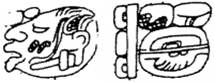
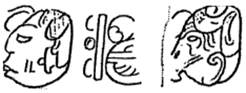
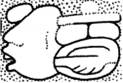
Grube-TLJ.p2.pdfp2.fig3a Grube-TLJ.p2.pdfp2.fig3b Grube-TLJ.p2.pdfp2.fig3c Grube-TLJ.p2.pdfp2.fig3d
CRN Element 53 CRN panel 3 CRN panel 2 CRN HS 3, Block 2
IX.<6:JALAM:CHAN:na> IX 6.<JALAM:CHAN> IX 6.<JALAM:CHAN> AJAW IX.<6:JALAM:CHAN>

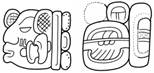
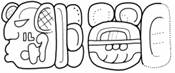

NAR Stela 24, front NAR Stela 24, right side NAR Stela 29, back
M&G.p74.1 = M&G.p74.box1 = Grube-TLJ.p2.fig2a Grube-TLJ.p2.fig2b Grube-TLJ.p2.fig2c
IX.6 <JALAM:CHAN>.<LEM?> IX.6 <JALAM:CHAN>.<LEM?>

Grube-TLJ.p3.pdfp3.fig4a
YAX Lintel 5 D1-D2
IX 6.<*JALAM:CHAN>
· No glyphs given in K&H, K&L, TOK.
· Resembles the top part of AJAW, but is distinct from it.
· Although different, there isn’t a discrepancy in logogram between BMM9.p10.c1.r4 and Grube-TLJ.p1.fig1:
o The first element is the same, but the second element is (respectively) po or BEN.
o This is because JALAM is just the cross-hatched eyeball on top of reduced AJAW. AJAW can be BEN.po or po.BEN – in BMM9, the BEN is covered by the new element, whereas in Grube-TLJ the po is covered.
· Caution: M&L has two different glyphs as 2M2 – this one (T284) and T170.
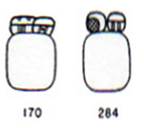
o This is definitely a typo in the second glyph, as the codes read 2M1, 2M2, 2M2, 2M3, 2M4, 2M6, 2M7, with no 2M5.
o A typo such as 2M1, 2M2, 2M2, 2M4, 2M5, 2M6, would have enabled amendment of the second 2M2 as 2M3, but the existing typo, with a missing 2M5, doesn’t allow an amendment with equal confidence. In all probability, the second 2M2 should be 2M3, 2M3 should be 2M4, 2M4 should be 2M5, and the last two, 2M6 and 2M7 should remain unchanged, but who can say for certain.
o As MHD has largely superseded M&L, there’s not much point trying to sort this out.
· Prominent persons named Ix Wak Jalam Chan:
o Lady Six Sky of NAR, daughter of Bajlaj Chan K’awiil of DPL, and mother of K’ahk’ Tiliw Chan Chaak, a ruler of NAR.
o Ix Wak Jalam Chan of Motul de San José, second wife of Kokaaj Bahlam IV, a ruler of YAX.
o Ix Chak Tok Chaak of CRN, wife of Chakaw Nahb Chan and mother of his two sons, K’inich Yook and Chak Ak’ Paat Kuy.
· Meaning:
o BMM9.p10.r4.c1 JALAM (no meaning given).
o 25EMC.pdfp37.#3: “weaver”.
o As per Grube-TLJ.p4-5 = “weaver” (Grube-TLJ.p4.l-7).
o Dorota Bojkowska says it’s quite commonly accepted as “weaver”.

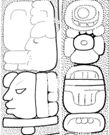
Zender-OtRoTCMPG.p11.pdfp11.fig8e = Grube-TLJ.p4.pdfp4.fig7 Grube-TLJ.p4.pdfp4.fig5
K1383 (RAZ) OXP Stela 5
IX.<ja:la:ma> IX:WAK ja:la:mi CHAN:na


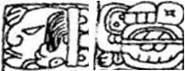

Grube-TLJ.p3.pdfp3.fig4b = MHD (Graham) = FAMSI (Montgomery) = (lost reference)
YAX Lintel 41 D1-D2
<IX[KAL{oomte’}]>.6 <ja[la]:ma>.<CHAN:AJAW>
· It’s the syllabogram-only spellings of jalam found and presented in Grube-TLJ which are the “substitutions” required to enable the decipherment of the logogram JALAM. In particular, the logogram spelling in YAX Lintel 5 D1-D2 (IX 6.<*JALAM:CHAN>) and on YAX Lintel 41 D1-D2 <IX[KAL{oomte’}]>.6 <ja[la]:ma>.<CHAN:AJAW> refer to exactly the same person – a noblewoman from Motul de San José (in both cases, her extended title ends in Ix Ik’a’ Ajaw), second wife of Kokaaj Bahlam IV, a ruler of YAX. This is the most exact form of “substitution” there is (exactly the same individual or thing), enabling us to know that the logogram is read JALAM.
· YAX Lintel 41 D1-D2: the la infixed in the ja is visible in the Grube-TLJ drawing and the photo, but not on the other drawings, where the artist perhaps thought that the dots of the infixed “upside-down la-face” were just the eroded remnants of the three diagonally running, non-touching dots commonly found in the “bay” of ja.