
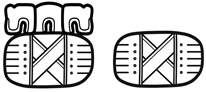
MHD.ZBD 2042bv 2042bb
IHKATZ IKATZ IKATZ
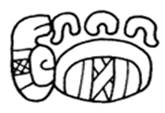
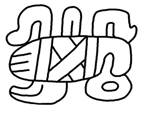
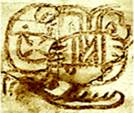
MHD (Martin) MHD (Looper) MHD (Kerr)
CLK Ear Ornament #2 glyph-block C K1505 A1 K4340 L
yi.IKATZ yi+IKATZ <<EL?[K’IN]>:*ni>.<IKATZ:?>
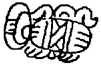

MHD (Villagra) Schele
PAL TI Ear Ornament glyph-block L PAL TI WT N4
yi.<IKATZ:?> K’UH{ul}.*IKATZ
· Features:
o Top: A trifoliate element, resembling the top (or reduced variant) of tzi:
§ Left: a wavy scroll with tip pointing left.
§ Middle: an inverted-U, bold.
§ Right: a wavy scroll with tip pointing right.
o Bottom: A boulder-outline with:
§ Optionally, bold walls and ceiling.
§ Two columns (vertical bands) dividing the interior into three parts – the left, some space between the two vertical bands, the right.
§ Crossed bands between the two columns.
§ The space on both sides of the vertical bands may be empty or have (hence, optionally) short, parallel, horizontal ticks, each tick ending (optionally) with a tiny dot.
· The dot is always on the “inside” of the boulder outline, i.e., to the right of the tick when the tick is on the left side, and to the left of the tick when the tick is on the right side.
· When the ticks and dots are present, it very much resembles (the boulder-only variant of) to/TOK.
o Optionally, perhaps, an additional element below the boulder-outline (K1505 A1, K4340 L, PAL TI Ear Ornament glyph-block L, PAL TI WT N4, see one of the cautionary notes below).
· For the slight variations in pronunciation, see the comments under the syllabogram-spelling.
· MHD has assigned ZBD as the 3-letter code for it:
o Reading: ihkatz / ihkaatz (I write ikatz, but this is just for convenience, following TWKM, not based on any detailed knowledge of or objection to why the initial i might be aspirated, or why the -a- might be long).
o Meaning (from the MHD Catalog): “bundle”, “burden”; “precious stone”.
· MHD statistics (2026-01-25):
o “blmaya1 contains ihkatz” – 32 hits.
§ … and “blengl contains precious stone” – 27 hits, vs.
§ … and “blengl does not contain precious stone” – 5 hits.
The 5 hits where ihkatz is not translated as “precious stone” are where it’s in a personal name (Ix Ihkatz, Ix K’iinil Ihkatz, and Kit Pa’ Ihkatz) and MHD does not “translate” personal names.
o “blmaya1 contains ihkatz” – 32 hits.
§ … and “blcodes contains ZBD – 5 hits, vs.
§ … and “blcodes does not contain ZBD – 27 hits.
Visual inspection of the 27 hits where the logogram ZBD = IHKATZ is not used to write the word ihkatz reveals that they are all syllabogram-only spellings. This means that there is no other logogram that is also used to write the word ihkatz.
o The fact that there is a breakup 27/5 and 5/27 in the above sets of queries is pure coincidence. It’s not the case that the 5 occurrences where Ihkatz is a personal name are the same 5 occurrences where ihkatz is written with a logogram. In fact, there is no correlation at all: all 5 occurrences of Ihkatz are a personal name are written with syllabogram-only spellings.
o Meaning of the logogram:
§ In the MHD Catalog, ZBD is given the meanings “bundle”, “burden”, ““precious stone”.
§ However, MHD translates ZBD uniformly as “precious stone(s)” in the inscriptions themselves, i.e., in context, the two other listed meanings of ZBD are not used.
o “blcodes contains ZBD” – 5 hits:
§ CLK: 1 hit.
§ Ceramics: 2 hits.
§ PAL: 2 hits.
This shows that ZBD is quite a rare logogram – most instances of the word ikatz are written with a syllabogram-only spelling (including all the personal names).
· Cautionary notes:
o Bonn’s example, 2042bb is given without the trifoliate “crest” at the top. This sows a slight seed of doubt as to whether that crest might be an end phonetic complement (the reduced form of tzi), rather than an integral part of the glyph.
§ It is unusual for an end phonetic complement to be on top of the logogram it complements, but, on the other hand, the shape of the reduced tzi makes that the most obvious position to place it.
§ I believe there are examples of tzi functioning as an end phonetic complement, where it occurs below the logogram it complements. In such cases, it retains the orientation it normally has (the middle element remains an inverted U). This indicates that that reduced form is seen as a form in its own right, rather than being attached to the boulder-outline main part, hidden by the logogram it’s complementing.
o Of the 5 known examples of the logogram for IKATZ, four of them have some glyphic element(s) under the boulder outline (see examples above):
§ K1505 A1 and PAL TI WT N4 have an element that resembles a wa.
§ K4340 L has an element that resembles a ka-comb.
§ PAL TI Ear Ornament glyph-block L has an element which very slightly resembles a “double ka-comb” or perhaps a “butterfly”/“bowtie” (while almost definitely not being either).
They appear to be considered non-essential (= “decorative”) parts of the logogram (i.e., not contributing anything to the text, neither semantically nor phonetically), as MHD doesn’t transliterate anything after the IKATZ logogram in these instances.
o The MHD reading of IKATZ in PAL TI WT N4 may be “from context”, as there are very few of the distinctive characteristics of IKATZ present in N4b:
§ The element on top looks more like a “butterfly”/“bowtie” (if anything), than the trifoliate crest of the canonical form of IKATZ.
§ The boulder element has no crossed bands.
§ There’s a wa-like element below the boulder element.


JM.p93.#4 JM.p94.#1 JM.p84.#2
i.<ka:tzi> i:ka:tzi i.<ki:tzi>


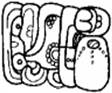
Schele Schele Teufel-PhD.p549
PAL TI CT A7 PAL TI CT A8 PNG Throne 1 A’1-B’1
i.<ka:tzi> i.<ka:tzi> u.<<chu[ku]>:wa>.<i.<ki:tzi>> or u.<<[ku]chu>:wa>.<i.<ki:tzi>>


YAX Lintel 1 K1 YAX Lintel 5 E1
i.<ka:tzi> *i.<*ka:*tzi>
· JM glosses this as “burden”, “load”, “tribute’ and gives short-a – ikatz.
· Stuart-VAMN.p499: … the term ikatz or ikitz, “load” or “cargo”.
· The variation in reading ikatz/ikitz is probably due to the variation in ka-tzi/ki-tzi, and the variation ikatz/ikaatz/ihkatz is probably due whether or not an epigrapher supports the Lacadena-Wichman rules for synharmonic and disharmonic spellings and the degree of confidence put into historical reconstruction based on Colonial Spanish and modern Maya cognates.
· In AT-E1168-lecture11.t0:07:21, in explaining a jade pendant from PMT, Tokovinine translates ikaatz as “precious jewel”.
· It occurs in PNG Throne 1 A’1-B’1, where a ruler Ha’ K’in Xook (Ruler 6) abdicated and fled after he “captured” (uchukuw) or “carried (away)” (ukuchuw) the ikitz – in this context interpreted as treasures belonging to the royal household / polity. The JM.p84.#2 example is quite possibly from this inscription. In the MHD translation (objabbr = PNGThr01), ikitz is rendered as “precious stones”.
· It occurs in PAL TI CT A7 and A8 in the context of chanal ikaatz, kabal ikaatz = “celestial and earthly bundles” (lost reference). Here, as in all other contexts where ikaatz occurs, MHD prefers the translation “precious stone”, yielding “celestial precious stone (and) terrestrial precious stone”. Neither translation results in a meaning that is very clear to me.
· It occurs in YAX Lintel 1 and YAX Lintel 5 not as glyphic text, but as a tag to the iconography. In each case, Yaxuun Bahlam IV is dancing with one of his wives (Lady Great Skull / Ix Chak Xim in the first case and Lady Six Sky / Ix Wak Jalam Chan in the second). The wife is holding a bundle, tagged as ikaatz.
· There are also proposals that it can mean “tribute”. LeFort&Wald-LNoNS32.p112.c2.para3 (1995): The main interest of this short text is that it mentions large quantities. These large numbers, forty and one hundred counted by multiples of twenties, are rare if not unknown in Classic carved inscriptions. This passage clearly refers to the offering or paying of objects in large quantities, likely material made of quetzal and jaguar, possibly as tribute as Stephen Houston has suggested, although the tribute reading for ikatz is still being debated among epigraphers. The basic meaning of ikatz is "burden, bundle" (Stross, 1988), and an alternative interpretation of this text as a reference to bundled offerings also is likely.