

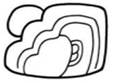
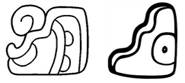

TOK.p17.r4.c1 BMM9.p13.r2.c4 IC.p37 MHD.ZY2.1&2 1717st
EHB EHB EHB

K&L.p27.#7
EB

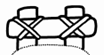
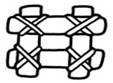


K&L.p27.#8 TOK.p7.r1.c3 TOK.p18.r4.c1 BMM9.p10.r2.c1 IC.p37
EHB EHB EHB EB EHB
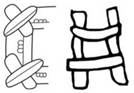
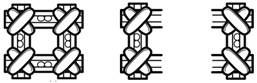
MHD.ZHC.1&2 0193bh 0193bl 0193br
· No glyphs given in K&H.
· Variants (2):
o A. Stairway – features:
§ Boulder outline, but there is a “stair” running upwards from left to right, making the outline more that of a triangle (with the acute angles in the bottom left and top right not very sharp, as there is a quite a lot of bottom left wall and top right ceiling).
§ Optionally with a ball (emphasizing that it’s a stairway as the ball can roll downwards).
§ Despite it being (presumably) a stone stairway, the “wood property marker” still often appears inside it.
§ A very stylized version exists, which approaches a (flattened) monster head (K&L.p27.#7.2&3).
o B. Ladder – features:
§ Full form:
· Four crossed sticks, lashed together by knots.
· The sticks form the perimeter of a square, except that the ends of the sticks extend slightly beyond the perimeter of the square.
· The “lashing” at each corner is indicated by a single set of crossed bands.
· The “sticks” can be plain “bands” (very elongated rectangles), or may have a wood property marker in them.
o When present, the two or three touching dots rest on a line which is perfectly straight (in contrast to normal wood property markers, where the line is usually slightly curved).
o Such a line in the “stick” of EHB (being perfectly straight), runs for the entire length of the stick, forming either a “spine” (IC.p37) or “reinforcement” for one of the “long” sides/walls of the stick (BMM9.p10.r2.c1, MHD.ZHC.1).
o When present, the other side/wall of the stick may also be reinforced (0193bh).
· Some forms are so simply that only the four “sticks” are present, no lashings or wood property markers (MHD.ZHC.2), but this is unusual.
§ Reduced form: half to two thirds of the full form, cut vertically (i.e., only the left or the right, never only the top or bottom).
· S&Z.#39.p107.l+1 explicitly says that both variants are read EHB: In Mayan languages, ehb means both “step” and “ladder” and this probably explains the two distinct forms of the EHB sign in Maya writing. The first is clearly the profile view of a staircase, a form frequently encountered in art. The second represents a lattice of lashed-together wooden poles seen from a frontal view.
· MHD statistics (2026-02-02) - a search in MHD on “objabbr contains …” gives:
o ZY2 (stairway variant): 29 hits, with some of them being possibly in the name of the TIK ruler Yax Ehb Xook.
o ZHC (ladder variant): 25 hits, with more than half being in the name of the TIK ruler Yax Ehb Xook.
I’m actually slightly surprised at these statistics. Instinctively, I thought the ladder variant was quite a bit more common (perhaps only because it’s memorable, because of its distinctive appearance).

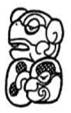
JM.p88.#3 IC.p37
e:bu e:bu