


K&H.p17.#1.1 ~ K&H.p81.#5 TOK.p21.r4.c4 BMM9.p16.r6.c1 JM.p67.#3 JM.p67.#2
CHUM[mu] CHUM CHUM CHUM[mu] CHUM[mu] <CHUM[*mu]:la>.<[ji[ya]>

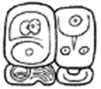

K&L.p35.#6 JM.p67.#4 JM.p68.#2
CHUM / CHUM[mu] <CHUM[mu].la>.<ji+ya> <CHUM[mu]:wa>.<[ni]ya>
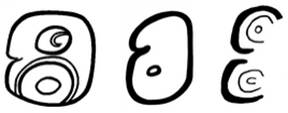
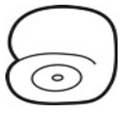
MHD.HTA.1&2&3 0644bt
CHUM

Coll-2
TRT Monument 6 H10 (‘D10’)
<<<CHUM[mu]>:wa>.ni>:ya
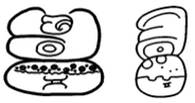
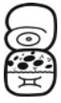
MHD.HTBa MHD.HTBb 0644bv
MEK’ CHUM CHUM

MHD.HL2
CHUM?
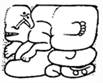
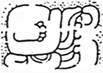
MHD (Stuart) MHD (Schele)
CPN Corte Altar pE CPN T11 North Door East Panel, Structure 10L11 C6
<?>.<CHUM?:mu:wa{n}> <CHUM?:wa>.ni.ya
· The iconographic origin of this logogram is the torso of a person sitting (without the head being portrayed). The bottom left is the thigh and knee of the person sitting cross-legged on the ground (e.g., common people or vassal nobles) or on a raised platform (e.g., the ruler).
· Glyph-block H10 of TRT Monument 6 is sometimes labelled as D10. This is because there was once an older (incorrect) system of glyph-block labelling, where the missing columns A-D were not labelled at all (they being completely missing), and the “real” column E (and onwards) was labelled as A (and onwards), resulting in column letters being 4 lower than they should be. Hence the incorrect labelling, under the older system of D10 instead of H10. The correct labelling (with the missing columns A-D) is deduced from the symmetrical T-shape of the total glyphic text of the inscription, where the left side of the T-shape (column A-D) is completely missing).
· JM.p67.#2 have a slightly unusual way of writing the -jiiy verbal inflection. Normally, it’s written as a conflation <ji+ya> where three of the “horseshoes” of the “four horseshoe” variant of syllabogram ji remain, while the fourth (an “internal” horseshoe, not the one on the left or right, usually the third from the left) is replaced by the smaller, “internal” dots of the middle of the syllabogram ya. (Occasionally, a slight variant of this is to have just two horseshoes of the ji on one side and the central dots and one longer, flowing “leaf” of the ya on the other.) Here, in JM.p67.#4, however, we see that apparently only the right “leaf” / element of syllabogram ya is present (at the bottom right, in JM.p67.#4), while the “animal paw” variant of the syllabogram ji replaces the rest of syllabogram ya (on the bottom left, in JM.p67.#4). At least, that’s one way of reading it.
· Variants (3):
o A. Complex (two-element) variant:
§ Top: the torso and bent leg of a person sitting cross-legged on a flat surface.
§ Bottom: a cushion the person is sitting on:
· Top: jaguar spots of the jaguar pelt covering the cushion.
· Bottom: the rest of the cushion with a po-like element, perhaps representing the dimple in the middle of the cushion, where there is sometimes a button, in modern cushions.
This is a very obscure variant (see statistics below). MHD even gives it two different readings MEK’ = “embrace” and CHUM = “sit”.
o B. Simple (one element) variant:
§ Just the top part of the complex variant – the sitting person – without the cushion.
§ An interesting aspect of CHUM is that it very often has the syllabogram mu infixed, as an end phonetic complement:
· When present, it’s placed in the centre of the top half of the glyph.
· Both the full (“head and scroll”) and the reduced (“scroll only”) variants can be found infixed in this way.
o C. Footprint variant:
§ Boulder outline: left fist with thumb pointing upwards.
§ Inside: A “footprint” with toes pointing to the right.
This is a very obscure variant (see statistics below), from only one site. Furthermore, the reading is only tentative anyway, from context.
· MHD statistics (2026-03-05):
o A. Simple (one-element) variant (HTA): 258 hits – of the 250+ hits, a considerable number have infixed mu, either full or reduced, as end phonetic complement:
§ Full mu: ~75+ hits.
§ Reduced mu: ~75+ hits.
§ No mu: ~35+ hits (includes a few with a mu end phonetic complement outside (to the right of) the CHUM.
§ Indeterminate: ~25+ hits.
§ No image: ~25+ hits.
Note that all figures are extremely approximate. Some eroded element in the middle of the top could be a full mu, reduced mu or not a mu at all. For example, a crescent with the tips pointing upwards was seen a number of times, and so eroded forms of that are hard to distinguish from an infixed mu. The very approximate nature of the counts does not detract from the usefulness of doing this counting exercise: these are just figures to give a ballpark feeling for how often there’s an infixed mu. 75 + 75 = 150, and 150/250 = 60%. So, more than half the occurrences of CHUM have an infixed mu as end phonetic complement – surely considerably higher than end phonetic complements for other logograms (except for ni beside TUUN, but that is never infixed). This confirms our subjective feeling that this infixing is quite common for CHUM.
o B. Complex (two-element) variant (HTB): 3 hits only (two from PAL, considered to be MEK’, and one from BPK, considered to be CHUM; only the CHUM example is given above).
o C. Footprint variant (HL2): 2 hits only (both from CPN, the reading of CHUM is tentative, based on context; both given in the examples above).
For all practical purposes, there’s only one variant of CHUM.