
AT-YT2021-lecture11.t0:49:24 = Zender-CaCiAMF.t0:21:39
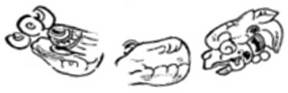
TIK MT 219 (lid of vessel with stucco covering) TIK Burial 195 Stucco Drinking Cup
yu.<[k’i]bi> ta CHIH yu.<[k’i]bi> ta CHIH
mayavase.com
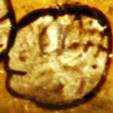
K1092 Z1
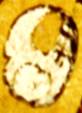
CHIH
· Chih = “pulque” is an alcoholic beverage made from the fermented sap of the maguey (agave) plant. Do not confuse this with the phonetically similar:
o chij = “deer”
o chik = “coati”
· Do not confuse pulque with atole, which is maize gruel – pulque is alcoholic while atole is not.
· Loughmiller-DtUFaPoCMCC.p7.fig4 renders this as chiih, with long-i.
· AT-YT2021-lecture11.t0:49:50 (discussing TIK MT 219 / TIK Burial 195 Stucco Drinking Cup): “This is a logogram for pulque – chih. It looks like a skull with big maguey leaves. So we think of pulque as a skeletal being because it’s buried in the ground, very much like the rhizomes of water lilies. And it dies, and then it ferments, and then you basically collect it, from the dead body of the pulque [plant]”.
· Zender-CaCiAMF.t0:21:39-22:25 (discussing TIK MT 219 / TIK Burial 195 Stucco Drinking Cup): These are the remains of a stucco drinking cup. And I think it was first pointed out by David Stuart that the text here records yuk’ib ta chih = “his cup for pulque”. And here instead of using the chi syllable – the hand that many of you recognize – there’s another syllabic sign which is in fact that skull with maguey fronds coming off of it; that’s the syllabic sign first recognized because of its substitution with the plain chi hand, but present here quite clearly. Potentially, it’s also the logogram CHIH for “pulque” since that’s what it depicts, but there’s no doubt that there’s many contexts in Maya art from this time that use it as just a syllable. If so, then it’s a syllable that originates from the word for maguey products, specifically, in this case, pulque proper.
· This is the “philosophical problem” of whether to read a glyph as a logogram or a syllabogram, when the word the logogram (perhaps) originally represented ends in a weak consonant and that glyph became used (by the acrophonic principle, without the final consonant) to write the syllabogram. In the contexts where the word intended is the “logogram’s” original meaning, one could just view the glyph as either the logogram itself, or as the syllabogram that it ended up as being (most of the time).
o In the former case, the final consonant is present in the logogram, and if another glyph follows to write it (= the final consonant), then it can just be considered as the optional end phonetic complement, present in that case. Otherwise, if not present, no such glyph is needed, as end phonetic complements are optional anyway.
o In the latter case, if another glyph follows to write it, then it can just be considered as just the fully syllabogram-only spelling of the word. Otherwise, the word is just underspelled.
· The two approaches result in exactly the same word being read, just a different way of viewing the situation. Zender-CaCiAMF.t0:21:39-22:25 above only suggests the first possibility, without strongly advocating for it. Personally, I think that it makes sense to read it as a logogram, in the situations where the glyph does happen to write the original meaning, but that’s a matter of taste. Both MHD and Bonn appear to have decided not to do this (in this instance, not in general), as both only recognize a syllabogram chi for this glyph. This is probably because the glyph with visible agave leaves is so rare that it just isn’t worth declaring a logogram for it (the form with the skull only is more common, but that has fewer arguments for being considered a logogram).
· EB1.p50.pdfp55.#6 chih (2) n. “pulque” gives references to seven examples, but considers them all (even the head/skull variants) to be pure syllabogram spellings. See below, under the syllabogram spelling of chih, for further details.
· The example from CPN Altar U I2-J2 is a detail from a photograph by Günther Eichhorn (guenther.eichhorn@gmail.com), found at: https://www.aerobaticsweb.org/images/HONDURAS/Honduras_0409_1536x1024.jpg.


AT-E1168-lecture6.t0:07:30(.9)
chi:hi



mayavase.com mayavase.com mayavase.com mayavase.com
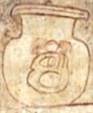
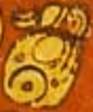
K732 K1092 R1 K1092 Y1 K4481
chi:hi chi:hi chi{h} u.<chi:hi>
· EB1.p50.pdfp55.#6 has “chih (2) n. pulque” with references to seven inscriptions, including K717, K732, K1092, and CPN Altar U I2-J2.
o I am unable to locate the chih written on K717.
o EB1 considers CPN Altar U I2-J2 to be syllabogram chi (the “head variant”), but it could (perhaps better) be considered to be the logogram CHIH.
o On K732, chi-hi is written as a label/tag on the iconography which shows a large, “lipped” vessel standing on the ground.
o There are three occurrences of the word chih on K1092:
§ K1092 R1 is in among the glyphs labelling the iconography. It’s the third glyph-block in a (rotated) L-shaped formation, between the two standing youths who are trying to help a third very drunk youth stand up.
§ K1092 Y1 and K1092 Z1 are two tags on the two long-necked vases with a tag labelling each as a container for chih. EB1 considers K1092 Z1 to be syllabogram chi (the “head variant”), but it could (perhaps better) be considered to be the logogram CHIH.
· There are contexts where the head variant only represents the sound chi (chi-, -chi-, -ch(i)), in which case it’s clearly a syllabogram. But there are also contexts where it represents the word for “pulque” = chih. In the latter case, it could still be considered to be a syllabogram chi which underspelled {-h} or it could simply be considered to be the logogram CHIH. See above, under logogram CHIH, for further details.