
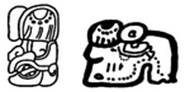
K&H.p48.pdfp50.#2.4 = 25EMC.pdfp30.#9.1 = 25EMC.pdfp4.#2.2 25EMC.pdfp4.#2.3&4
BULUCH / BULUK BULUCH / BULUK


TOK.p23.pdfp23.r4.c4 MHD.PN3a 1005st T1005a
“11” / buluk BULUCH / BULUK BULUCH -

MHD (Kerr)
K1837 PSS-M
20.11

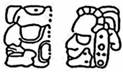

TOK.p24.pdfp24.r4.c3 PM6 1736st
? BULUCH BULUCH
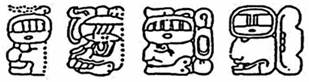

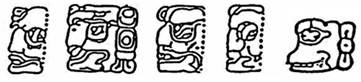

MHD (Mathews) MHD (Schele?) MHD (Schele?) MHD (Schele?)
BPK Sculptured Stone 1 C1 PAL T18 Stucco, Bodega 174 436 PAL T18 Stucco, Bodega 174 451 PAL T18 Stucco, Bodega 174 513
<12:HEEW>.<11:WINIK> 11.IMIX 11.<IHK’:SIHOOM:ma> 11.<1:WINIK:<ji+ya>>
· Variants (2) – KAB-based and LEM-based:
o KAB-based:
§ No glyphs given in K&L (2018), BMM9 (2019), but given in K&H (2020), TOK (2017), 25EMC (2020).
§ TOK.p23.r4.c4 (2017) gives only “11”, but buluk given in AT-E1168-lecture6.t0:39:45 (2015-2016) in connection with the bar-and-dot notation.
§ Both MHD and Bonn give it, with a reading of BULUCH (MHD also gives BULUK).
§ Note that one of the KAB-based examples has a LEM at the top (MHD.PN3a) though this is not intended (by MHD) to be a defining characteristic of this glyph – the conflated KAB in the anthropomorphic head is the defining characteristic.
§ This glyph is basically the animated variant of KAB = “earth”:
· At least one “pond” (the one in the top left) is present, often with the second “pond” (the one in the bottom right) also present.
· These ponds will typically be cross hatched.
· When present, the “pond” usually has its squiggly protector (the top left one with the protector on the right; the bottom right one with the protector on the left). (1005st shows an example with a bottom right “pond” without its squiggly protector.)
§ AT-E1168-lecture6.t0:50:11: “11” and “12” are a total mystery, “2” is a total mystery; as far as I know [in terms of the reason for their particular (god-)head variants]. [Sim: see under “12” for some comments on this.]
o LEM-based:
§ No glyphs given in K&L (2018), K&H (2020), BMM9 (2019), 25EMC (2020).
§ TOK.p24.pdfp24.r4.c3 (2017) lists it, but without pronunciation.
§ Both MHD (current) and Bonn (current) give it, with a reading of BULUCH.
§ There are not that many occurrences of this variant (4). In the MHD corpus:
· They come from only two sites: BPK and PAL.
· Even from PAL, they only occur in one monument – the Temple 18 stuccos.
· They seem to be very clear, both visually (they are not eroded) and in terms of meaning (they’re easily known to be “11” from context, as they occur in a DN or as a coefficient of a day-name in the Tzolk’in or of a month-name in the Haab calendar).
· The above patterning suggests that the KAB-based glyph was deciphered earlier than the LEM-based one, indeed, that the reading/meaning of the LEM-based one is relatively recent, as it’s only given in the “dynamic” databases of MHD and Bonn, but not given in the older (“static”, printed) pedagogical works.
· Overall usage statistics for “11” (2025-09-07) – total number of times “11” is written in the MHD corpus is 610 = 594 + 12 + 4:
o Bar-and-dot (“blcodes contains 011”): 594 hits (594/610 = 97.38%).
o KAB-based head (“blcodes contains PN3a”): 12 hits (12/610 = 1.97%).
o LEM-based head (“blcodes contains PM6”:) 4 hits (4/610 = 0.65%).
The fact that the head variants are used as little as 3% of the total number of times “11” is written is perhaps not surprising. This is about the same percentage as with “12” (see next entry).