


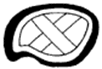

K&L.p43.#1.1&2 TOK.p11.r1.c2 BMM9.p11.r3.c4 JM.p36.#4 = 25EMC.pdfp29.#9.1 25EMC.pdfp29.#9.2
AT AT AT AT AT
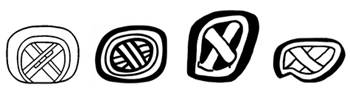


MHD.XQBa.1&2&3&4 0552st T552
AT ta AT -


MHD.XQBa.5 0304st T3042
ta - -
· No glyphs given in K&H.
· Used as a rebus in words like chakat, ihk’at, (y)atan.
· Do not confuse with AAT = “penis”, which has a long-a, while this has a short-a.
· Variants (2):
o Boulder outline:
§ Outline can be:
· “symmetric cave” (K&L.p43.#1.1, BMM9.p11.r3.c4, 25EMC.pdfp29.#9.2, MHD.XQBa.1, T552), or
· “tv set” / “cartouche” (K&L.p43.#1.2, MHD.XQBa.2&3, 0552st), or
· Codex “bird (head) with beak” (JM.p36.#4 = 25EMC.pdfp29.#9.1, MHD.XQBa.4)
§ Inside:
· Crossed bands.
o U-shape:
§ A U-shaped outline (vertically rectangular, boulder-outline, open at the top).
§ Almost the entire inner region is darkened.
§ (White) crossed bands in the darkened region.
· MHD views the U-shaped form as merely a sub-variant of the boulder outline (MHD.XQBa.5 vs. MHD.XQBa.1&2&3&4) whereas TWKM gives it a totally different code (0304st vs. 0552st).
· According to MHD, only the boulder-outline is found in the Classic period, whereas all three forms (boulder outline, U-shape, and “bird head”) are found in the Codices. In the Classic, it had only the reading AT, but in the Codices, it can have either the reading (as a logogram/rebus) AT (boulder outline, bird form) or (as syllabogram) ta (U-shaped form). TWKM agrees that the boulder-outline is AT, but doesn’t assign a reading to the U-shaped form.
· Almost all teaching resources give this as a logogram of unknown meaning (used as a rebus). However, MHD glosses XQBa as meaning “bathe”. There are 300+ occurrences of the use of this glyph (“blcodes contains XQBa”, 2026-02-12, “Classic - Blocks” only). However, after the exclusion of occurrences of XQBa used to write chakat, ihkat, atan, Yopaat, as well as excluding instances where the reading of the presence of at is doubtful anyway (“bllogosyll does not contain at?”) or where the transcription isn’t known (“blmaya1 not equal to _” and “blmaya1 not equal to ??”) there were only 5 hits left, none of which (to me) seemed to very strongly suggest meanings associated with bathing. Even if there were, it might better to view these as one-off uses of the AT logogram (of unknown meaning) as a rebus to write a word related to bathing, rather than that the logogram itself has an intrinsic meaning of “bathe”. That seems more likely to me, than that a logogram of distinctly known meaning (= “bathe”) is used as a rebus to write to many other words.