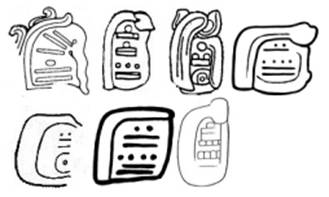


K&L.p21.#3 TOK.p18.r5.c2 BMM9.p13.r2.c1 25EMC.pdfp29.#8.1
AN (a’n) AAN AN AN
25EMC.pdfp29.#8.2&3&4&5 = K&L.p21.#3.6&1&2&3
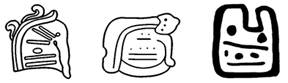

MHD.ZT7.1&2&3 1641st
AN A’N


Stuart-TCZ.p2.fig3 (Stuart) = MHD (Grube) = MHD (MHD Archive)
PMT Panel 7 Jamb 3, Dallas Museum of Art 1968.39.FA
a.A’N
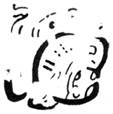
MHD (Houston/Montgomery)
BPK Mural E’1
*u.<BAAH+AAN>:hi{l}


Tokovinine Tokovinine
NAR Stela 46 E2 NAR Stela 46 E6
u.<<BAAH[AN]>:li> u.<<*BAAH[*AN]>:*li>


Coll-1 Coll-1
YAX Lintel 14 A1 YAX Lintel 14 G1
u.<BAAH[AAN]:hi:li> u.<BAAH[AAN]:li>


Graham Coll-1 Graham
YAX Lintel 23 K2 YAX Lintel 25 G1 YAX Stela 18
<a:AN>.<IX:*k’a[ba]:la> <u:BAAH[AN]:li>.<IX:{y}OHL:la> u.<<BAAH{il}[AN]>:nu>
· No glyphs given in K&H.
· Not in EB1, but K&H, K&L, BMM9 (the “descendent” dictionaries of EB1) all give “unripened maize” – used as part of impersonation expressions as a verb a’n “to be, exist”.
· Features – it appears to be the stem / trunk of a plant on the left:
o Going straight upwards on the left of the glyph, with slight narrowing as it goes upwards and towards the right, at the top of the glyph.
o It ends with a heart-shaped, leaf-like element, pointing to the right – occasionally even slightly downwards (25EMC.pdfp29.#8.3).
o If the entire glyph is a rather squarish (= as wide as it is tall), then the turn to the right of the trunk can be quite sharp – almost 90 degrees; but if the entire glyph is more of a tall rectangle (= taller than it is wide), then the turn to the right of the trunk can be quite gentle (especially if the top/tip of the trunk doesn’t go all the way to the far right of the glyph).
o The trunk has optional bolding on the right or a spine.
o Optionally (very occasionally), 1-2 heart-shaped leaves coming off the trunk, but only on the left (on the “outside” side of the glyph), never on the right (on the “inside” side of the glyph), as that space is occupied by the “bars and dots” which are the distinguishing characteristic of A’N.
o Because this trunk forms an “inverted-L”, there will be a “large empty space” to the right of the vertical, lower part of the trunk and under the horizontal, upper part of the trunk. This space is filled with a few (2-5) numbers in the “bar-and-dot” notation.
§ These numbers are never read out – they do not add anything to the logogram, neither semantically nor phonetically.
§ They’re only there to show that this is the logogram A’N (see next point).
· Do not confuse A’N with the visually very similar full form of LAKAM. They both have the large trunk on the left, going up and to the right at the top, ending in a heart-shaped leaf pointing right:
o A’N always has “bars and dots” – this is the distinguishing characteristic of A’N, which LAKAM never has.
o A’N seems to (optionally) have leaves only on the left on the trunk, never on the right, and even then, much fewer leaves than LAKAM.
· Often reduced to just a few bars and dots infixed within BAAH, when writing ubaahila’n.
· YAX Lintel 23 K2 seems to be one of the few instances of A’N not in connection with ubaahila’n. It’s unclear what it means in this context. MHD appears not to know either, as the blengl is given just as “??”.
· Even in the very well-known context of ubaahila’n, the true meaning isn’t that clear to me. Traditionally it was translated as “(in) impersonation of”, “(in) impersonating”. Some epigraphers prefer “personification of”. I suppose, literally, ubaahil = “the image of” + “existing” somehow results in the meaning of “personification of” (or “impersonation of”).
· More information:
o There are three related works devoted solely to the topic of ubaahila’n (two of them very lengthy):
§ López-LPdDySSdY:
· A 23-page paper.
· Published in 2016.
· Has the title: Las Personificaciones de Dioses y Seres Sobrenaturales de Yaxchilán.
§ LópezOliva-PhD:
· A PhD thesis of more than 800 pages.
· Published in 2018 with an electronic version in 2019 (whatever that means).
· Has the title: Las Personificaciones (?UB’AAHIL ?A?N) de Seres Sobrenaturales entre los Mayas de Tierras Bajas del Clásico.
§ LópezOliva-LPdlSSM:
· A commercially available book of more than 400 pages.
· Published in 2025.
· Has the title: Las Personificaciones de los Seres Sobrenaturales Mayas - La Deificación de los Gobernantes y la Encarnación de los Dioses en el Periodo Clásico (250-900 D.C.).
o The first one covers only Yaxchilan, while the last two are much more general.
o The last two have very similar titles, and I would surmise that the latter is (at least partly) derived from the former. Examination of their contents pages reveals that both cover Yax Nu’n Ahiin and K’an Chitam, but the former covers K’inich Waw (which the latter doesn’t) while the latter covers Yik’in Chan K’awiil and Naranjo (which the former doesn’t). There are also other smaller differences in coverage.
o All three are in Spanish, and I would infer that the last is an important work on the basis of the fact that this is not an “everyday topic” and a publisher would be unlikely to bring out a book of sizeable proportions unless the original work had shown itself to be of high quality, well presented, etc in the first place.

Graham
NAR Stela 24 (right side) D4
a.nu
· The disharmonic spelling, with second syllabogram nu, is perhaps one of the reasons for the reading with a glottalized vowel.
· Note that EB1 reads this as anul (giving NAR Stela 24 E3-D4 as a reference) – EB1.p25.pdfp30.#2: anul n. “incarnate, embodied” » ’u-[BAH]hi-li ’a-nu > ubahil anu[l] [Sim: 1) In EB1, square brackets indicate underspelling, which means that EB1 reads anul instead of the more modern reading a’n.]