
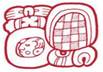
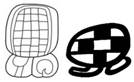

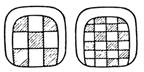
TOK.p15.r5.c4 MC.p118.pdfp119.r3.#1 MHD.ZD4.1&2 0594st T594a&b
? “GI” ? - -
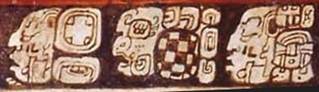
mayavase.com
K1941 I-J-K
IX.<K’AN:na> AHK?.<wa:“CB”>.yu IX.<MUT:la:AJAW>
· Features:
o “CB” (= “Chequerboard”) – there’s considerable variation in the size of the grid, not all of them are even square:
§ A 3 x 3 grid: T594a, PAL TI WT A6, PAL TS O6/F6 and PAL TS D6.
§ A 4 x 4 grid: TOK.p15.r5.c4, PAL TI ET B9, D12, and F10.
§ A 5 x 5 grid: K1941 I-J-K.
§ A 6 x 6 grid: 0594st.
§ A 3 x 4 grid (PAL Temple 19 Platform South Side)
§ A 4 x 5 grid: MC.p118.pdfp119.r3.#1, PAL TI WT A6 and PAL TI CT E7.
§ Other (many more squares): MHD.ZD4.1, 0594st, and T594b.
o TOK (TOK.p15.r5.c4) and Bonn (0594st) treat only the chequerboard itself as the glyph whereas MHD (MHD.ZD4) considers the wa-like element at the bottom to be an integral part of the glyph.
· The pronunciation and meaning of “CB” are unknown.
· Do not confuse “CB” with some variants of PAKAL. They resemble one another because some variants of PAKAL can also have a “chequerboard”. However:
o Context and the presence of a circle at each of the corners can determine PAKAL, as “CB” never has a circle at each of the corners.
o “CB” has bold walls and ceiling, which PAKAL never has.
o “CB” can (and often does) have a wa-like element at the bottom, never present in PAKAL.
· God-GIII of the Palenque Triad has a very long, complex name, with many parts. The very last part consists of K’INICH and then two glyphs, both of which have not yet been deciphered.
o Very last part (Part 1):
§ This glyph has been assigned the code MHD.PY2 by MHD and 0239st by Bonn.
§ Neither MHD nor Bonn have given it a reading or a meaning.
§ I have given it the nickname “MNA” = “Maybe Not Ajaw”.
§ For more information, see “MNA”.
o Very last part (Part 2):
§ This glyph has been assigned the code MHD.ZD4 by MHD and 0594st by Bonn.
§ Neither MHD nor Bonn have given it a reading or a meaning.
§ I have given it the nickname “CB” (= “Chequerboard”).
§ “CB” often appears with a wa-like element at the end, but this is optional.
· Order of reading in the deity name:
o The “CB” glyph occurs most frequently as the last part of the name/title of God-GIII of the Palenque Triad. While his full name is very long, it is often shortened to just this glyph (“CB”), with an AJAW-like glyph (“MNA”) above or to the left of it, the two glyphs being preceded by K’INICH.
o The naïve approach would be to read “MNA” as AJAW, and to view the wa-suffix as its end phonetic complement (even though it’s attached to the “CB” rather than the “MNA”).
§ This may not be correct – that is to say: “MNA” might not be AJAW (hence the nickname “MNA” / “Maybe Not Ajaw”).
§ If “MNA” isn’t AJAW, then the wa-like element associated with “CB” might not be a wa. Instead it might be just an integral part of “CB”. [I’ve written a wa In the transliteration under the examples above just out of force of habit. But my gut feeling is that the MHD approach is the right one, and no wa should be transliterated as it’s simply part of the “CB” glyph.]
o The order of reading the two glyphs (“MNA” and “CB”) is then thrown into doubt, in the sense that it’s mainly a reading of AJAW (for “MNA”) which would cause us to read “MNA” after “CB”, despite it being above or on the left of it. If “MNA” isn’t AJAW, then it might well be read before “CB".
· K1941 J is slightly aberrant:
o It’s one of the few instances of “CB” without an “MNA” to its left.
o The element which resembles wa is at the top instead of the bottom.
o The syllabogram wa normally consists of two circles – one circle with a “bay” on the “far” side of the circle and the other circle with a “bay” on the “close” side of the circle (“far” and “close” being viewed in relation to the main sign). The circle with the “bay” on the “close” side can optionally have two slightly angled struts between the “bay” and the circle (the way yi does). A subvariant of wa consists of one circle with a “bay” on the “far” side of the circle and an L-shaped element with the “bay” on the “close” side, i.e., one of the circles (the one with the “bay” on the “close” side) is replaced by an L-shaped element. However, the wa-like element in K1941 J is not like either of these variants of wa. Instead:
§ The circular element on the left appears to have its “bay” in the middle of the left wall.
§ The circular element on the right appears to have a “bracket” inside. This superficially might make it seem like the L-shaped element of one of the subvariants of wa, but that’s incorrect. In the case of the L-shaped element, the “leg of the L” points to the “outside” of the glyph (so that the “outside” of the glyphic text is contiguous with the “area ‘enclosed’ by the L”), whereas in K1941 J, the “L” points to (and touches) the left element (so that the “outside” of the glyphic text is cut off from the “area ‘enclosed’ by the L”.
o I think all this is supporting evidence for the idea that the wa-like element associated with “CB” is not an end phonetic complement of AJAW, but instead an integral part of the “CB” glyph.
· For further examples of “CB”, see under “God-GIII”, which shows many examples of the most common usage of “CB”, namely as the very last part of God GIII’s name.