| CMGG entry for syllabogram ta
|
|
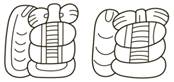
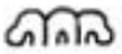
Variant: flint
MC K&H JM TOK.p6.r2.c1 MHD.1B1.3&4&5 0103ex
MC K&H TOK.p6.r2.c2 MHD.1B1.1&2 0103st
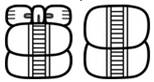
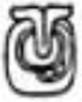
· Features – a flint outline (ovalish / rectangular glyph), with: o A single or double band running down the middle, in the direction of the short axis. § The single band can have either one or both sides bolded, the double band less so. § The band(s) “bind” a single (e.g., MHD.1B1.3&4, 0103ex) or double (e.g., MC, K&H. etc) flint outline (ovalish / rectangular) element with the same long axis as the long axis of the glyph. Then this internal element is doubled, they don’t touch. § The “bound” elements are optionally cross hatched (TOK.p6.r2.c2, MHD.1B1.1&2&3, 0103ex, 0103st), and may be either be completely clear of the boundary of the glyph (most of the examples above), or each element may touch its respective side (TOK.p6.r2.c2, 0103st) · There are 2 subvariants: o A. A single “bound” element, or o B. A double “bound” element. · Do not confuse this “flint” variant of ta with the visually similar “flint” variant of ki. o They are both flint outlines, with a single or double band running in the direction of the short axis. o That single or double band appears to “bind down” something to the surface of the flint. All these “bound down” elements are also longish, with their long axis in same as the long axis of the actual glyph. o However: § ta has what appear to be one or two ovalish/rectangular elements bound down. § ki has what appears to be a “fork-like” element bound down (an illusion, but that’s what it looks like, nevertheless).
|
|
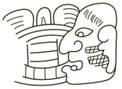
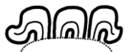
Variant: boulder
MC K&H JM TOK.p10.r5.c3 TOK.p14.r1.c2
MHD.YM2.1&2&4&5 0565st
MC.p159.c4.r1.6 MHD.YM2.3 0565hh
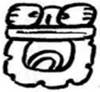
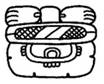
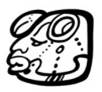
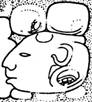
· Subvariants (2): o A. Boulder: § A “three-bump” horizontal line dividing the boulder roughly in 1/3 (bottom) and 2/3 (top). § A bold ceiling. § In the centre of the top 2/3’s, two slightly curved bands (curved pillars) going from ceiling to the “three-bump” line – the two curved bands may optionally have very short horizontal bands between them, creating a “ladder”. § On the left of the bottom 1/3, a bold right feeler. o B. Head: § The distinctive elements of the boulder form are present in a “generic” anthropomorphic head. · Unfortunately, MHD doesn’t distinguish the head subvariant from the regular one, so it’s difficult to get statistics on their relative frequency. I would, however, imagine that the regular form far outnumbers the head form.
|
|
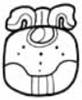
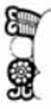
Variant: centipede
MC K&H JM TOK.p8.r4.c5 MHD.3M3.1&2&4
MC.159.c4.r1.5 TOK.p8.r4.c6 MHD.3M3.3
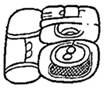
· Features: a long, rectangular outline, with the feelers, head, body, and tail of a centipede. · Subvariants (2): o A. The whole centipede lies parallel to the main sign: § Head: · Circle or circle with top of head bold or circle is a circle of tiny dots, or optionally absent. It can also be a short bar (rectangle) with a spine. · Two feelers at the end – can be bold feelers or non-bold feelers with or without a protector. § Body: · Single band on long axis of the centipede · Parallel ticks on both sides for the legs, perpendicular to the single band; no dots at the end of each tick § Tail: · Circle with dot in the centre, with a dotted circle between the central dot and the outside edge of the circle (= “washer” with dotted spine). Alternatively, a circle of tiny dots, with one dot in the centre (no spine). · The tail can optionally have two feelers also, reflecting the structure of real-life centipedes. o B. Body of the centipede goes into the main sign: § The very front (the “head”) and very end (the “tail”) are consistently outside the main sign. § In contrast, only part of the body is outside the main sign – this is either the part directly adjoining the head or the tail, not both. Due to the occasional difficulty of distinguishing the head from the tail, it’s sometimes unclear which part of the body this is. My general impression is that it’s the end part of the body rather than the front. § The visible part of the body emerges either perpendicular to the main sign or at an angle.
|
|
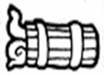
Variant: torch
BMM9.p6.pdfp6.c2.r1.6 JM.221.4 ta ta
MHD.2SAa.1&2 MHD.2SAs.1&2 1510bv T150 TAJ ta TAJ -
· This is not given in K&H, K&L, TOK, 25EMC. This suggests that the syllabogram reading as ta is fairly recent – reading it as the logogram TAJ is certainly given in K&H, K&L, TOK, BMM9, 25EMC. o MHD recognized ta and TAJ as readings very early on. o Bonn only TAJ (up to 2024 and some of 2025), but now also ta (after August 2025). · Also curious is that Thompson took the glyph to consist of only the “sticks bundled together”, without the “flames” (T150). This forced some epigraphers to describe the glyph with flames as T122:150, where T122 is the reduced variant of K’AHK’ = “fire”, with just two scrolls (one to the left and one to the right or one upwards and one downwards, depending on the orientation), as a way of “adding” the flames to the sticks – see MoraMarín-TOoMSaOC.p204.pdfp12.h immediately below. o This was probably because Thompson mistook the “plain bundled sticks” (T150a) to be a form of “BT” (“BONE-THRONE”), which are probably “bundled bones” (T150bc), but where T150a has no darkened / cross hatched areas while T150bc do. o Subsequent epigraphers were stuck with T150a belonging with T150bc and a clear separation / distinction only became possible with: § MHD’s creation of MHD.2SA (the “torch” glyph) and MHD.1B7 (the “bundled bones” glyph), with the explicit matching of MHD.2SA to T150a and MHD.1B7 to T150bc in the MHD Concordance. § Bonn’s creation of 0150st and 1510bv, with the implicit match of 0150st (the “bundled bones” glyph) to T150bc by dint of the “inherited” T-number and the totally “completely new” creation of 1510bv (the “torch” glyph) for the non-existent T-number corresponding to the TAJ logogram. · MHD statistics (2025-07-05) for the syllabogram (ta) vs. logogram (TAJ) use of this glyph: o A search in MHD on “blcodes contains 2SAs” (for the syllabogram) yields 34 hits. o A search in MHD on “blcodes contains 2SAa” (for the logogram) also yields (by coincidence) 34 hits. But this isn’t at all low, for logograms. · As syllabograms go, 34 is extremely low, especially for such a common sound. But other variants are used far more often (see below for overall usage statistics over all variants of ta. · Iconographic origin - this is actually just TAJ = “torch” used acrophonically / dropping the final consonant: o MoraMarín-TOoMSaOC.p204.pdfp12.h: T122:150 ta (iconically a pine torch) from a descendant of proto-Mayan *tyaj ‘pine/torch’ (Mathews & Justeson 1984).
|
|
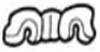
Variant: jellyfish
TOK.p16.r5.c3 MHD.AAG 1715st T155e ? ta - -
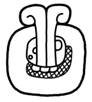
· Features – the outline is that of an inverted bold U, with: o A slight “flaring” of the ends of the two “legs” of the U. This inverted U hence has a “bay” in the middle of the bottom of the glyph. o At the end of each of the flared ends of the U, a series of very slightly curved parallel, more-or-less vertical ticks. o The entire U-outline may be bolded (1715st) or just the bottom part (T155e), or just the inside of the “bay” of the U may be reinforced (TOK.p16.r5.c3). o In any case, in the top half of the glyph, a “ladder” runs from the top of the “bay” to the ceiling of the glyph. · Looper&Polyukhovych-SICV (2022) is a recent paper which proposes the reading ta for this glyph. The argument presented sounds plausible, as the paper cites a newly photographed ceramic vessel (Mint Museum Bowl 1999.129.7), where ta-pa{aj}-{u}lu è ta paaj ul = “for sour/fermented atole” occurs in the PSS. It occurs in exactly the spot where ta <adjective> <food-substance> would be expected, in the highly formalized syntax of a PSS (e.g., in the formulaic phrase: yuk’ib ta (yutal) ixiim te’el kakao = “(the) drinking vessel for (fruity) maize-tree-type cacao of”). For this reason, the reading of ta for the “JELLYFISH” glyph seems to be quite acceptable. · Acceptance of the ta reading: o TOK (2017) lists it but doesn’t give a reading as it was published long before the proposed reading. o Bonn has separated out the “jellyfish” glyph (T155e) from the “floppy pear” variant of HUL (T155abcd) by declaring a 0155st (the “floppy pear” glyph) “inherited” from the old T-number, and a “newly created” 1715st for T155e (the “jellyfish” glyph). It is however more cautious, in not accepting a reading of HUL for 0155st and not accepting a reading of ta for 1715st (all of 2024 and the start of 2025). As of August 2025, Bonn gives the reading ta for the “JELLYFISH” glyph. o MHD has achieved the same separation, with MHD.1SJ for the “floppy pear” glyph and MHD.AAG for the “JELLYFISH” glyph. However, MHD is very progressive and has HUL and ta readings for the two, respectively (ever since the inception of the site, as far as I can tell). · This glyph was for a long time in a “transitional state”. I originally thought of it as an undeciphered logogram, and gave it the nickname “JELLYFISH”, with the idea that as the ta reading got accepted, the “JELLYFISH” nickname (and corresponding logogram) could be removed from the CMGG. This stage has been reached with the acceptance of the ta reading by Bonn. · Overall MHD statistics (2026-03-10). A search in MHD on “blcodes contains …”: o The “boulder” variant of ta (YM2): 789 hits. o The “flint” variant of ta (1B1): 704 hits. o The “centipede” variant of ta (3M3): 388 hits. o The “torch” variant of ta) (2SAs): 34 hits. o The “jellyfish” variant of ta (AAG): 3 hits. It’s perhaps slightly surprising that the boulder variant occurs more often than the flint variant, but they’re both at about the same order of magnitude, and about double that of the third most frequently occurring variant – the centipede variant.
|