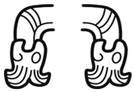
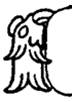
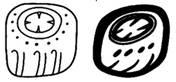
| CMGG entry for syllabogram t'a
|
|
Variant: o-like
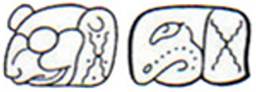
Gronemeyer-FtG.p2.pdfp2.fig1 = MHD (Grube) IKL Lintel 1 glyph-block B IKL Lintel 1 glyph-block 2 <t’a:ba>.yi
Gronemeyer-FtG.p3.pdfp3.fig3 Gronemeyer-FtG.p4.pdfp4.fig4b UXM Capstone Block C PNG Looted Altar Support A5b T’AB.<t’a:ba> t’a:T’AB[*yi]
Gronemeyer-FtG.p6.pdfp6.fig5a block #3 Gronemeyer-FtG.p6.pdfp6.fig5b XLM Lintel 1 Stone I Block C Museo Amparo Jamb B3 <bo:t’a>.ja <bo.ja>:t’a
Gronemeyer-FtG.p6.pdfp6.fig5c Gronemeyer-FtG.p9.pdfp9.fig9a&b T226
Dumbarton Oaks Ceramic
Vessel DO 114
A1
CHN Temple of the Four Lintels <bo.ja>:t’a t’a.<T226:li> -
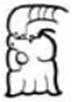
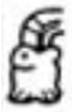
· Do not confuse this glyph with the visually similar o and TE’: o In Dumbarton Oaks Ceramic Vessel DO 114 A1 it looks slightly like TE’. o In CHN Temple of the Four Lintels A8 it does indeed look like o; however, o often has a cross hatched area at the far end of the feather, which is absent in this one. Gronemeyer himself says that this one is very tentative and might in fact be a o after all. If it is a t’a, then he proposes that the “depressed man” glyph be read T’AL, with t’a as an initial phonetic complement (otherwise read as PAAT by other epigraphers). · The variant of t’a which looks like o is still just a proposal, in Gronemeyer-FtG. · For CHN Temple of the Four Lintels, a system of glyph-block labelling which assigns only 4 columns and 4 rows to the whole inscription would result in the glyph-block with the proposed t’a (and depressed man / T226 glyph) being the bottom quarter of B4 (= B4d, as it were, with B4a, B4b, B4c, B4d being each a quarter of a glyph-block). With a system with 8 columns and 8 rows, it would be D8.
|
|
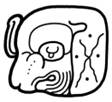
Variant: tooth + torch
TOK.p16.r4.c3 BMM9.p6.pdfp6.c3.r1 MHD.ZYB 1713st ? t’a? - -
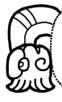
· Features: o The main part of the glyph is a “duckbill” shape – representing a “tooth” – with reinforced or bolded left wall and ceiling (optionally the right wall as well (1713st)). o There’s an element in the middle of the glyph which can be: § A “wood property marker” (TOK.p16.r4.c3), or § A medium-sized circle (BMM9.p6.pdfp6.c3.r1), or § A bold circle (MHD.ZYB), or § A dot (1713st). o On the left, “outside” the tooth, there’s the top half of a torch (the top of the bundle of sticks and two scrolls representing flames) sticking out at an angle. · TOK.p16.r4.c3 lists the “tooth + torch” glyph without pronunciation (and so there is no indication if it is a syllabogram or logogram), but BMM9 gives a tentative reading of t’a, with a question mark. · The original source of the proposal is not known to me (nor, indeed, do I know of any sources referring to this reading). Gronemeyer-FtG is a proposal for reading a hitherto undeciphered glyph as t’a, but not this one. Instead, it’s for the o-like glyph (see above). · Do not confuse this glyph (t’a?) with a whole set of glyphs with the “tooth” as the main outline of the glyph, but with various distinctive elements on the left: o chu has an “axe”. o ha has a “bone property marker”. o k’e has one end of a “bone”. o t’a? has a “torch” (this reading is still only a proposal). o ye has two or more “cascades of dots”.
|


 =
=