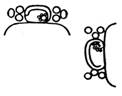
| CMGG entry for syllabogram si
|
|
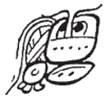
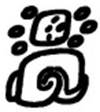
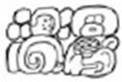
Variant: stylized beetle
MC K&H JM
TOK.p9.r2.c5 MHD.3M6.1&2 0057st T57abcdef
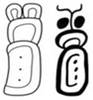
· Features – a tripartite glyph with: o Left – an ovalish / rectangular element, with: § Reinforcement of the ceiling and (optionally) left wall (and even more optionally, right wall)). § A row of three or more small, non-touching dots (canonically three, but sometimes more). o Middle: § A u-shaped “bracket” – a u rotated 90 degrees anticlockwise. § The u has, typically, reinforcement, either just at the “bottom” of the u (on the right because of rotation), or “bottom” and both walls. o Right: § A left and right scroll/feeler, each with its own protector. § As with other occurrences of a similar element in other contexts, the feelers themselves can “degenerate” to just single ticks (TOK.p9.r2.c5, 0057st). Alternatively, the feelers with protectors may manifest as double washers (JM) or double u-brackets (MHD.3M6.1). · Further comments: o The feature description above is from left to right, for a horizontal orientation, but this is a rotatable glyph, is also be found in a vertical orientation (e.g., TOK.p9.r2.c5, MHD.3M6.1&2, 0057st, T57ac) with the described elements going from bottom to top. o T57f is an unusual form, with an additional scroll-like element on the left. o While this is classified as a “rotatable” glyph, in the sense that it can occur in any of the four positions (left, above, right, below) relative to a “main sign”, it isn’t fully rotatable, in that the feelers never point downwards. I’m unsure if they point to the left, but all the examples above point to the right. o The “reinforced ceiling” is always on the side which is away from / opposite the “main sign”. o MHD.3M6.2 shows a (Classic, painted) form where the feelers don’t have a protector, but this is quite exceptional. · Do not confuse this with the visually similar tu: o si has three small non-touching dots in a row. o tu has cross hatched area (with optional face).
|
|
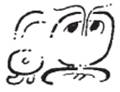
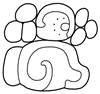
Variant: representational beetle
MC K&H JM MHD.3M6.3
· Features – a vertically rectangular, tripartite glyph consisting of: o Bottom: a “washer” – representing the body of a beetle or snail? o Middle: a 3/4-circle – representing the head of a beetle or snail? o Top: two “feelers” – representing the feelers of a beetle or snail? · Iconographic origin: o The “representational” variant is codical (only) and therefore postdates the “abstract” form, which is Classic. It’s a bit odd that this more representational form evolved from the more abstract form. Nevertheless, it seems plausible to me that the abstract variant is a stylized form of the body of a beetle or snail. o The MHD Catalog doesn’t venture a guess in this (or any other direction), giving only “?” in the “picture” field.
|
|
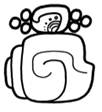
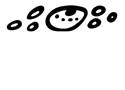
Variant: rat head
MHD.APC.1&2&3 1550st
Looper Graham QRG Stela F B8 YAX Lintel 10 D6 u:si?:<na/li> <u:si:ji>.<u:<[CHIT]CH’AB>:?>
· There is a rare variant, featuring a rat’s head. · Sergei Vepretskii: this [= the “rat head” glyph] is in fact a very rare form of si, making YAX Lintel 10 D6 usij uchit (u)ch’ab = “the child of”. This is cited in Kettunen&Helmke-RoB.p34.pdfp34.fig65i. · MHD statistics. A search in “Classic - Blocks” (2026-03-08) on “blcodes contains …”: o 3M6 (“stylized beetle”): 381 hits: o APC (”rat head”): 28 hits: 28/381 ~= 7.3%. We see that the “beetle” variant outnumbers the “rat head” variant by more than 1 in 10 in the Classic period.This confirms our own perceptions and Sergei’s explanation that the “rat head” variant is quite rare. · Just for interest’s sake, we can also look at the MHD statistics for “Codical – Blocks”. A search in “Codical – Blocks” (2026-03-08) on “blcodes contains …”: o “3M6 (“representational beetle”): 28 hits. § Note that this 28 is totally different from the 28 “rat head” variants of si in the Classic period. § The fact that there are 28 occurrences of the “rat head” variant of si in the Classic period and 28 occurrences of the “representational beetle” variant of si in the Post-Classic period is pure coincidence. o APC (”rat head”): 2 hits. 2/28 ~= 7.1%. Here too, we see that the “beetle” variant outnumbers the “rat head” variant by more than 1 in 10 in the Post-Classic period. Perhaps surprising is that the relative proportions of the two are so similar, but that could, again, be pure coincidence (of what survived, and what could be read of what survived).
|