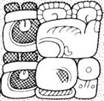
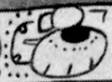
| CMGG entry for syllabogram sa
|
|
Variant: comb
MC K&H = K&L TOK.p13.pdfp13.r4.c1 BMM9 25EMC
MHD.XV4.1&2 0630bh T630
MC K&H = K&L JM TOK.p8.pdfp8.r2.c5 BMM9 25EMC 0630bl 0630br
Zender-BH.p4.Fig5b Zender-BH.p4.Fig5c CPN Temple 21a Bench CPN Temple 18 SW Jamb sa.ja (part of Yax Pasaj Chan K’awiil) sa.ja (part of Yax Pasaj Chan K’awiil)
MHD.XV4.3 T283abc
0630md 0630mt
Stuart-YM.p1.fig1a (Stuart) Stuart-YM.p1.fig1b (Stuart) PAL PT Q10 PAL Temple 21 Bench Edge glyph-block #10 sa.<mi:ya> sa.<mi:ya>
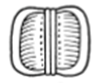
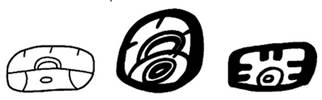
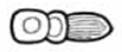
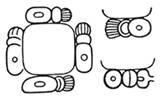
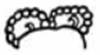
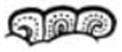
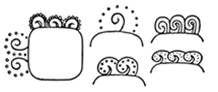
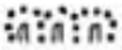
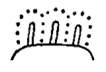
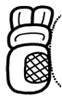
· Features – this is the “comb” variant of sa: o The “comb” has the typical bold floor, wall, and ceiling. o A series of parallel ticks – the “teeth” of the “comb”. o A dot at the end of each tick. · Subvariants (3+): o A. Full: § Double comb – “mirror image” symmetric. § Two bars in the middle, at the end of the “teeth, along the long axis of the comb (perpendicular to the teeth). o B. Reduced: § Single comb. § Two, one, or no bars at the end of the “teeth”. o C. Reduced, saw-edge: § Single “comb”. § The outline of the glyph at the end of the “teeth” is a saw-edge – this subvariant has no “bar” at the end of the teeth and dots of the “comb”. This appears to be a codical form, recorded by Thompson as T283. o D. Extended: § The full subvariant, “doubled” or “tripled” (stacked). § These variants are given by Bonn (0630md, 0630mt), not given by MHD. § Although the combs themselves are doubled or tripled, the vertical bars are not – they run all the way from top to bottom as a single, long, unbroken bar, not as doubled or tripled short bars. PAL PT Q10 and PAL Temple 21 Bench Edge glyph-block #10 are examples of them: PAL PT Q10 is the “tripled” variant (fully reduced to the left half only), while PAL Temple 21 Bench Edge glyph-block #10 is also the “tripled” variant (with only a very small part of the right side obscured by the glyph(s) to its right) – also the teeth of the comb have been reduced to nothing. Both have a “double bar” in the middle. · Despite its long, narrow outline, the reduced (sub)variant is not a “rotatable” glyph. Unlike the reduced variant of ka (the “ka-comb”) which is rotatable and can occur in any of the four positions (to the left of, above, to the right of, and below) a main sign, the reduced form of sa appears only to the left or right of a main sign (as far as I have seen). · Do not confuse the (“two-comb”) full variant of sa with tz’i: o tz’i has the bolding going all the way across the ceiling. o sa has a break caused by the double vertical bars. · Do not confuse the (“two-comb”) full variant of sa with the “boulder-only” (sub)variant of to: o to has crossed bands in the middle. o sa doesn’t have crossed bands in the middle. · Do not confuse the (“two-comb”) full variant of sa with the syllabogram su. The two only superficially resemble one another: o sa has two symmetrically placed “combs” with a double vertical band between them, and these bands are never curved. o su has only a single vertical band separating the two halves with “whiskers” – the band can be slightly curved, with two touching dots on one side, forming the “wood property marker”: § The “combs” of sa have a dot at the end of each tooth of the comb whereas su has no dot at the end of each “whisker”. § The double vertical bands down the middle sa are never curved, and lack the two touching dots associated with “wood property marker” down the middle of su.
|
|
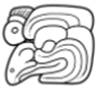
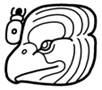
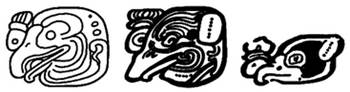
Variant: human head with KAB or UT/HUT infixed in the mouth
MC K&H K&L TOK.p24.pdfp24.r3.c4 BMM9 25EMC.1&2&3
MHD.PM1.!&2&3 1004st
T1004ab
MHD.PMA 1577st
MHD (Moholy-Nagy & W. Coe) MHD (Moholy-Nagy & W. Coe) TIK Temple 1 Burial 116, Bone, MT 38A H2-H3 TIK Temple 1 Burial 116, Bone, MT 43 glyph-block #2-#3 ja.<sa:wa> <k’o:cha:wa>.ni ja.<sa:wa> <k’o:cha:wa>.ni
MHD (Moholy-Nagy & W. Coe) MHD (Moholy-Nagy & W. Coe) TIK Temple 1 Burial 116, Bone, MT 44 glyph-block #2-#3 TIK Temple 1 Burial 116, Bone, MT 51A glyph-block D-E ja.<sa:wa> <k’o:cha:wa>.ni ja.<sa:wa> <*CHAN.*na>.*K’AWIIL
MHD (Moholy-Nagy & W. Coe) MHD (Moholy-Nagy & W. Coe) TIK Temple 1 Burial 116, Bone, MT 51B glyph-block D-E TIK Temple 1 Burial 116, Mosaic Vase, MT 56 I-J ja.<sa:wa> <CHAN.na>.K’AWIIL ja.<sa:wa> <k’o:cha:wa>.ni
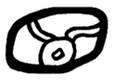
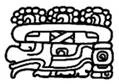
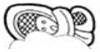
· Features – an anthropomorphic head with a KAB or UT in the mouth: o The head has a “bracket”/“grip” (or lock of hair) as forehead ornament. o There can be a partitive disk in the bottom right. o The top of the mouth (upper lip) is not needed – the KAB or UT can begin immediately below the nose. · Subvariants (2): o A. KAB in the mouth – the usual “cave” with: § Bold top half of left wall, ceiling, and right wall. § Darkened circle with squiggly protector in the top left (protector to the right of and below the darkened circle). § “Pond” with squiggly protector in the bottom right (protector above and to the left of the darkened circle). o B. UT/HUT = “face” in the mouth – the element is called UT/HUT for lack of a more convenient name – I don’t know if it really is meant to be an UT/HUT (or indeed, if that glyph really is read as UT/HUT). It consists of: § A boulder-outline, with, inside, § In the bottom left, a roundish element with a bump sticking out somewhere around the 3 o’clock position, with, inside, § A small circle. · It’s quite reasonable to associate MHD.PM1 and 1004st with T1004ab, but it should be realized that (in particular) T1004a is not (just) sa. T1004 is instead (clearly) sa[ja[la] = sajal, with the la infixed in the ja, and the ja, in turn, infixed in the sa. The state of decipherment in Thompson’s time was so embryonic that Thompson didn’t realize that this was a whole sequence of (infixed) glyphs and hence gave it a code of T1004a. Increased understanding in the course of time resulted in MHD.PM1/sa and 1004st/sa as the “descendants” of T1004a, but definitely not the equivalent of T1004a. · The “UT/HUT in head” subvariant is known from only 8 occurrences, all from not just one site (TIK), but in fact from Burial 116 in Temple 1 of TIK. Of the 8 occurrences: o Seven are on bone and one is on a vase. o Six write the sa of Jasaw K’ochwan and two the sa of Jasaw Chan K’awiil (but these are probably the same person anyway?). · This variant is an anthropomorphic head with a distinguishing element in the mouth. It’s one of a set of head glyphs, all with a distinguishing element in the mouth. The list below shows the unique distinguishing element: o For UK’ = “to drink”: HA’ = “water”. o For WE’ = to eat: WAJ = “food”, “tamale”. o For BULUCH/BULUK = “12”: double (stacked) LEM. o For sa = syllabogram: KAB = “earth” or UT/HUT = “face”. o Undeciphered glyphs: cross hatched ovalish rectangle, an element resembling the syllabogram mo, TAJ = “torch”.
|
|
Variant: crest
MC JM = 25EMC.pdfp45.r10.2 TOK.p32.pdfp32.r2.c2 BMM9.p21.pdfp21.r1.c3 25EMC.pdfp45.r10.3 sa sa SA’ SA’ SA’ SA’
0278bv SA’
K&H.p45.pdfp47.r4.c2 SA’
MC JM = 25EMC.pdfp45.r10.1 0278bt T278 sa sa SA’ -
MHD.32Ma MHD.32Ms.1&2 1772st - wu/hu wu
MHD.32Ms.3 0104st T104 wu/hu - -
Stuart = Montgomery PNG Stela 8 Y13 u.<sa:ja:la> u.<sa:ja{l}>
0278bb SA’
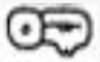
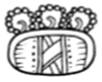
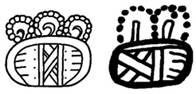
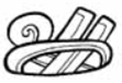
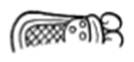
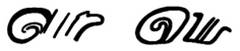
· The full form is well-known as a logogram for SA’(AL), the “main sign” in the NAR EG. · The reduced form can also be read as hu/wu. · Subvariants (2+): o A. Full – a vertically bipartite glyph: § Top – the “crest”: · Left: o A scroll curling to the left (optionally bold) with protector. · Right: o Two or three touching (NE to SW) diagonal bars, optionally with reinforcement on one long and one short edge (= an L-shaped reinforcement). o One MC example has only two bars, but one MC and two JM examples (counting full and reduced) have three, so perhaps three is canonical. § Bottom – an AT-like element: · Perimeter: bold boulder outline or “symmetric cave” (= bold left wall, ceiling, and right wall). · Inside: crossed bands (each band optionally with one bolded side). o B. Reduced: top part of full form (= the “crest” alone). o C. Boulder-only: bottom part of full form (= the “boulder outline” part alone): § This subvariant is given only by Bonn (0278bb). § And even then, only as logogram SA’, not as syllabogram sa. · In almost all the examples in the CMGG of syllabograms from the pedagogical sources and from the MHD and Bonn Catalogs, no reading is given below the example. This is because it’s pointless (and takes up space) to have the same syllable written, over and over again, under the examples. However, for this particular glyph, different epigraphers and sources give very different readings, so it’s useful to show these differences. o It is not given as sa in K&H (2020), K&L (2018), TOK (2017), BMM9 (2019), 25EMC (2020). It seems to be significant that all five of these pedagogical sources give the other three common variants and subvariants (“full comb”, “reduced comb”, “head with KAB infixed in the mouth”) but uniformly don’t give the “crest” variant (full or reduced) as sa. If given, then they’re given with another reading, not sa. o In BMM9, it is given as wu, and Dorota Bojkowska has a handwritten note that Beliaev suggests hu. o In FK2, it is given as hu. o Similarly, neither MHD nor Bonn (dynamically modifiable and hence reflecting the latest insights (in contrast to printed works, which are “frozen in time”)) give the “crest” form with a reading of sa. o MHD gives only the reduced (“crest”) form, and doesn’t recognize the “full” form with the AT-like element underneath: § The “crest” as a logogram is given no reading (simply the acknowledgment that it’s a logogram, not a syllabogram). § The “crest” as a syllabogram is given the reading hu/wu. In that way, MHD differs slightly from the more recent pedagogical sources and Bonn. Nevertheless, it shares the same view of not considering any form of this glyph to be the syllabogram sa. · PNG Stela 8 Y13 is a context in which there can be no doubt that the word written is sajal. o To me, this shows that the “reduced” variant isn’t just used for wu/hu, but can be used to write sa as well. o This is the usual phenomenon of the “third dimension”, where glyphs are written “in front of” other glyphs (from the point of view of the reader). As in the reduced variants of AJAW or NAL, this leaves just the top part of the later glyph peeking out from behind the other glyph – a “crest” of some sort – giving the illusion of a reduced variant on the top. o The reduced form is listed as sa in JM (2002/2006) and MC (2000/2005), perhaps influenced by PNG Stela 8 Y13. · This patterning (the two oldest works giving sa, but none of the later ones, and neither MHD nor Bonn doing so) implies that the modern consensus is that this glyph doesn’t write sa. How this ties in with PNG Stela 8 Y13 is unclear to me. All the more so as sa from SA’ by the acrophonic principle seems to make sa such an obvious reading for this “crest alone” form.
|