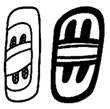
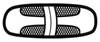
| CMGG entry for syllabogram pi
|
|
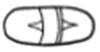
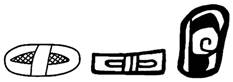
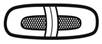
Variant: cave
MC K&H JM TOK.p36.r1.c1 MHD.ZC5.3 0177bb
MC JM TOK.p8.r4.c1 MHD.ZC5.2&5 0177bl 0177br T177abcd
(lost reference) TOK.p18.r2.c2 MHD.ZC5.1&4 0177bh 0177mp
· Features: o This is the “cave” (KAWAK) variant of pi. § The “cave” has the typical bold half of left wall, ceiling and whole of right wall. § A “pond” in the bottom right. § A “stalactite”/“grapes” in the top left. As in all “caves”, the “stalactite”/“grapes” may be absent, or reduced to a T or Y element. o The distinctive characteristics are either a doubling of the “cave” or the presence of a “bracket”/“grip” (or both). · Subvariants (3): o A. Double “cave” with no grip/bracket. o B. Single “cave” with a grip/bracket having two struts infixed. o C. Double “cave” with a grip/bracket having two struts infixed. Bonn has identified a triple “cave” (0177mp). · Do not confuse the “single cave” variant of pi with ch’u: in both cases, there’s a grip with infixed struts, ending in one or two elements each having a boulder outline. o In pi, the boulder outline is one or two “caves” (each with pond and optional stalactite/grapes). o In ch’u, the boulder outline is one or two “LEMs” at the end of the grip/bracket.
|
|
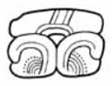
Variant: animal head
MC JM TOK.p27.pdfp27.r2.c3 MHD.SB1s.1
· Features: o Bird-head with hand-jaw. o This glyph is identical to the logogram for PIK/PIH. o See under PIK/PIH for more detailed information on features. · This would appear to be a case of a syllabogram derived from a logogram (PIH) by the process of losing a (weak) final consonant – perhaps even from PIK, though the final -k is not weak (though it does seem to be one of the most frequently dropped “non-weak consonants”, in cases of deriving a syllabogram from a logogram by the application of the acrophonic principle). · Lack of support for the pi reading. o Bonn does not list this glyph as pi, only as PIK. Bonn also doesn’t give it a reading of PIH, under the logogram reading. o This aligns with the fact that not that many pedagogical sources list the pi syllabogram reading as well. In fact, K&H, K&L, BMM9, 25EMC also don’t list the pi reading. · Overall statistics for the syllabogram variants of the syllable pi (2025-09-06) – a search in MHD on “blcodes contains” yields the following: o “cave” (ZC5): 335 hits (the various sub-variants are not distinguished). o “bird-head” (SB1s): 1 hit. § This is glyph-block C1 of the CPN HS (Phase B). § No image of the glyph-block itself is available in MHD. This is probably the reason that the pi reading isn’t listed that much. Perhaps it’s just a one-off aberration. Perhaps it’s even particularly tenuous in the CPN HS, because a lot of the monument is still a jumble of tumbled down blocks, and a definitive order has yet to be established.
|