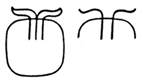
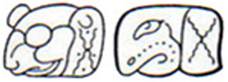
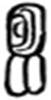
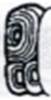
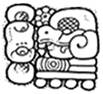
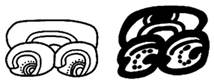
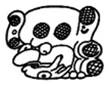
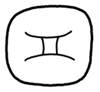
| CMGG entry for syllabogram nu
|
|||||||||||||||||||||||||
|
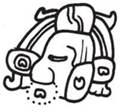
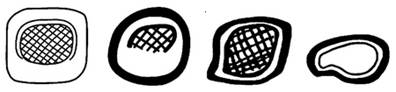
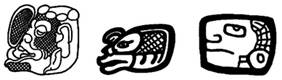
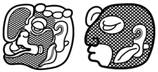
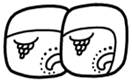
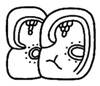
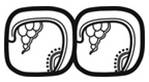
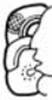
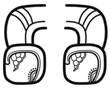
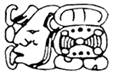
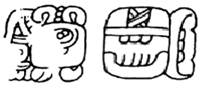
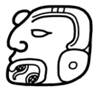
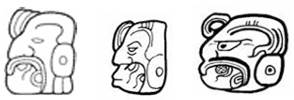
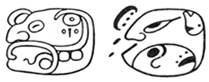
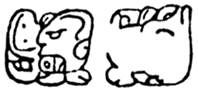
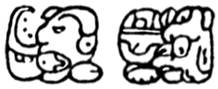
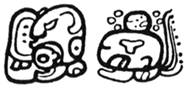
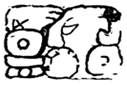
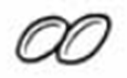
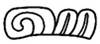
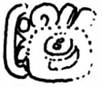
Variant: two eyeballs
MC K&H TOK.p6.pdfp6.r3.c3 TOK.p6.pdfp6.r3.c4
JM.p186.#3 JM.p186.#4 T106abcd
MHD.22F.1&2&3 0106st
MHD (Schele) MHD (B. Fash) MHD (B. Fash) MHD (Schele) CPN Altar U J5 CPN Stela 6 C3 CPN Stela 6 C6 CPN StELA 13 E10 u.<<BAAH{il}[A’N]>:nu> <u.CHAN:nu>:<ti.K’AHK’.TI’> <18.u.BAAH>:<CHAN.nu> ka.<KAN:nu>
MHD (Grofe) MHD (B. Fash) MHD (Schele) CPN Stela A B5 CPN Stela B B8 CRB Stela 1 C2 <<tzi.pi>:TI’>.<nu:na> <u.<BAAH{il}[A’N]>>:nu u.<CHAN:nu>
MHD (Stuart) MHD (Stuart) MHD (Houston) DCB Stela 2 I1-H2 DCB Stela 2 K2 DPL HS 4 Phase A I2 <u:cha:CHAN:nu>.<*CHAK:wa:<WAY[bi]>> <CHAAK:ki>.<K’UH{ul}:<PA’+CHAN>:AJAW:wa> u.<cha:CHAN:nu> u.< CHAN:nu>
MHD (Looper) MHD (Tokovinine) MHD (Graham) MHD (Graham) QRG Stela D A20a TAM K30177 G1 YAX Lintel 2 O1 YAX Lintel 24 F1-F2 13.<nu:TZUTZ> u.<CHAN:nu> u.<CHAN:nu> <KOKAAJ:BAHLAM:ma>.<u:cha:CHAN:nu> a{j}.<<SAAK/XAAK>:ki>
MHD (Graham) MHD (Graham) MHD (Graham) YAX Lintel 25 F3 YAX Lintel 25 W1 YAX Lintel 46 F6 <u:CHAN:nu>.<AJ:<SAAK?/XAAK?>:ki> <u:CHAN:nu>.<AJ:<SAAK/XAAK>:ki> u.<cha:CHAN:nu>
MHD (Tokovinine) MHD (Tokovinine) MHD (Graham) YAX Stela 11 Y2-Z2 YAX Stela 12 B4-A5 YAX Stela 18 C2 u.<cha:CHAN:nu> a{j}.<u:ku{l}> u.<cha:CHAN:nu> a{j}.<<SAAK/XAAK>:ki> u.<<BAAH{il}[A’N]>:nu>
MHD (Moot) MHD (Polyukhovych) = MHD (Looper) K3744 I Vase, Art Institute of Chicago 2009.735 glyph-block M nu.“RAZ-EG” CHAN.nu
MHD (Moot) MHD (Kerr) MHD (Kerr) MHD (Kerr) MHD (Kerr) Holmul Plate glyph-block R K0558 R2 K2206 P K2352 S7 K2352 X3 <BIH:tu>.nu CHAN:nu CHAN:nu CHAN:nu CHAN:nu
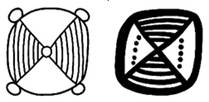
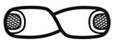
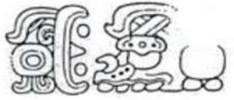
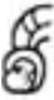
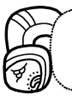
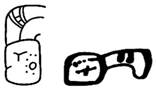
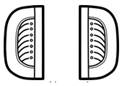
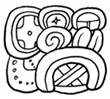
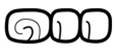
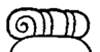
· Features – a rectangular, rotatable glyph (one axis much longer than the other), with: o One “death eye” at each end. The “inside” edge of each death eye maybe: § Bolded (MC, K&H, TOK.p6.r3.c3, TOK.p6.r3.c4, MHD.22F.3, T106c, 0106st), or § Non-bolded (T106abd, MHD.22F.1&2). o The eyes look in opposite directions: either left and right or up and down, depending on the orientation of the “rectangular” outline (with curved corners). o A sort of “twist” in the glyph, between the two death eyes. · In QRG Stela D A20a, the “unexpected” nu can perhaps be explained as an end phonetic complement to the “13” = huxlajuun. · Frequency of occurrence by site: o “Ceramics”: ~32 hits. (This is just a count of objabbrs beginning with COL, so a few of them might not be ceramics.) o CPN: 21 hits. o YAX: 15 hits. o BPK, CHN, CRN, DCB, DPL, PAL: 4-7 hits. o AGT, BKP, CLK, CNJ, COB, CRB, DBC, DZL, EKB, FLS, NAR, NTN, OXK, PMA, PNG, QRG, RAZ, SBL, SBP, SCU, TAM, TNA, XUL: 1-3 hits. The numerical values are just as a rough guide – the huge number at one site and the small number at another has more to do with the number of inscriptions for a site than that some sites used this variant so much more than other sites did. · Geographical distribution (not exhaustive, just to give a rough idea): o North-west and west: PAL, TNA. o Yucatan / north and north-east: CHN, COB. o Usumacinta: PNG, BPK, YAX. o Peten: FLS, NAR, NTN, XUL; RAZ (extreme north-east of the Peten region). o “Central north”: CLK. o “Central south” / Petexbatun / Pasion region: AGT, DPL, SBL. o “Central east”: BKP (Baking Pot). o South-east: CPN, QRG. So, not regionally restricted. · Note that this glyph can assume quite “abstract” forms: o Holmul Plate glyph-block R shows one occurrence where the usually round “eyes” are triangular in shape, the cross-hatched eyeballs have been reduced to a couple of parallel straight lines at the “far/outside, flat end” of the triangle, and the “twist” between the two “eyes” has been reduced to just two single, slightly curved lines, emanating from the centre. o K0558 R2, K2206 P, K2352 S7 are even further removed, with just some “tassels” for the cross-hatched eyeballs. o TAM K30177 G1 has the eyeballs just as ticks. But the connection between these more abstract and the more representational forms is clear.
|
|||||||||||||||||||||||||
|
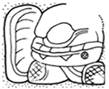
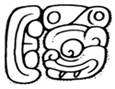
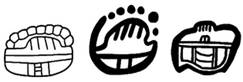
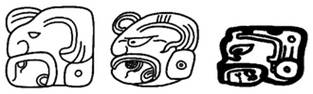
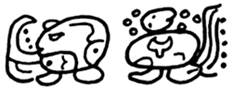
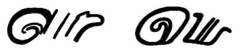
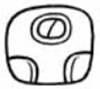
Variant: eyeball and tassels
K&L.p53 TOK.p8.r2.c2 FK.pdfp9.r3.c6 = KuppratApp.#4.1 = MC.p159.r5.c1.#5
MHD.3M9.1&2 0151st T151abcde
FK.pdfp5.r1.c2 = KuppratApp.#3.2 = MC.p159.r5.c1.#4
MHD (Mathews) MHD (Kerr) BPK Stela 2 D5 K2914 O4 <nu:pa>.ja nu.“RAZ-EG”
MHD (Schele) MHD (Schele) CPN Structure 10L11 West Door North Panel C4 CPN Structure 10L11 West Door South Panel C2 u.<TUUN/ku>.nu tu.ku.nu
MHD (Houston) MHD (Schele) MHD (Schele) MHD (Schele) LTZ Panel 1 G9 PAL TC A15 PAL TFC L11 PAL TFC G7 u.<CHAN:nu:9> nu.<NOHOL:la> nu{un?}.<ya:AJAW:CHAN> nu{un?}.10:AKAN>
MHD (Stuart) MHD (W. Coe) = AT-E1168-lecture9.t0:18:03.#4 MHD (Graham) RAZ Vessel 15, 'Cacao pot' O TIK Temple I Lintel 3 F6 YAX HS2 L1 nu.“RAZ-EG” nu.<u{n}:<JOL+CHAAK>> 13.<nu:?:PIK>
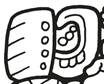
· Features – a rectangular / flint outline, rotatable glyph, with: o A “death eyeball” at the top – the eye looking to the left. § Perhaps this eyeball is iconographically related to the “two eyeballs” variant. § Subvariants of the “eyeball” – subvariants have: · The conventional cross-hatched (inner) circle for the eyeball: MC.p159.r5.c1.#4, BPK Stela 2 D5, CPN Structure 10L11 West Door North Panel C4, CPN Structure 10L11 West Door South Panel C2, TIK Temple I Lintel 3 F6, or · A series of concentric arcs, slightly reminiscent of a MUT logogram rotated 90 degrees clockwise (but without the “bow”/“knot” tied around the element): K&L.p53, TOK.p8.r2.c2, MC.p159.r5.c1.#5, MHD.3M9.1, PAL TC A15, PAL TFC L11, PAL TFC G7, YAX HS2 L1, or · So few concentric arcs, sometimes with a single (bold) arc on the inside with the opposite curvature, so that it begins to resemble a LEM: 0151st, T151c, YAX HS2 L1(?). § When in its “canonical” position to the left of a “main sign” – vertically rectangular – the “eyeball” looks to the left, but will, of course, look “up”, “right”, “down” when rotated into other positions. o Two “tassel” elements at the bottom. § The commonest form is for the tassels to be straight, vertically rectangular, quite “wide” (most of the examples above). In TIK Temple I Lintel 3 F6, each “tassel” even has a spine of its own. § They can be still quite wide, but slightly curved (YAX HS2 L1). § They can be very narrow and curved – down to just a single line, with a tiny dot at the end (RAZ Vessel 15, 'Cacao pot' O). o The whole glyph can even be upside down (CPN Structure 10L11 West Door North Panel C4, CPN Structure 10L11 West Door South Panel C2). · A subvariant of this (MC.p159.r5.c1.#4) is where there’s: o An additional “bracket” between the eyeball and the tassels (a crescent with tips pointing up, with reinforced floor), and o An additional element above the eyeball, consisting of: § A “left feeler” with its own “protector”. § Perhaps, a repeat of this element, a little to the right and behind it and extending a little higher (such that the “left feeler” in the second element is just barely visible). Alternatively, it could be interpreted as the first element having a further “partial protector” on the right of it. · The general policy in CMGG is to select non-eroded, “typical”, real-life examples to illustrate the variants and subvariants. Particular preference is given to glyph combinations where the resultant transcription is “obvious” (and write commonly occurring words or names). All to the end of making it easy for the reader to “master” each particular variant This general policy has been slightly adjusted. In the case of the “eyeball with tassels” variant of nu. Here, some examples have been selected despite it being not entirely clear what word or name they write. That’s because I wanted to illustrate the full variation in subvariants of this variant, so, as long as a real-life glyph was definitely a subvariant of the “eyeball with tassels” variant of nu, I included it as an example. For example, it’s not entirely clear what the exact phrase PAL TC A15, PAL TFC G7, or YAX HS2 L1 are actually writing.
|
|||||||||||||||||||||||||
|
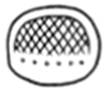
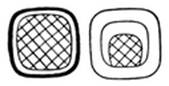
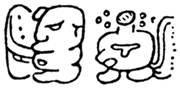
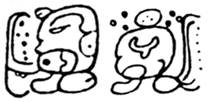
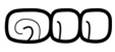
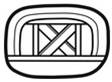
Variant: boulder
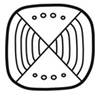
MC K&H = K&L.p50.pdfp50.r1.c5.1 JM TOK.p11.r1.c1
K&L.p53.pdfp53.c3.r5 MHD.XQ9.1&2 0592st T592
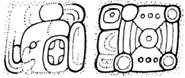
MHD (Houston) ZenderEtAl-TSSw.p37.pdfp3.fig1 = MHD (Safronov) = MHD (Polyukhovych, Looper) DPL HS4 Phase A F2-G1-H1 LTI Kimbell Panel F1 nu.na JOL CHAAK.ki u.<cha:nu>
MHD (Graham) MHD (Greene) MHD (Sánchez) MHD (Schele, Villagra, Fernández) NAR Stela 24 E3-D4 PAL Tablet of the Slaves L1 PAL T18 Jamb C13 PAL Temple 18 Stucco 459 u.<<BAAH.li>:hi> a.nu IX.<ki:nu:wi> 1.IX.<*ki:nu:wa> IX.<ki:nu:wi>
MHD (Moot) = MHD (Looper) MHD (Safronov) MHD (Looper) MHD (Culbert) MHD (Culbert) PAL T21 HB B5 PNG Panel 3 P’1 QRG Stela C C10 TIK MT 176 R3 TIK MT 176 V2 IX.<*ki:nu:wi> tz’u.<<nu{2}>:TE’> tz’u.<nu{2}> tz’u.<nu{2}> tz’u.<nu2>
MHD (Gronemeyer) MHD (Graham) TRT Monument 8 B61 YAX Lintel 23 H2-I1 <tz’u:<{2}nu>>.MO’ <2nu>.<<k’a+ba>:la> XOOK.ki
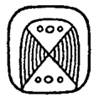
· Features: o This is one of the boulder outline glyphs which can be very round, i.e., a circle (e.g., MC, K&H, K&L, MHD.XQ9.1), rather than the square with rounded corners, though the latter is also often the case. o Optionally, four small- to medium-sized circles, one in each of the four corners – NW, NE, SW, SE (MC, K&H, K&L, MHD.XQ9.1). § When these circles are present on the perimeter, then there’s also a medium-sized circle in the centre of the glyph (small in the case of MHD.XQ9.1). o There’s an X though the main part of the glyph, dividing the circle into 4 quadrants – N, S, E, W. § When there’s a circle in the centre of the glyph, then the X stops at the boundary of the circle and doesn’t go all the way to the centre of the glyph (MC, K&H, K&L, MHD.XQ9.1). o Typically, the W and E quadrants are cross hatched / darkened, and the other two are not, though the opposite also occurs (LTI Kimbell Panel F1b (bottom). (This part of the LTI Kimbell Panel is, for unknown reasons, in “mirror image”, and so is read from right to left, making F1b (bottom) in the bottom left of the glyph-block.) o Optionally, in the non-darkened quadrants, there’s either: § Two short, slightly diverging ticks, going radially out from the central circle, when such a circle is present (MC, K&H), or § Three or more small, non-touching dots, in a line or arc, in the middle of the quadrant, irrespective of whether or not there’s a central circle present (K&L, MHD.XQ9.2, 0592st, T592). There are typically three or four dots, but it can go up to even five dots (MHD.XQ9.2). · In LTI Kimbell Panel F1, the “disharmonic” spelling cha-nu is probably to indicate the complex vowel of cha’an = “captor”, “master”, “guardian”.
|
|||||||||||||||||||||||||
|
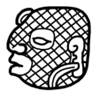
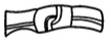
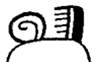
Variant: knot and tassels
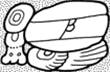
MHD.3MD.3 0282ex NUN / nu NUUN
MHD (W. Coe) MHD (W. Coe) MHD (W. Coe) MHD (W. Coe) MHD (W. Coe) TIK Stela 31 A23 TIK Stela 31 F6 TIK Stela 31 F11 TIK Stela 31 E20 TIK Stela 31 N2 YAX.<nu{’un}:AHIIN> YAX:<nu{’un}:AHIIN YAX.<nu{’un}:AHIIN> YAX.<nu{’un}:AHIIN> YAX:<nu{’un}:AHIIN
MHD.3MD.2&4 0282md NUN / nu NUUN
Rabe = MHD (Kerr) MHD (Ozaeta, Pinelo, Caal) MHD (Stuart) MHD (Hales) K1446 glyph-block G TIK 'Hombre de Tikal' C4 RAZ Mural, Tomb 12 glyph-block F 'Mountain Pot' Tripod Vase D3-C4 nu:<“RAZ-EG”> YAX.<nu{’un}:AHIIN> nu:<“RAZ-EG”> nu{’un}:YAX AHIIN
TOK.p9.r3.c2 FK.pdfp9.r3.c5 = FK2.p15.r3.c5 = KuppratApp.#3.4 = MC.p159.r5.c1.#6 MHD.3MD.1&5 NUUN / WAYIS nu nu nu nu NUN / nu
MHD (Schele) MHD (Schele) MHD (Schele) CPN Altar G1 D1 CPN Altar T H1 CPN Altar U I4-J4 nu{’un}.<<ya+AJAW>:CHAN> nu{’un}.<ya:AJAW:CHAN> nu{’un}.<ya:AJAW:wa> CHAN.na
AT-E1168-lecture9.t0:18:03.#6 = MHD (Fahsen) MHD (Fahsen) MHD (Houston) DPL HS2 D2 (West Step 6) DPL HS2 E1b (East Step 4) DPL HS4 Phase A C2-D2 (Step 3) nu.u nu:<JOL+*CHAAK> <nu{’un}>.<JOL+CHAAK> <nu{’un}>.JOL CHAAK.ki
MHD (Polyukhovych) MHD (Polyukhovych) PAL House C HS D2c-D2d PAL House C HS D3b-D3c nu{’un}.<hi:HIX> LAKAM.CHAAK nu{’un}.<u:JOL> CHAAK
0282st T282 NUUN -
AT-E1168-lecture9.t0:18:03.#1 = MHD (Fahsen) MHD (Kerr) DPL HS2 E1b (East Step 3) K4021 L nu{’un}:<[JOL]CHAAK> / {2}nu: <JOL+CHAAK> nu{’un}:BAHLAM
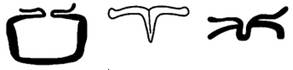
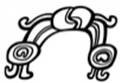
· Reading – there is a lack of consensus on this glyph: o MC, FK.pdfp9.r3.c5 & KuppratApp (all older sources) list this as (only) syllabogram nu. o TOK.p9.r3.c2 has a similar looking glyph but views it as being a logogram NUUN/WAYIS., no syllabogram reading. o MHD recognizes both syllabogram nu and logogram NUN (but the number of real-life inscriptions where it’s used as a syllabogram are insignificant compared to the logogram usage). o Bonn recognizes it only as a logogram NUUN. The difference between NUN and NUUN is merely a difference in length and is quite common in Maya epigraphy, arising perhaps from different approaches to historical reconstruction based on the modern Mayan languages, or different attitudes towards the validity of the Lacadena-Wichmann rules for disharmonic spellings. The difference between nu and NUN/NUUN is also known, but perhaps less common. This latter arises because any text which one epigrapher reads as NUUN can always be interpreted as nu{(u)n} – i.e., as underspelling of the final -n, as -n is one of the sounds that can be underspelled. · 'Mountain Pot' Tripod Vase C4 is interesting because the YAX (read first) is under/inside the nu/NUN/NUUN. · It very often appears in a context where it could be interpreted as an initial phonetic complement for the EG of Rio Azul, leading to some sources reading that logogram as NUUN or NU’UN. However, other sources restrict themselves to only saying that the logogram begins with n- (the initial phonetic complement), without venturing an opinion on the sounds of the rest of the word. · Its major uses seem to be: o To write nu’un in a whole lot of names/titles of various rulers: § Nu’un Bahlam. § Nu’un Hix Lakam Chaak. § Nu’un Jol Chaak. § Nu’un Yajaw Chan. § Yax Nu’un Ahiin. o As an initial phonetic complement (or a separate preceding word) for the EG of RAZ, the main sign (an anthropomorphic head with a syllabogram mo in the mouth) of which is undeciphered. · Subvariants (4): o A. Symmetric – knot with flanking, non-drooping tassels: § A knot in the middle. § On each side of the knot, flanking tassels “in a straight line”, forming a rectangular shaped glyph. § This glyph is difficult to distinguish from some of the subvariants of the “knot” variant of HUUN. § The “knot” variant of HUUN can be symmetric (reminiscent of a bowtie, with “tassels” on both sides) or asymmetric (a loop at one end and tassels at the other) – both having the knot in the centre. This variant of nu/NUN/NUUN appears to be always symmetric. § Context will be the major way to decide if HUUN or nu/NUN/NUUN is being written. o B. Symmetric – knot with flanking, drooping tassels (these “tassels” are exaggeratedly long): § A knot in the middle. § On each side of the knot, trailing downwards, slightly curved, parallel bands, forming an inverted-U. § At the end of the curved band, a “washer”. § At the bottom of each “washer”, two or three curved “tassels”, each “tassel” can be: · A slightly flattened “washer” (TOK.p9.r3.c2), or · A horseshoe (AT-E1168-lecture9.t0:18:03.#1 = almost a washer with the centre offset to the side), or · A slightly bent element, with a blunt tip, somewhat resembling a canine tooth (FK.pdfp9.r3.c5), or · A scroll (in the case of AT-E1168-lecture9.t0:18:03.#6, with a spine). o C. One tassel – broken: § Half of the symmetric subvariant (“B”), without the knot between the two halves. § This subvariant has, between the two curved bands (i.e., in the “cascading tassel”), a set of crossed bands. § The spot where the knot is missing forms a point where this subvariant may be attached to a “main sign”. When the droopy side is the left side, this point of attachment will be on the top right (TOK.p9.r3.c2, FK.pdfp9.r3.c5 = FK2.p15.r3.c5 = KuppratApp.#3.4 = MC.p159.r5.c1.#6, MHD.3MD.1&5, AT-E1168-lecture9.t0:18:03.#6). o D. One tassel – whole: § One could perhaps even identify a subvariant of “D””(or perhaps it’s just a sub-subvariant of “C”) where the point where the knot is missing doesn’t form an attachment point for a “main sign”, but, instead, forms a “closed element”, which holds the crossed bands (0282st, T282, AT-E1168-lecture9.t0:18:03.#1). The distinction between “C” and “D” is quite arcane – a “D” where the top right is partially obscured by a glyph to the right of it would be indistinguishable from “C”. · For “historical reasons”, I’m leaving this as a syllabogram nu for the moment but in the long run, I think it should probably end up as a logogram NUN/NUUN: o MHD already has the overwhelming majority of occurrences of this glyph as a logogram. o Bonn has this glyph as exclusively a logogram. · A final note arguing for syllabogram nu.
o The top row of the table shows the “RAZ-EG” with two different variants of syllabogram nu (the “two eyeballs” and the “eyeball and tassels” variants) as (presumably) initial phonetic complements. o The bottom row of the table shows the “RAZ-EG” with two different subvariants of the “knot and tassels” glyph (the “symmetric knot with drooping tassels” and the “one tassel - broken” subvariants). o To me, there is sufficient parallelism the top row and the bottom row for us to conclude that this is a classic case of “substitution”, and that “knot and tassels” glyph is hence shown to be a variant of syllabogram nu.
|
|||||||||||||||||||||||||
|
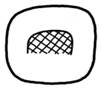
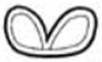
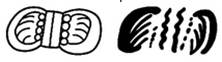
Variant: two eggs or rugby balls
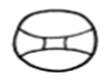
MC K&H JM TOK.p6.r4.c2
MHD.22F.4 0149st T149abcd
MHD (Förstemann) MHD (Förstemann) MHD (Förstemann) MHD (Förstemann) Dresden Codex DRE06b03 Dresden Codex DRE07b01 Dresden Codex DRE07b02 Dresden Codex DRE07b03 tz’u.nu tz’u.nu tz’u.nu tz’u.nu
MHD (Förstemann) MHD (Förstemann) MHD (Förstemann) MHD (Förstemann) Dresden Codex DRE08b01 Dresden Codex DRE08b02 Dresden Codex DRE09b01 Dresden Codex DRE09b02 nu.chu nu.chu u.nu.chu u.nu.chu
MHD (Villacorta) MHD (Villacorta) MHD (Villacorta) MHD (Villacorta) Madrid Codex MAD020d02 Madrid Codex MAD020d03 Madrid Codex MAD021d01 Madrid Codex MAD100c02 tz’u.nu tz’u.nu tz’u.nu tz’u.nu
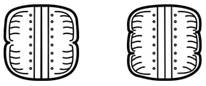
· Features: o Two “eggs” or “rugby balls”, often at an angle (similar to the positioning of real rugby balls on the “tee”, in preparation for the kick). o While the pedagogical sources give the rugby balls with a NE-SW orientation, MHD and Bonn give the opposite – NW-SE – orientation. Thompson gives both orientations and horizontal. · Do not confuse this variant of nu with the visually very similar reduced form of k’u: o nu has a solid line reinforcement of the left edge whereas k’u has a dotted line as the line reinforcement of the left edge. o The two elements of nu can be rounder whereas those of k’u are more egg-like (“rugby balls”) [only in the TOK example]. · This turns out to be a Codical / Post-Classic only variant. o A search in MHD (2026-03-02) on “blcodes contains 22F” yields: § “All – Blocks” option: 150 hits. § “Classic – Blocks” option: 134 hits. § “Codical – Blocks” option: 16 hits. 134 + 16 = 150. o Restricted usage: § Stepping through the 134 Classic blocks shows no double eggs/rugby balls, while stepping through the 16 Codical blocks shows all double eggs / rugby balls. So this variant of nu is Codical only. § Conversely, a search in “Codical – Blocks” on “blcodes contains …” for 3M9, XQ9, or 3MD yields no hits. This means that not only was the double eggs / rugby balls variant restricted to the Codices, but also that it was the only variant used in the Codices. · Overall MHD statistics (2026-03-02) – seen from a search in MHD on “blcodes contains <XXX>”, where <XXX> is: o 22F.1&2&3 (“two eyeballs” variant): 134 hits (Classic only): § Caution, this is actually only 101, because visual examination of the hits reveals that there are 14 with no image, and 3 possible misclassifications (not 22F.1&2&3). But these are always ballpark figures anyway, because of judgement calls, and the occasional grey area between whether a variant is one or the other. § Within these margins of error, it remains true that there are about twice as many instances of the “two eyeballs” variant, as the next 3 most common variants, all of which are at the same order of magnitude. So, ~100 compared to ~50 for the next 3. o 3M9 (“eyeball and tassels” variant): 69 hits (Classic only). o XQ9 (“boulder” variant): 56 hits (Classic only). o 3MD (“knot and tassels” variant): 47 hits (Classic only). [Caution: these are actually a mix of 3MDa (the glyph as a logogram NUN/NUUN, 43 hits) and 3MDs (the glyph as a syllabogram, 4 hits). But given the uncertainty in logogram/syllabogram status of 3MD, I’m just counting them all as syllabograms, for convenience). o 22F.4 (“two eggs / rugby balls” variant): 16 hits (Codical only).
|