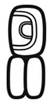
| CMGG entry for syllabogram no
|
|
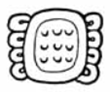
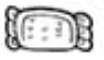
Variant: boulder form
MC ~= K&H JM MHD.ZD2s.1 0595th
TOK.p12.r2.c3 MHD.ZD2s.4 0595tm
TOK.p10.r5.c4 MHD.ZD2s.2&3&5 0595tp
0595tl 0595tr T134ab
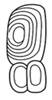
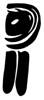
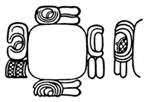
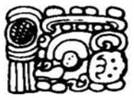
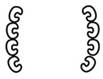
· Features – a “boulder outline” glyph consisting of: o Optionally, a bold border (MC, all around, making a “cartouche”) or reinforced walls and ceiling only (JM, a “symmetric cave”). o Inside: Typically, 9 non-touching crescents, each pointing upwards, in a 3 x 3 matrix. § The crescents can be non-bold (K&H) or bold (TOK.p12.r2.c3). § When bold, they’re fairly bloated, with no sharp tips – almost bold-u’s rather than crescents. o Outside: Three or more stacked horseshoes, on the left and right, pointing “inwards”, i.e., pointing to the right on the left side, and pointing to the left on right side). § There is an equal number of horseshoes on both sides. § Some epigraphers refer to these horseshoes as “nubbins”. · Subvariants (3): o A. Full: “horseshoes” + boulder form (e.g., K&H, as in the feature description above). o B. Boulder form only (TOK.p12.r2.c3). o C. “Horseshoes” only (TOK.p10.r5.c4): § 1. Both sides (TOK.p10.r5.c4, MHD.ZD2s.2&3&5, 0595tp). § 2. Left side only (0595tl). § 3. Right side only (0595tr). As so often is the case with Maya glyphs, “C” can be considered a “reduced form” of “A”, or as a conflation of “A” and whatever main sign takes the central position or as a main sign “covering” the full form of nu (placed between the nu and the viewer), with just the horseshoes sticking out from either (or both) sides. · Note that Thompson considered the left and right reduced forms to be “rotatable” forms of a single stack of horseshoes, and hence assigned them the codes T134a and T134b, respectively. He apparently didn’t realize that they’re not rotated forms of one another, but instead a (single) reduced form of the full form, with the central part missing. This full form is in fact a “main sign” and is not rotatable. This is why these stacked horseshoes never appear at the top or below a main sign; at least, not in their capacity as syllabogram nu – they do (regularly) appear underneath a main sign as a reduced form of ji. · Do not confuse the very reduced form of no (“C2” and “C3” above) with the visually identical “rectangular” / “horseshoe” form of ji: o no occurs only on the left and right of main signs. o ji occurs only on the top and bottom of main signs.
|