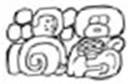
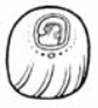
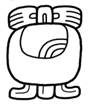
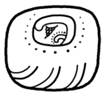
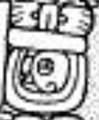
| CMGG entry for syllabogram lo
|
|
Variant: boulder
MC = K&H JM.p163 TOK.p15.r1.c1 lo / CHIT lo lo / CHIIT
MHD.XN2.1&2&4&5 0580st lo / CHIT lo / CHIT
MHD (Montgomery) MHD (Schele) MHD (Montgomery) “Hellmuth Panel” B1 CPN Stela B1 IXZ Panel 3 pK1 6.<mo+lo> 10.<mo+lo> 12.<mo+lo>
MHD.XN2.3 1693st lo / CHIT -
MHD (Prager) DBN Capstone 3 E1 lo
MHD.SCD.1 0580hs lo lo / CHIT
Graham YAX Lintel 14 D1-E1 4.IMIX 4.<mo+lo>
MHD.SCD.2 0580hc lo lo / CHIT
Looper QRG Stela F B14/D14 <ti:1:AJAW>.<13:<mo+lo>>
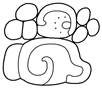
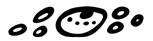
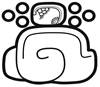
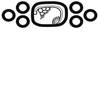
· Features – boulder outline with: o Bottom – a washer, which: § May be a “full” washer (MHD.XN2.3), or § Just a circular arc dividing the whole glyph into a top and bottom half, with a dot in the centre of the bottom half (MHD.XN2.1&5 and 0580st), or § Anything between these extremes (MHD.XN2.2&4). IXZ Panel 3 pK1 is an interesting example where the arc dividing the glyph into top and bottom is actually bold. o Top: § Two horizontally touching dots, in the middle of the top of the “washer” (MHD.XN2.3 is an example with three dots, see cautionary note below). § Instead of two touching dots, there can be a semicircle (the top half of a circle), divided into two by a vertical line. The vertical line can be: · Perfectly straight, dividing the semicircle into two symmetric halves, or · Sightly curved – usually, the NW quarter of a circle – resulting in the right half more resembling a dot. This alternative for the two dots can, itself, also have a protector. This can be seen in the examples MHD.XN2.1&4 above. The example from the “Hellmuth Panel” (of the Los Angeles County Museum of Art) B1 is such an instance without a protector. § The canonical element is described as “two touching dots”, but they are, in practice, never two perfect circles. Instead, the bottom of each dot is slightly flattened, where it makes contact with the top of the “washer”. This can be seen in almost all the examples above. This makes the distinction between “two horizontally touching dots” and “a semicircle divided vertically into two halves” far smaller than one might, in the first instance, think. With such an insight comes the realization that the difference between a vertical line and an arc is also quite small. All this is just minor variation on two small horizontally touching elements – flattened dots, quarter circles, etc. § Optionally, the two dots may have a protector over them (MHD.XN2.1&2&4 and 0580st). The protector may be darkened, but this is very uncommon (only MHD.XN2.2, from the examples above – see below for further analysis of this point). · Variants (3): o A. Boulder: as described in “Features” above. o B. Skull(?): the boulder variant infixed into the top of a skull (the nose hole and bone-jaw can be seen in MHD.SCD.1 and 0580hs). o C. Head(?): a rather aberrant form, given by both MHD and Bonn (MHD.SCD.2 and 0580hc). Both MHD and Bonn distinguish the “boulder” variant from the “head” variant, but MHD doesn’t distinguish the skull from the head variant (both are just subsort examples of MHD.SDC) whereas Bonn does make the distinction, with their 2-letter suffixes: -hs (head, skullcap) and -hc (head, creature). Also, MHD has not assigned a 1-letter -a or -s suffix to SCD, as all known examples of this glyph are (apparently) syllabogram lo. I.e., unlike for the boulder outline variant, the head variant is only ever read lo, never CHIT. · Reading(s): o The 3-dot (sub)variant of the “boulder” variant of lo (MHD.XN2.3, 1693st): § The Bonn Catalog gives 1693st in the “Artefacts” field as occurring in “Dzibilnocac, Capstone 3”. § MHD’s Glyph Dwellers Report #72.p53 indicates that the 3-letter code for Dzibilnocac is DBN (caution: not DZB – DZB is Dzibanche). § MHD’s Glyph Dwellers Report #72.p33 shows that DBN Capstone 03 has “objabbr = DBNCST03”. § In the MHD TTT’s, a “3-dot lo” can, indeed, be found on “objabbr = DBNCST03”, glyph-block E1. § This means that MHD.XN2.3 may be considered the equivalent of 1693st. · MHD reads DBNCST03”, glyph-block E1 (in the TTT) as lo with no question mark (indeed, it’s very close to MHD.XN2.3 of the MHD Catalog, both being 3-dot forms, with the three dots in a triangular formation). · Bonn does not give a reading for 1693st. § This reflects an important difference in the reading of this 3-dot form between MHD and Bonn. o This syllabogram also has a reading as logogram CHIT. However, MHD and Bonn differ slightly on the applicability of this variation: § Both agree that the boulder variant can be read as either syllabogram lo or logogram CHIT. § MHD indicates that the other variants are only read as lo. § Bonn leaves open the possibility that the other variants can be read as either lo or CHIT. · Do not confuse the boulder variant of lo with one variant of u – the so-called “muluk-u”: “muluk-u” is lo rotated 90 degrees clockwise. · Do not confuse the boulder variant of lo with IHK’: o In general (“canonically”), lo has no darkened area/protector, while IHK’ has a darkened area in the middle of the glyph (attached to the middle of the top of the “washer” (or of the inner arc which divides the glyph into a top and bottom half). o Conversely, in general (“canonically”), lo has the horizontally touching double dots in the middle of the glyph (attached to the middle of the top of the “washer” (or of the inner arc which divides the glyph into a top and bottom half), while IHK’ doesn’t. These are reasonably reliable characteristics to distinguish the two glyphs, however, there appear to be examples where the distinguishing characteristic of the one is present in the other (e.g., MHD.XN2.2 above) – perhaps as a result of “cross-contamination”. · Overall MHD statistics (2026-03-30) for syllabogram lo – seen from a search in MHD on “blcodes contains <XXX>”, where <XXX> is: o XN2s (“boulder” variant, used as a syllabogram): 298 hits. o SCD (“head” variant): 3(!) hits. These 3 hits fall into the following “categories”: § PAL “Del Rio Throne” from Palace House E – glyph-block E1: quite badly eroded; the glyph is unclear to the extent of making it hard to say if it’s the -hc or -hs form. § QRG Stela F B14: · Clearly the -hc form. · Easily known to be lo (despite its very aberrant form, and only one occurrence) because it’s in a calendar context – a CR with both Tzolk’in and Haab date – a coefficient (“1”) and AJAW for the Tzolk’in, and a coefficient (“13”) and mo-lo for the Haab. § YAX Lintel 14 D1-E1: · Clearly the -hs form. · Easily known to be lo (despite its very aberrant form, and only one occurrence) because it’s in a calendar context – a CR with both Tzolk’in and Haab date – a coefficient (“4”) and IMIX for the Tzolk’in, and a coefficient (“4”) and mo-lo for the Haab. Here we see the interesting phenomenon of codes being “declared” for very aberrant forms of a glyph (“variants”) which are, essentially, “one-offs” (a.k.a. hapax legomena). We also see the reason for the slight difference in approach between MHD and Bonn, in terms of the lo vs. CHIT reading for the non-boulder forms. MHD goes for the “practical” approach – the non-boulder forms are extremely rare, and only occur as lo, so we might as well just consider that they can only be lo. (If such a head form of CHIT is later discovered, SCD can become SCDs and the new form can be SCDa.) Bonn goes for not excluding the possibility of the logogram reading in the future, by allowing lo / CHIT for all 2-letter suffixes of 0580, even though lo / CHIT is currently known only for -st, with only lo for all known forms of -hs and -hc (Bonn’s methodology only allows assignment of readings to the level of the 4 digits anyway, not distinguished by 2-letter suffix). Both approaches are equally valid and have their advantages and disadvantages. · Visual examination of the 298 hits for the “boulder” variant reveals the following information. These statistics are very approximate and are only meant to give a very global indication of general tendencies. This is because many are really very quick judgment calls, and the border between Indeterminate and a certain fixed number of dots can be a grey one: o How common is a darkened protector? § The “special” 3-dots in a triangle: 1 hit. (This case is excluded, as it doesn’t have a protector and the dots are not touching one another and the top of the “washer”.) § No image in MHD: 37 hits. § Image in MHD but number of dots and whether there is a darkened protector is indeterminate (too eroded): 82 hits. § Non-darkened protector: 170 hits. § Darkened protector: 8 hits. We see that 8/(170+8) = 4.49% < 5%, i.e., less than 1 in 20 of the non-eroded occurrences of the boulder variant of lo in MHD have a darkened protector. It does show however that it’s not totally unknown or even extremely rare, perhaps, as speculated above, as a result of cross-contamination with IHK’. o How many dots in a row, on the “washer”? Again, when an inscription is slightly eroded, it can be a judgement call / grey area in counting the number of dots (or to call it too eroded to try and count). So, here too, the numbers are very approximate, just to give a general indication of the tendency/trend. § 1 dot: 5 hits. § 2 dots: 164 hits. § 3 dots: 9 hits. § 4 dots: 1 hit. We see that 164/(164+5+9+1) = 164/179 = 91.6% of the boulder variant occurrences of lo have two touching dots – as expected. It does, however, also show that almost 10% have a different number of dots than 2.
|