| CMGG entry for syllabogram ki
|
|
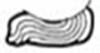
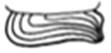
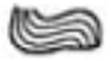
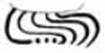
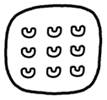
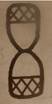
Variant: flint with tied down fork
MC JM TOK.p6.r2.c3
K&H MHD.1B2.1&2 0102ex
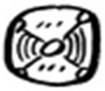
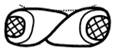
· Features – a flint outline (ovalish / rectangular glyph), with: o A single or double band running down the middle, in the direction of the short axis. § The single band can have either one or both sides bolded, the double band less so. § The band(s) help to “bind” what appears to be a single element: a “fork-like” object, with tines on one side and the rest of the fork to hold the tines together on the other. This is however an illusion. It’s perhaps: · Two dots (circles or semicircles) on one side of the band (related to the wood property marker). · Two or three parallel ticks on the other side of the band (related to the three and four-bump lines of other variants of ki). · Do not confuse this “flint” variant of ki with the visually similar “flint” variant of ta. o They are both flint outlines, with a single or double band running in the direction of the short axis. o That single or double band appears to “bind down” something to the surface of the flint. All these “bound down” elements are also longish, with their long axis in same as the long axis of the actual glyph. o However: § ki has what appears to be a “fork-like” element bound down (an illusion, but that’s what it looks like, nevertheless, see below). § ta has what appear to be one or two ovalish/rectangular elements bound down.
|
|
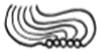
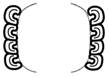
Variant: flint with bumps and wood property marker
MC K&H JM 0102bl 0102br
TOK.p6.r2.c4 MHD.1B2.3 0102bh
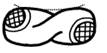
· Subvariants (2) - a flint outline (ovalish / rectangular glyph), with: o A. “Asymmetric” subvariant: § A 3-bump line on one side of the glyph, running in the direction of the short axis, with the bumps pointing to the centre of the glyph (MC, K&H, JM, 0102bl, 0102br). The first four have the 3-bump line on the left, but the fifth one has it on the right (0102br). § A “wood property marker”, running from one of the long sides of the glyph to (typically) the middle of the 3-bump line. o B. “Symmetric” subvariant: § Two 3-bump lines, one on each side of the glyph, running in the direction of the short axis, with the bumps pointing to the centre of the glyph (TOK.p6.r2.c4, MHD.1B2.3, 0102bh). § A “wood property marker”, running between the two 3-bump lines (TOK.p6.r2.c4, ~MHD.1B2.3). · Further variation: o The 3-bump line is canonical, but it can have more bumps (MHD.1B2.3 has 5 bumps!). o In the “asymmetric” subvariant, the wood property marker can just run from one side of the glyph to the other, without touching the 3-bump line (0102br). o In the “symmetric” subvariant, the wood property marker can just run from one side of the glyph to one of the 3-bump lines, without touching the other 3-bump line (0102bh). · It seems to me that the “tines” of the “fork” in the “flint with tied down fork” are actually related to the ticks which create the 3-bump line. o That’s why there are typically two tines in the fork (corresponding to a typical 3-bump line), while there can be more tines (corresponding to a greater number of bumps in the line). o That’s why the “3-tine fork” of TOK.p6.r2.c3, MHD.1B2.1&2, and 0102ex is actually just the descendent of a 4-bump line, with the “bumps” completely “flattened out”. o Furthermore, what then appears to be the “other side of the fork” (coming out from under the other side of the band(s) which binds the fork to the glyph) is simply the two touching dots of the wood property marker. o The band that “binds the fork to the flint” is hence probably just a descendent of the band which the two dots of the property marker were attached to. · MHD has not assigned distinct codes for the “flint with bumps and wood property marker” (sub)variant vs. “flint with tied down fork” (sub)variant. This is probably correct, historically speaking, as the latter probably evolved from the former. But it means that we are unable to easily present statistics on the relative frequency of occurrence of the two forms. · MHD statistics (2026-03-30): o I feel that there are two variants here, the “flint with tied down fork” and the “flint with bumps and wood property marker”. o MHD does not distinguish them and has assigned a code of MHD.1B2 to both. o Bonn also sees them as very closely related: § It considers the “full” form to be with the 3-bump line on both the left and the right: 0102bh. § The form with the 3-bump line only on the left is then 0102bl. § The form with the 3-bump line only on the right is then 0102br. § The form which I saw as a “tied down fork” is then just 0102ex – a slight variation on 0102bl, with: · The 3-bump line on the left “straightened out” into a vertical line with three horizontal ticks on the left. · The curved line of the “wood property marker” also “straightened out” into a vertical line, with the two dots on the right. The resulting two vertical lines then form the illusion of a vertical band tying down a “fork”, with the two dots forming the top of the fork and the ticks forming the prongs/tines. o A search in MHD on “blcodes contains 1B2” returns 1,071 hits so it would be difficult to get statistics on the these (sub)variants by visual inspection. Subjectively, from the limited number I’ve actually seen, the “flint with tied down fork” seems to be the most common.
|
|
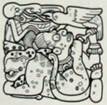
Variant: bird head
BMM9.p4.pdfp4.c3.r3.1 = K&L.p53 MC2OL TOK.p26.r4.c3 MHD.BT5.1 1545st
Coll-1 (Schele) Coll-1 (Grube) Coll-1 (Lacadena) = MHD.BT5.2 Schele CPN Stela P C4 CRC B16-sub Stucco p19 EKB Acropolis M96G O1 PAL PT P5 3:wi{n}:<ti.ki> <K’UH{ul}:K’AN:tu>.<ma:ki> u.<ki:ti> PIK.<ki:yi>
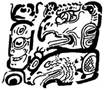
· Features: o Bird head with trilobate element over the eye. o (Optional): the top right has a feather-element (resembling syllabogram o), bent into an L-shape to fit into the top right corner. o (Optional): an inverted u-shape protector over the eye, with (optionally) a dotted spine. · This must be a “more recently deciphered glyph”, as it’s not in the MC (2001) and MC2 (2005) syllabogram table but is in MC2OL (2012). Of course, “recently” means different things to different people (depending on when a person starts learning Maya glyphs). · A search in MHD with “blcodes contains BT5” gives 10 hits, but only CPN Stela P C4 and CRC B16-sub Stucco p19 show the distinct trilobate element over the eye. The reading of PAL PT P5b (top) as ki (despite the lack of a trilobate element over the eye) is from MHD. · Drawing credits and glyph-block references are from MHD as the drawings I have access to are uncredited and have not been provided with glyph-block labels.
|
|
Variant: head
0102hh
0102hc
0102hh MHD (von Euw) XLM Column 3 A2 <ya.<ja:wa>>.<na:ki>.wi
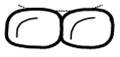
· Features: o 0102hh (-hh for “head, human”) is simply a “generic” head with the distinctive characteristics of the “flint with tied down fork” variant transferred to it. o 0102hc (-hc for “head, creature”) is an animal head with the distinctive characteristics of the “flint with tied down fork” variant transferred to it. However, it has, additionally, some distinct characteristics of “thick lips” and 3 horizontally touching dots on the cheek, and even grass blades along the floor. · MHD hasn’t assigned a separate code for these head forms. · The Bonn Catalog currently (2026-03-30) gives no indication of where 0102hh occurs in the “Artefacts” field. · The Bonn Catalog gives 0102hc in the “Artefacts” field (2026-03-30) as occurring in: o CPN Altar A’ (MHD’s “objabbr = CPNAltAp”): I’m unable to find a head variant of ki in the MHD TTT of this inscription. o XLM Column 3 (MHD’s “objabbr = XLMCol03”): § This is at XLM Column 3 A2, though the “fork” has been slightly idealized in the Bonn Catalog example, compared to the drawing of the inscription. § The forehead ornament also appears to be slightly more elaborate in the drawing of the inscription than in the Bonn Catalog example. MHD has coded this as <ya.<ja:wa>>.<na:ki>.wi = (with slight re-arrangement of the reading order) ya-ja-wa- wi-na-ki è yajaw winaak = “(the) Lord of (the) Person(?)” (but here, just the name of someone). · Overall MHD statistics (2026-03-30) for syllabogram ki – seen from a search in MHD on “blcodes contains <XXX>”, where <XXX> is: o 1B2 (“flint” variant): 1,071 hits. o BT5 (“bird head” variant): 10 hits. This shows that the “bird head” form is very rare indeed, both in absolute and relative terms, being (as it is) outnumbered by the “flint” form by a factor of more than 100. These statistics do not include: o A separation of the “flint with tied down fork” form from the “flint with bumps and wood property marker” form. o The human head and the animal head forms (which seem to be “one-offs” anyway).
|