| CMGG entry for syllabogram k'i
|
|
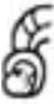
Variant: single wing
MC2OL K&H TOK.p7.r3.c2
· Single wing – wing-shaped outline, with: o Top: bold ceiling and top part of the edge “near the body” o Edge “near the body” (representing the attachment to the body of the bird? / partitive disk?): § One or two bold, semi-circle arcs – region inside inner arc is (optionally) cross hatched. § Arc of dots outside of the outer arc. o Edge “far from the body”: § A series of parallel, slightly curved ticks (representing the feathers of the wing). o Variation possible of feathers on the right or feathers on the left, i.e., mirror images of one another. · Both the single and double wing variants are “more recently” deciphered glyph, as they’re not in the MC (2001) and MC2 (2005) syllabogram table but are in MC2OL (2012). Of course, “recently” means different things to different people (depending on when a person starts learning Maya glyphs). Indeed, in MC2, the entire cell for k’I is empty, whereas it now has to glyph variants.
|
|
Variant: double wing
MC2OL
· Double wing: o Two single wings, mirror images of one another, joined horizontally at the edge “near the body”.
|
|
Variant: face
TOK.p12.r2.c4 MHD.ZAE 0540st T540
· Features: o A half darkened “face”. o The “face” is created by three non-touching dots, in a triangular formation, pointing downwards. · There are 2 subvariants: o A. “Face” formed from dots. o B. “Face” formed from upwards pointing crescents (TOK.p12.r2.c4). · TOK (2017) gives this glyph with a tentative reading of ki?, whereas MHD gives it a tentative reading of k’ i?. As MHD is more recent, I’ve grouped this glyph with the other k’i’s rather than with the other ki’s.
|