| CMGG entry for syllabogram je
|
|
Variant: lem
MC = K&H JM
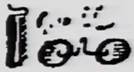
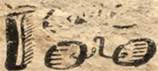
TOK.p34.r1.c4 MHD.ZFE.1 0069bv
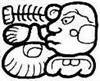
MHD (Graham) Graham PAL Bench 1 / Subterranean Throne glyph-block B YAX Lintel 47 B8-C1 a.je.ne yi:pi ya.<je:le>
MC = K&H JM TOK.p10.r3.c3 MHD.ZFE.1 MHD.ZFE.2 0069bb
M&G.p158.5 PAL TI Sarcophagus Lid 34-35 <a:je>.<ne:{y}OHL> ma:ta
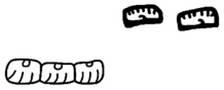
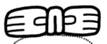
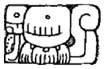
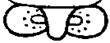
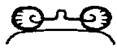
· Subvariants (2): o A. Full – a combination of a boulder outline with a horizontally rectangular tripartite element along the bottom: § Top – boulder: · (Optionally) bold outer edge. · Curved ladder inside, with bold or non-bold rungs – ladder can be replaced by curved arcs, making the entire element “LEM”-like. § Bottom: (typically) three touching circles, each circle having: · Top: A tiny dot. · Bottom: three (or more) parallel short vertical ticks. o B. Reduced: the three touching circles of the bottom of the full form. · Additional points / aberrations: o MHD.ZFE.2 is aberrant in that: § The circles have parallel ticks at the top rather than at the bottom, and, correspondingly, the tiny circle at the bottom rather than at the top of the larger circle. This suggests that the reduced form may have become a “rotatable sign” and hence been rotated 180 degrees. § There are only two circles instead of three, and they are non-touching rather than touching (and they’re “slightly flattened” circles). o In PAL Bench 1 / Subterranean Throne glyph-block B is aberrant in that the main boulder part: § Has neither a LEM nor a “ladder”, but instead just a tiny dot in the upper part. § Has what could be a horizontal ka-comb, with teeth pointing upwards (or “grass blades”?) at the bottom. In reality, such aberrations are not at all uncommon: context and “common sense” will tell the reader that these are slightly or greatly aberrant examples of their more conventional fellow glyphs. All the descriptions of features here refer to “canonical” / “abstract” / “idealized” glyphs, which (say) 80% of each “family” conform to. But there’ll always be the (say) 20% which don’t exhibit some “canonical” features, or which are even extremely aberrant: context is key. · Do not confuse the reduced variant of je with a reduced variant of AKAN = “grass”, “grassland”: o The reduced variant of je is three touching circles (each with three ticks and a dot) which peek out from the behind the bottom of any glyphs covering it, i.e., are (visually) below the covering glyph. (Note the exception provided by MHD.ZFE.2.) o The reduced variant of AKAN is three touching circles (each with three ticks and a dot) which peek out from the behind the top of any glyphs covering it, i.e., are (visually) above the covering glyph. · MHD usage statistics (2025-08-24). Of the 55 occurrences of “LEM”-je (either full or reduced forms), in decreasing order of frequency: o 18 write the word yeh te’ = “deed of”, “doing of” (transcribed yeejte’ in MHD). o 4 write the word yitaj = “with”, “accompanied by”. o 4 write the word ajel = “?”: 2 instances in the name Hux Ajel; 2 instances in the name It Paat Yipyajel (it’s unclear to me if yajel is a possessed form of ajel). o 3 write the word ajen = “awaken”, “dawn”: 2 instances in a name (Ajen Yohl Mat, Hux Ajen), and 1 instance possibly as an actual verb. o 2 write the word bajew = “?”: both in the name Bajew Chan Took'. o The remaining 24 are loose, individual words, unrelated to the others (I haven’t counted utihmajel under ajel as I have no idea of the meaning of utihmajel).
|