| CMGG entry for syllabogram ha
|
|
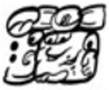
Variant: skull
MC JM K&H TOK.p22.r4.c1 Wikipedia
MHD.SD1.1&2 1042bh
Estrada&Tokovinine-CANCMD.p14.pdfp14.fig9b Estrada&Tokovinine-CANCMD.p14.pdfp14.fig9a K1837 PSS-H Chochkitam Zacatel Cream Vase H a.<ha{al}> a.<ha:la>
1042br
MHD.32L 1931tv
MHD (Graham) MHD (Graham) CHN Las Monjas Lintel 4 E1-E2 CHN Las Monjas Lintel 7 glyph-block A <<K’UH{ul}:lu>.<nu:ku:AJAW>>:<ha.i> <ha.i>:<u.<wo:jo:li>>
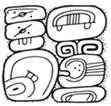
· Usual variant – a skull with a cloth knot: o Features: § Knot – can be: · Symmetric: knot in the middle, tassels on each side (resembles the reduced variant of hi). · Asymmetric: knot in the middle, loop on one side, tassels on the other. § Skull: the usual features: · AK’AB/“darkness property marker” infixed in the forehead. · Medium-sized round eye. · Nose hole. · Bone-jaw with two or three teeth hanging from the top. · (Optionally,) %-sign on cheek. · (Optionally,) a “complex ear”, with paper strip pulled through hole in earlobe. o Subvariants (3): § A. Horizontal: Knot to the left of the skull. § B. Vertical: Knot above the skull. § C. No knot at all, just the skull (e.g., 1042br). o Iconographic origin – the theme of the Maya on the Thames 2019 glyph workshop was acrophony, and there it was explained that ha is derived from HA’, which means “fly” (the insect). [Sim: § The skull is associated with boniness and so are insects. § The glottal stop is one of the “weak consonants” which are frequently underspelled (and it’s these weak consonants that often make certain logograms become syllabograms.] o The Wikipedia image is from https://en.m.wikipedia.org/wiki/File:Maya_Syllabary_Ha_1.jpg. o Do not confuse this variant of ha with one of the (only superficially) vaguely similar variants of CH’EEN (the “bundle and bird-head variant): § ha has a knot on the left (occasionally on top) and a skull on the right (occasionally on the bottom). § CH’EEN has a “bundle” on the left (occasionally on top) and a bird-head on the right (occasionally on the bottom). o MHD statistics (2025-07-14) – a search in MHD on “blcodes contains SD1” yields 129 hits (representing 130 ha’s, because one glyph-block has two ha’s): § Knot on left: 78 hits. § Knot above: 10 hits. § Knot absent: 12 hits. § Indeterminate: 15 hits. § No image: 15 hits. Remarks: § A yu- or a- to the left of the skull (with no knot) can be mistaken for the knot (so the MHD transliteration helps to spot these). § Erosion (definitely or almost definitely a ha from context, but the position of the knot is uncertain) and some instances indicated as ha? (unsure if it’s actually a ha) add to the instances of “Indeterminate”. § The “knot on the left” is in the overwhelming majority (almost 8 times more often), but “knot on the top” also occurs occasionally. o MHD usage statistics (2025-07-14) – the skull variant of ha is used to write: § ha’i = “that one”, the emphatic third person pronoun: 41 hits. § ahal = “victory”: 18 hits. § ha’oob“= those ones”, the emphatic third person plural pronoun: 11 hits. § uuh (= “necklace”), including inflections: 12 hits. § ko’haw (= “helmet”), including inflections : 3 hits. § Patah: 3 hits – in Ix Ahkul/Ahkal Patah, a noblewoman, wife of Aj Sak Teles and mother of the BPK ruler Yajaw Chan Muwaan II. This accounts for more than half the occurrences, all the others not falling into any particular pattern of usage. This means that the single most common use of this variant of ha (41 out of 129 = 32% = almost 1/3 of all occurrences) is for writing ha’i. If we add the instances of ha’oob as being essentially the “same” usage, then 52 out of 129 = 40%, which is even higher. · There is a very different variant – a "tripartite vertical” (to borrow Bonn’s terminology): o Features: § Three roundish elements stacked one on top of the other, the first two (going from top to bottom) identical. § Top: a %-sign inside. § Middle: a %-sign inside. § Bottom: a flint outline, with – hanging from the middle of the ceiling – a dot flanked by two short vertical ticks. § Optionally, on the very top, there can be a horizontal bar (MHD.32L). § Also, the top and middle elements can be “symmetric caves” (bold walls and ceiling, 1931tv). o Despite the considerable difference in appearance, it’s probably related to the usual skull variant in the sense that the two %-signs relate to the theme of death – a single %-sign can be seen on the skull variant as well. o MHD statistics (2026-03-01): § A search in MHD on “blcodes contains 32L” yields 7 hits: § Of them, 6 are from CHN and 1 from HLK (Halakal, in the Yucatan Peninsular). The two sites are: · 7 km and over an hour’s walk apart (according to Google Maps, along a modern, rather circuitous route). · 4 km apart as the crow flies (according to the latitude and longitude of the two sites, as gotten from the Bonn 3-letter site code page, and Google’s calculation of the distance base on those coordinates). I.e., very close to one another. § All 7 occurrences are from the 10th baktun, 10.*.*.*.*, i.e., the “Terminal Classic”. § In a similar way as with it’s more well-known counterpart, the skull variant, this tripartite vertical variant is used mostly (here, in fact, exclusively) to write ha’i = “that one”, the emphatic third person (singular) pronoun. § As the usage of these two variants do not significantly overlap in either time or space, they are not treated in the usual way of adding up the total number of occurrences and seeing what proportion of them each variant forms, of the total. Instead, the vertical tripartite variant is just treated as an “outsider”, interesting to observe, but not grouped with the others.
|
|
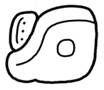
Variant: tooth
K&H TOK.p16.r4.c4 MHD.ZYC.1&2 1555st
· Features: o The main part of the glyph is a “tooth” with reinforced or bolded left wall and ceiling (optionally the right wall as well (MHD.ZYC.1)). o There’s a small to medium-sized circle “inside” the tooth (i.e., inside the main body of the glyph), supposedly representing a precious stone, inlaid into the tooth, as was done by the Classic Maya. o On the top left, “outside” the tooth, there’s an ovalish / rectangular element, at about a 45-degree angle to the horizontal and vertical. It’s at the same position that a “forehead ornament” would be, in a head glyph. · Subvariants (2): o A. The oval has 3 tiny non-touching dots in a row, on the long axis of the oval. This makes it resemble a “bone property marker”. o B. Instead of the three tiny non-touching dots, a single curved line, multiple parallel curved lines, a single scroll, or nothing (this last could simply be erosion). The reference works tend to give only the subvariant with 3 tiny non-touching dots, but a search in MHD on “blcodes contains ZYC” gives 33 hits, of which only four have the 3 tiny non-touching dots – all the others are a mix of the alternatives given in “B”. · Thompson never listed this glyph. · Do not confuse this variant of ha with a whole set of glyphs with the “tooth” as the main outline of the glyph, but with various distinctive elements on the left: o chu has an “axe”. o ha has a “bone property marker”. o k’e has one end of a “bone”. o t’a? has a “torch” (this reading is still only a proposal). o ye has two or more “cascades of dots”. · Overall MHD statistics (2025-08-23) – seen from a search in MHD on “blcodes contains <XXX>”, where <XXX> is: o SD1 (“skull” variant): 129 hits. o ZYC (“tooth” variant): 33 hits. 129 / 33 = 3.9 ~= 4, so there are almost 4 times as many occurrences of the “skull” variant as the “tooth” variant, for writing ha. The “tripartite vertical” variant (MHD.32L/1931tv) is excluded from these statistics for reasons explained above (see under “MHD statistics” of the skull variant).
|