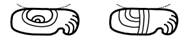
| CMGG entry for syllabogram cha
|
|
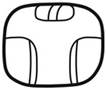
Variant: boulder
MC = K&H TOK.p32.r5.c2 MHD.XS4.1&2 1557bv
JM JM TOK.p14.r1.c3 1557bb
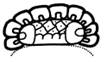
· Subvariants (2): o A. Full: § Top: one or multiple pairs of “feelers” – shorter feelers can have protectors. § Bottom – CHUWEN-like: · Boulder outline. · LEM-like element hanging from the middle of the ceiling. · Two mirror-image “grips” on the bottom left and right. o B. Reduced: bottom part of full form, i.e., without the “feelers”. · Do not confuse cha with the visually similar se: o The reduced subvariant of cha is identical to se. o The full subvariant of cha has “feelers”, which se never has.
|
|
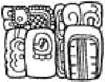
Variant: three eyeballs
MC = K&H JM LTI - Kimbell Panel F1 MC = K&H TOK.p10.r1.c2
MHD.32F.1&2
MHD (Krochock) MHD (Stuart) CHN Temple of the Four Lintels Lintel 3 D6 CRN Element 56 pC4 AJ.<cha:ba> *3.<YAX:SIHOOM>.<ka:cha:ja>
MHD (Krochock) MHD (Kerr) MHD (Kerr) MHD (Safronov) HLK (Halakal) Lintel G7 K1092 R4 K3230 G LTI Panel 1 F1 <u:pa:sa:*wa>.<cha:ba:tu:ba> u.<cha:nu> <cha.la>.ba u.<cha:nu>
MHD (Voss) MHD (Montgomery) Museo del Pueblo Maya de Dzibilchaltú Incised Femur B3 PNG Throne 1 K’4 cha.<CHAN:na> <cha:hu>.<ku:NAAH>
· Bonn doesn’t seem to have assigned a codepoint for this variant (2025-06-04). · Features: o Three circles in a row. o Within each circle, a smaller, (optionally) darkened (=cross hatched) circle, touching either the top or bottom of the larger circle, creating the impression of (a pupil within) an eyeball. o Typically, the eyeball on the left and right look “upwards” / “outwards” (have the inner circle on the top of the outer circle), while the middle eyeball looks “downwards” / “inwards” (has the inner circle on the bottom of the outer circle). (JM seems to have an example with all three eyeballs looking outwards.) o The “pupils” may have a bold or non-bold outline. · The above description is one of “convenience”, as it’s easy to express in words. In reality, there’s considerable variation in the appearance of the “eyeballs”. o The inner circle may be darkened or not darkened (cross hatched or not cross hatched in stone inscriptions). o Rather than an outer and inner circle (“eyeballs”), there may be just a crescent or a “swollen horseshoe”. o Rather than an inner circle, there may be just a tick within the outer circle. All these forms can be seen in the examples above. · These might be considered to be subvariants, or they might just be considered to be different forms of a “canonical” eyeball: o The presence or absence of darkening isn’t really that significant (and absence could even be from erosion). o If the inside of the inner circle is open to the outside (i.e., open to the background of the glyph/glyph-block), this forms a “bay” which then makes the whole element a “swollen horseshoe”. o Opening the gap for the “bay” even more (and reducing the swollenness) results in a crescent. o The inner circle can be reduced to just a tick within the outer circle – this might even be considered to be an extremely swollen horseshoe. These forms could hence even be considered “points along a spectrum”, where the one form “shades into” another: o When does an element stop being a swollen horseshoe and become a crescent (when the inside becomes round enough and the two ends become far enough apart)? o When does an element stop being a swollen horseshoe and become a circle with a tick (when there is no more tiny indentation in the circle, at the point where the tick is shown)? · MHD statistics (2025-06-03) – a search in MHD on “blcodes contains 32F” yields (surprisingly) only 16 hits. o Eyeballs: 2 hits. o Swollen horseshoes: 3 hits. o Circle with tick: 3 hits. o Crescents: 1 hit. o Three circles: 1 hit (this could be considered just an eroded form, with the tick so small or eroded as to be not visible). o No image or Indeterminate / unclear / hard to say: 6 hits. As can be seen from these statistics, the swollen horseshoes / circles with ticks are actually the most common form. But it’s perhaps easier to think of this glyph as being canonically or ideally “three eyeballs”, with subvariants where the pupil is increasingly reduced. If this glyph were “essentially” / “intrinsically” three horseshoes (or crescents or circles with a tick), there would be no obvious reason to draw them as eyeballs, whereas if they were “essentially” / “intrinsically” eyeballs, then they could “evolve” into one of the other forms.
|
|
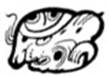
Variant: scroll and eyeball
JM.47.1 0108ts 0108th T108
AC7.1&2
YAX Lintel 27 H1 YAX Lintel 1 A7b
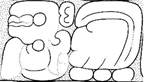
· Features – a glyph with a horizontally rectangular outline consisting of: o Left: a leaf-like element, which could variously be described as a scroll curling to the left / bold left feeler or left feeler with protector. o Right: an eyeball (with the pupil often but not always cross hatched). · The “simplistic” analysis is to view this as a variant of the syllabogram cha, very commonly seen above the snake-head glyph (normally read as CHAN). In such an approach, this distinctive form of cha is viewed as the initial phonetic complement of CHAN, to write cha’an = “guardian” / “master”. o An argument in favour of this is the occurrence of nu after the snake head, used as a final phonetic complement to produce a disharmonic spelling to indicate that there’s a complex vowel in the word, i.e., to show that cha-CHAN-nu è cha’an = “guardian” / “master” is being written, rather than chan = “snake”. However, there is often no end phonetic complement, when writing cha’an = “guardian” / “master” – only this unusual variant of cha (as “initial phonetic complement”). o In such an analysis, one might even consider the snake-head glyph in this context as a rebus, as it’s no longer writing chan = “snake”, but instead writes cha’an = “guardian”, “master”. · MHD does not consider this horizontally rectangular, bipartite form to be an independent glyph. Instead, it seems to consider it to be just the top part of a snake-head glyph, with this horizontally rectangular element on top – a logogram given the code MHD.AC7 and meaning “guard”. This seems to be a different approach from that taken by many other epigraphers, perhaps because the “top” is never found in any other position than above a snake-head, in particular, that it’s never “rotated”, so as to appear to the left of the snake-head. Nor does it occur above, below, to the left or right of any other glyph. I.e., it isn’t used as a phonetic complement (initial or final) for any other word than cha’an = “guardian” / “master”, nor in syllabogram-only spellings of another word. o A very similar issue is at hand in the case of the “goggle eyes” glyph and the “row of teeth” glyph. They were formerly viewed as forms of the syllabograms ch’o and ko respectively, combined to write a syllabogram-only spelling of ch’ok = youth. However, in the light of the fact that they never occur outside of writing ch’ok, it’s now considered that this combination is actually a logogram CH’OK = “youth”. o The difference between the cha’an and ch’ok situations is that the snake-head of cha’an doesn’t seem to consistently differ in any significant way from that of regular snake-head used to write CHAN = “snake”. · Bonn treats this bifoliate glyph (0108th) as a variant of a tripartite glyph (0108ts), where the two outer elements are leaf-like (each element consisting of two longish scrolls) but the middle element is more an “eyeball” (a smaller circle inside a larger circle, with both circles sharing a portion of their circumference). This might have been necessary because of the “strict methodology” of assigning Bonn codes: each of the 2-letter suffixes has a fixed, very specific meaning. This (perhaps) resulted in the -th suffix (“tripartite horizontal”) being assigned to the tripartite glyph (viewed as the “basic” glyph), and the bipartite form being assigned the suffix -ts (“tripartite left-middle”), with the latter seen as a derivation of the former. While this strict methodology is in general very useful as a way to manage the complexity of Maya glyphs, it seems, in this particular case to have resulted in a situation where the very commonly seen form is viewed as the derivation of a more basic/fundamental one, but where the latter form is hardly ever seen. As Bonn currently doesn’t have TTT’s, it isn’t possible to see where 0108ts occurs in inscriptions, nor is it possible to get a statistical analysis of the relative frequency of 0108ts vs. 0108th. · See cha’an = “guardian” / “master” for more information.
|
|
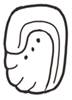
Variant: hand
MC K&H TOK.p20.r2.c2 668st
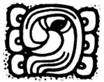
· The outline of this glyph is a left fist, viewed from the back of the hand. It is one of four glyphs with this characteristic: o cha: IK’ in the top left. o ho: 3 non-touching dots in a triangular formation, pointing downwards. o k’a: horizontally stretched, cross hatched, inverted u in the top left. o (One variant of) Glyph-G7: with the head of a young man below and a NAAH on the left of both. The bottom left has a 180-degrees rotated curved-L with one or two reinforcing lines to the right. · In the hand variant of cha, the bold-T (“IK’”, symbolic of breath or wind) also can take the form of a short, slightly curved horizontal line (tips pointing upwards), with a “u” under it, making it resemble a tooth or (in this context) an eye. · Bonn gives this glyph also the reading CHAAK.
|