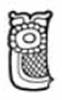
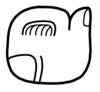
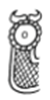
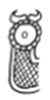
| CMGG entry for syllabogram ch'a
|
|
Variant: two eggs in a nest
MC K&H JM TOK.p18.r2.c4
MC MC JM K&H TOK.p8.r4.c4
· Variants (3): o A. Full: § Top: Two circles – touching or non-touching, each circle: · Can have a dotted reinforcement inside the perimeter. · Can have either a dot or a crescent (tips pointing upwards) in the centre. · Can itself be made up of touching dots. Not every combination is valid – for example, a crescent in the centre tends to be inside a single circle, not to have a “fancy” outer border. · Has a pair of feelers – feelers can be: o Standard left and right feelers (scrolls). o “Pax” feelers (curving upwards). · Standard feelers tend to have protectors while “pax” feelers don’t. § Bottom: boulder-outline with a single, large U indentation in the middle of the top (between the two circles). · Cross hatched area slightly smaller than the outline. · Outer edge of cross hatched area usually bold o B. Reduced-1: left or right half only (currently no examples of right half only). o C. Reduced-2: top part only (currently no examples). Perhaps this doesn’t exist, and only exists for k’u. · Do not confuse the full forms of ch’a and k’u. They resemble one another because the bottom parts of both are identical. The difference is in the top part: o ch’a has two circles, each with two scrolls / left-and-right “feelers”. o k’u has two sloping “rugby balls”. · Iconographic origin: o AT-YT2021-lecture16.t0:02:16-02:30 Tokovinine explains that this represents a basket with smoking incense in it; that CH’AJ is the word for liquid inense. That’s the explanation for this glyph becoming used as a syllabogram for ch’a. In the equivalent AT-E1168-lecture18:10:01-10:23 he doesn’t say anything about the iconographic origin of ch’a at all, showing it only to warn of the possibility of its confusion with k’u.
|