Background to the Video List
Author: Sim Lee
Last updated: 2026-04-27
[This document is part of the Learner's Maya Glyph Guide.]
General
I have compiled a list of Maya-related videos available on the internet (Videos). My initial reason for compiling the list was to have convenient access to as many videos on Maya epigraphy as possible. This means that I attempted to find all such presentations from Maya conferences (Maya at the Playa, Maya at the Lago, etc) as well as lectures for the general public (for example, given by a guest lecturer at a museum). I feel that the covid pandemic actually led to a far greater number of lectures being recorded and uploaded to the internet, which has turned out to be quite a boon for Maya enthusiasts.
The scope of the list soon extended to videos on Maya-related topics other than epigraphy – history, religion, culture, art, architecture, food, etc. From there, it was only a small step to include even more peripheral topics like the Olmecs and Teotihuacan (though I didn’t try to be as thorough for these as for the other categories).
I also tried to be as eclectic as possible in my selection. Of course, the videos featuring the major Maya epigraphers and archaeologists (e.g., Coe, Houston, Martin, Prager, Saturno, Stuart, Tokovinine, Zender) formed the core, but I certainly didn’t exclude videos produced by enthusiastic laypeople (e.g., travel accounts to famous (and obscure) Maya sites, passionate and well-informed amateurs wishing to explain some aspect of Maya history or culture to the public, etc). I’ve even included what appears to be a short presentation by some high-school students from Belize.
In the same spirit, I applied very broad criteria for “genre”. The core genre was lectures, but documentaries and interviews also found their way onto the list[1]. Here too, I’ve not applied very strict criteria, and have included many of the slightly sensationalist documentaries, with dramatic background music and relating how mysterious the Maya civilization was, or how dramatic “The Collapse” was. Similarly, travelogues or nature documentaries with some Maya-related content have been included, even if this isn’t the main thrust of the video. Short clips where the Mayan or Spanish names are badly mispronounced are, however, excluded, as are sensationalist documentaries about human sacrifice. Travelogues with no narration and only a music soundtrack and/or shaky camera have been omitted. Slideshows of Maya art or of visits to archaeological sites, with no narration, have similarly been omitted. The same applies to content related to aliens, New Age ideas, or extremely non-mainstream theories about the origins or advanced technological level of the ancient Maya. One last category I excluded are videos where the audio-track is machine-generated, especially the early ones, where the voice is very “robot-like” and there is very little inflection and tone (there were only two or three such Maya-related videos, in any case). On the other hand, for videos which did get included, I didn’t confine myself to the Classic and Pre-Classic period, but included some videos on the Colonial period (e.g., on the Popol Vuh) and also on the modern Maya; though here, again, I have not striven to be comprehensive.
The one very glaring gap in the list involves videos in Spanish. As I don’t speak Spanish, I don’t feel that I would do a very good job of compiling a similar list of such videos. Not only that, but the list was originally for my own private use (for citing in my notes interesting facts explained in the videos). Spanish-language videos couldn’t contribute in any way in that activity. This is in contrast to my inclusion of Spanish-based material in written academic works. In this latter case, Google Translate has reached a stage of sufficient sophistication that this material can be helpful to me, and so I do use and include such references.
Of the videos that did finally end up on my list, I’ve tried to standardize the format of what information I record about each video. For videos available on YouTube (by far the most important single source), I record the YouTube title, the upload date, and as much of the text in the description box as possible. The only parts of the description box which I omit are requests for feedback, encouragement to click “Like” or to become a Patreon supporter, links to URL's for merchandizing, etc. After a lot of vacillation, I decided to also omit “Table of Contents” information, particularly those with timestamps. They’re extremely useful for a viewer (to jump to a spot of particular interest) but they can just be clicked on in the description box itself, when actually viewing the video. The “Table of Contents” entries themselves give some information on the nature of the video, but in the end, I thought it didn’t warrant the extra space. In summary: I try to include as much as possible from the text of the description box of what is directly related to the content of the video, without trying to editorialize and omit what I don’t consider “relevant enough”. This means that the level of detail in these descriptions can vary considerably, depending on the amount of detail the uploader decided to include. In a very small number of cases, I feel that there’s important information which hasn’t been supplied in the text of the description box. That might be information available in the “About” section of the YouTube channel of the uploaded video. Or it might be information given verbally at the start of the video, or in the credits at the end. In such cases, I summarize that information and present it in square brackets, so that it’s clear that this is editorial information supplied by me, rather than by the original uploader. I do however silently correct the occasional typo and sometimes improve the punctuation.
The titles and descriptions in the tables are those given by the video uploaders (= the creators of the website or YouTube channel) and may hence differ from those of the original makers of the video itself (e.g., as given in the opening credits). For this reason, it’s not “primary source information” and (unlike the titles of academic papers and dissertations), is not blocked from being translated into another language (e.g., Spanish) if deemed appropriate for the target audience.
Finally, I record the total playing time. I think this is useful, as I (and any other person using the list) can quickly see which are the shorter videos, which might be nice to watch during brief breaks from the normal activities of daily life. Conversely, one can see which videos are really long, and hence decide to set aside more time later, to watch such videos properly.
In the process of compiling the list of videos uploaded to YouTube, I made use of the “suggested videos” which appear on the right-hand side. That is, if I had a Maya-related video in the main part of the YouTube screen, then I would see other Maya-related videos in the right column. By going to those videos, yet further Maya-related videos would appear in the right column. But the sum total of all the videos which turned up in this slow, iterative process was far higher than if I had put “Maya glyphs” or “Maya archaeology” or “Maya civilization” into the YouTube search box (putting “Maya” alone doesn't work because the word has many other different meanings, e.g.: as a personal name, a term in Buddhist philosophy, and the 3D modelling package).
In any case, this is the resulting list, which I will of course continue adding to. I hope that this list will be of benefit to users of the LMGG website.
Linguistics
I’ve included 13 videos from the field of linguistics:
· Glottalization / Ejectives: Three (very short) videos relate to the nature and pronunciation of glottalized consonants (and vowels). None of them refers directly to Classic Maya. The first is a short demonstration of the sounds of Modern Yucatec; the second concerns the growing use of glottalized stops in Modern English; and the last is an explanation of glottalized consonants from a cross-linguistic point of view, i.e., across all the languages of the world. Despite their not directly addressing Classic Maya, I feel that all three nevertheless could be very helpful to learners trying to master these sounds in Classic Maya (they certainly helped me). Particularly the second demonstrates the contrasts between glottalized consonants and their non-glottalized counterparts, and even covers the distinction between short, long, and glottalized vowels. The first video also discusses the initial glottal stop. This is obligatory in words “beginning with a vowel” (if one discounts the initial glottal stop) in German. This phenomenon – known as “hard attack” – is known but not obligatory in English, but is (apparently) gradually also becoming more common in English. Classic Maya is like German in that such a glottal stop is also obligatory, for words “beginning in a vowel” (again, if one discounts the initial glottal stop). As in German, it’s not necessary to indicate this in the orthography (German orthography / Classic Maya transliteration), because it’s always present in this environment. Glottalized consonants are called ejectives in the first and last video, but this difference is just a matter of terminology, not of substance.
· Ergative Languages: Seven videos are explanations of ergativity, varying considerably in length from very short to somewhat longer. I found the concept very difficult and for a long time simply accepted the ergative-related constructs of Classic Maya as a given, mechanistically, without fully understanding the concept itself. These videos helped to get me over that particular hump.
· The Mayan Language Family: Three videos are about the Mayan language family, one of which is an in-depth interview with James Tandy, where Tandy explains about the evolution and characteristics of the entire family. I feel that these might be of interest to some learners of Classic Maya as well. They help to give some context to statements in academic papers and books referring to the descendants of Classic Maya words in the modern Mayan languages (“cognates”).
They can all be found listed in their own section in the Table of Contents of Videos:
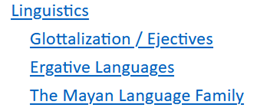
The above is just a screenshot, but the blue links are, of course, clickable in the actual Table of Contents.
Travel Vlogs
It was in early 2026 that I noticed a large number of “travel vlogs” in YouTube. I had always included the good ones I’d noticed, right from the start of compiling this list. But I put the few that I saw under “Documentaries”, with the feeling that they were in some way “amateur documentaries”. At this point, however, the number seemed to have grown enormously. I felt that this large number warranted a separate “chapter”. All the old ones were moved to this new chapter. An additional reason was that I felt that some users might not be interested in any vlog, “as a genre”. It would be handy for such users to have these vlogs hived off to their own chapter, instead of interspersed among the other documentaries. Conversely, some users might be particularly interested in vlogs, and so it would be convenient for them, to have a dedicated chapter. With the large number to choose from, it was difficult to select which ones to include on the list, from the newer ones. This problem was made more difficult because many of the vloggers had no special interest in Mesoamerica - they were just “world travellers” documenting all the places in the world that they’d been to.
I tried to include only the ones where the vlogger had done sufficient research – even if they weren’t specializing in the Maya or Mesoamerica – that they had something to say of sufficient interest to the users of the LMGG website. By coincidence(?) there turned out to be a fair degree of correlation between that and the ability to pronounce the names of the sites and rulers more or less correctly (adjusted by and allowing for sounds not found in the vlogger’s native language). Some might question the usefulness of including this category at all, but I feel that they give a sense of vividness and reality to a Maya site - a vividness which maps, photographs, and written descriptions cannot convey. This might then be helpful to those of us who don’t have the time or financial resources to go to the sites ourselves.
AI Slop
This video list has been in an important part of the LMGG website since the Beta Release in 2023. Every single release since then – major or minor – has seen the addition of new videos: either ones which have long existed on the internet, but hitherto unnoticed by me, or new ones uploaded since the previous time the list was updated.
It was, however, in the period of the first quarter of 2026 that I started to notice a frustrating number of AI-generated Maya-related videos. They were of varied length – from 3 to 5 minutes, 15 minutes, 30 to 40 minutes, or even beyond an hour. Some showed just a succession of still photographs or drawings, where the “camera” pans slowly across the still, or zooms slowly in or out. Some stills showed Hindu temples, Roman gladiators, or some totally inaccurate conception of what Maya warriors were supposed to have looked like (mostly some distortion of Roman soldiers, given a “darker complexion”). One video had the voice of David Attenborough narrating. One showed a map of the Maya lands, with well-known sites marked in spots which have no relation whatsoever to where they are in the real world (with arbitrary and random “sac-beys” joining them, as dead-straight lines).
The narration often had very little connection to the images shown. A number had a sort of resonant hum in the background of the soundtrack, or a monotonously repeating tune. Some had the telltale signs of incorrectness in voice inflection (though this is getting increasing hard to detect); or the mispronunciation of common English words with different pronunciations for the same spelling (“bow” as an act of obeisance vs. “bow” as in “bow and arrow”); or even very badly mispronounced Maya names (ajaw was pronounced “a jaw” (in English) – as in “this creature had a jaw the size of a whale’s”). One showed an animation of a group of people moving a large stone block on small logs serving as wooden rollers, but the axis of rotation of the logs was such that the block couldn’t possibly have moved forward; or the logs didn’t rotate at all, while the block nevertheless moved forwards. There were whole inscriptions on monuments where the text didn’t even look remotely like Maya glyphs (though they were, at least, in double-column glyph-blocks). There was a photo of a 3D scanner in a modern subway tunnel, and a photo of a modern tarred road winding through very mountainous terrain which couldn’t be Maya-related – triggered by the words “scan” and “road” in the script. There was even real-life footage of cars speeding along on a modern multi-lane highway, because the script said that “the Maya built raised highways”. There was a modified photo of a modern-day college-age basketball team, dressed in coloured singlets and shorts, with the background modified to (vaguely) resemble an indoor(!) Maya ballcourt. There were scenes of people wearing masks which might have been stereotypically African. There were photos/paintings of what looked like a council meeting from a Sci-Fi film (wise old men with long white beards, in flowing "Roman" robes), European mediaeval scenes, a modern army in full combat gear – all these three to accompany a script explaining how a Maya city-state defended itself from other city states. There were scenes of an “expert” explaining something, but we don’t hear what it is – it’s just a generic “scholar explaining something” – not necessarily even an archaeologist, just a man in a suit with many books in the background – and the narration at the time wasn’t even connected to “experts”. I found most of them absolutely intolerable within the first 30 seconds.
I hesitated for a long time, wondering if I should actually make an AI Slop “chapter” in the video list, listing the worst of these videos, and with comments on which of the features mentioned above were present in that particular video (down to giving timestamps of where each bit of “outrageousness” could be seen). In the end, upon consultation with friends, it was decided that this would only be helping these channels by upping their hit rate. My solution is just to note and bemoan here their sudden proliferation. It’s no consolation that Maya studies won’t be the only field where this is happening.